Mayidavolu plates of Sivaskandavarman
A Prakrit copper-plate grant issued from Kanchipura by the Pallava crown prince Sivaskandavarman to his official at Dhannakada (Amaravati). It gives the village of Viripara in Andhrapatha, the Telugu country, to two Brahmans. It was found in 1899 at Mayidavolu near Narasaraopet and edited by E. Hultzsch in 1901. It is the earliest Pallava copper-plate charter, and it shows the Pallavas ruling as far as the Krishna.
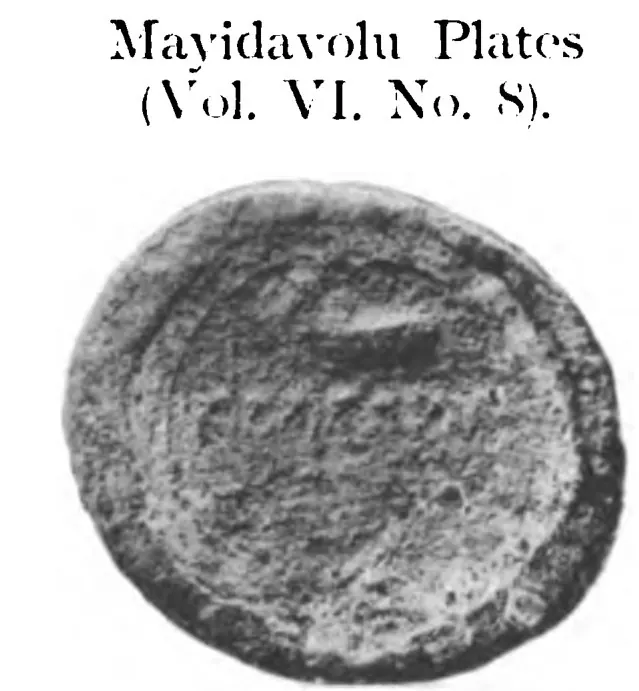
The Mayidavolu plates are the oldest Pallava charter on copper. They show a Pallava prince at Kanchipura giving orders about a village in the Telugu country.1 He gave them through an officer at Dhannakada, the old Satavahana centre near Amaravati.1 See Sivaskandavarman and the Pallavas.
Discovery and description
A man digging in a field found the plates about the middle of 1899.2 The field was on the site of an abandoned village north of Mayidavolu, a village twelve miles east of Narasaraopet in what was then the Krishna (then Kistna) district.2 The site, about four acres, held the ruins of a small old temple.2
J. Ramayya, who had already brought the Chikkulla plates to notice, sent the plates to V. Venkayya.2 E. Hultzsch edited them from Venkayya’s ink impressions.2 The owner later gave them to the Madras Museum.1
There are eight plates, written on fifteen sides, held on a ring whose ends are fixed in an oval seal.2 The seal shows in relief a couchant (lying) animal with a hump, “apparently a bull”.21 Below it is a legend that Hultzsch read as Sivaskandavarmmanah.21 Plates ii to viii are numbered with the old number signs.13 The date is written both in words and in numerals.13
Script and language
The alphabet is like that of the Hirahadagalli plates of the same king.3 But it has letters of unusual form that Hultzsch called “an epigraphic curiosity”.3 The language is a Prakrit which differs from literary Pali in several ways.1 The spelling mostly follows the cave inscriptions, in which one consonant stands for a double one.13 The family name is written Palava.13
Content
In Hultzsch’s translation the order begins: “From Kanchipura the Yuva-Maharaja Sivaskandavarman (of the family) of the Pallavas, who belongs to the gotra of the Bharadvajas, orders (his) official (vyaprita) at Dhannakada”. For his own victory and the increase of his merit, life and power, the prince had given the village of Viripara in Andhrapatha to two Brahmans.4 They were Puvakotuja and Gonandija of the Agnivesya gotra (clan), and received it with all the immunities of a Brahman’s grant.4
The village was to be free from digging for salt and from the entry of soldiers.4 It was also free from supplying bullocks, boiled rice, water-pots, cots and lodgings.4 Anyone who troubled the donees would suffer bodily punishment.4 The order is dated on the fifth day of the sixth fortnight of summer in the tenth year.45 The prince was himself the executor.45
The places
Hultzsch could not identify Viripara.1 The order went to the officer at Dhannakada, which he took to be Amaravati, so he placed the village near Amaravati.1 See Amaravati and Dharanikota.
D. C. Sircar noted that different scholars had identified Dhannakada with Dharanikota, Amaravati, Vijayawada (then Bezwada) and Nagarjunakonda.6 Andhrapatha, Hultzsch explained, means the Telugu country.1
Date
The tenth year is apparently that of Sivaskandavarman’s father, whose name the plates do not give.1 Hultzsch placed the grant much earlier than the 8th century because of its archaic alphabet and its Prakrit, but gave no closer date.1 G. Jouveau-Dubreuil compared its letters with the Kondamudi plates of Jayavarman, and dated it about 200, or soon after 236.7
Sewell’s chronology dated it about 234.8 Sircar placed it in the first quarter of the 4th century.9 He compared its wording with the Manchikallu inscription of the Pallava Simhavarman.1011
Footnotes
-
Hultzsch, “Mayidavolu Plates of Sivaskandavarman” (1901), p. 85 (archive.org (opens in a new tab)). ↩ ↩2 ↩3 ↩4 ↩5 ↩6 ↩7 ↩8 ↩9 ↩10 ↩11 ↩12 ↩13 ↩14 ↩15
-
E. Hultzsch, “Mayidavolu Plates of Sivaskandavarman”, Epigraphia Indica VI (1900–01), p. 84 (archive.org (opens in a new tab)). ↩ ↩2 ↩3 ↩4 ↩5 ↩6 ↩7 ↩8
-
Hultzsch, “Mayidavolu Plates of Sivaskandavarman” (1901), p. 86 (archive.org (opens in a new tab)). ↩ ↩2 ↩3 ↩4 ↩5 ↩6
-
Hultzsch, “Mayidavolu Plates of Sivaskandavarman” (1901), p. 88, translation (archive.org (opens in a new tab)). ↩ ↩2 ↩3 ↩4 ↩5 ↩6 ↩7
-
Hultzsch, “Mayidavolu Plates of Sivaskandavarman” (1901), p. 89, translation (archive.org (opens in a new tab)). ↩ ↩2
-
Sircar, Successors of the Satavahanas (1939), p. 185 (archive.org (opens in a new tab)). ↩
-
G. Jouveau-Dubreuil, The Pallavas (1917), pp. 2–3 (archive.org (opens in a new tab)). ↩
-
Robert Sewell and S. Krishnaswami Aiyangar, The Historical Inscriptions of Southern India (1932), p. 16 (archive.org (opens in a new tab)). ↩
-
D. C. Sircar, The Successors of the Satavahanas in Lower Deccan (1939), p. 166 (archive.org (opens in a new tab)). ↩
-
D. C. Sircar, “Two Inscriptions from Guntur District”, Epigraphia Indica XXXII (1957–58), p. 87 (archive.org (opens in a new tab)). ↩
-
Sircar, “Two Inscriptions from Guntur District” (EI XXXII), p. 89 (archive.org (opens in a new tab)). ↩
Photos
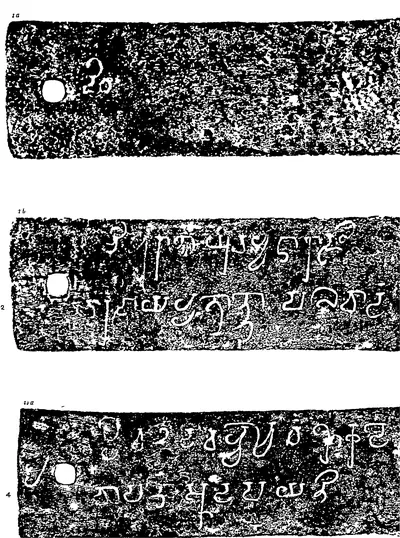 "Mayidavolu Plates of Sivaskandavarman", plates i a, i b and ii a (Epigraphia Indica VI, plate between pp. 84 and 85 (PDF p. 112 of the archive.org scan in.ernet.dli.2015.56212))Inscription rubbing · 1901
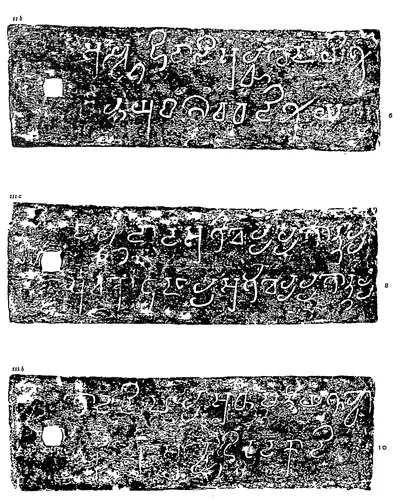 "Mayidavolu Plates of Sivaskandavarman", plates ii b, iii a and iii b (Epigraphia Indica VI, plate between pp. 84 and 85 (PDF p. 113 of scan in.ernet.dli.2015.56212))Inscription rubbing · 1901
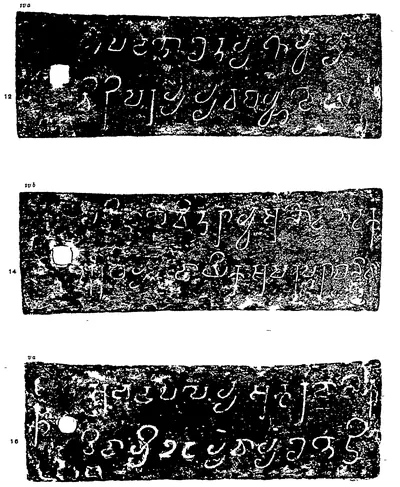 "Mayidavolu Plates of Sivaskandavarman", plates iv a, iv b and v a (Epigraphia Indica VI, second plate between pp. 86 and 87 (PDF p. 116 of scan in.ernet.dli.2015.56212))Inscription rubbing · 1901
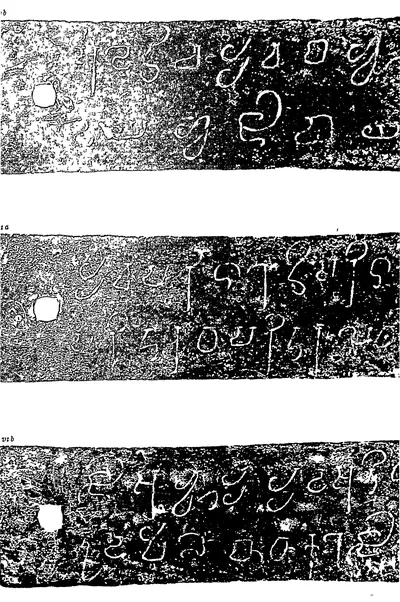 "Mayidavolu Plates of Sivaskandavarman", plates v b, vi a and vi b (Epigraphia Indica VI, second plate between pp. 86 and 87 (PDF p. 117 of scan in.ernet.dli.2015.56212))Inscription rubbing · 1901
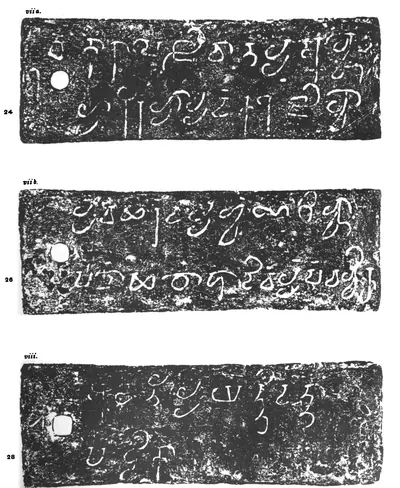 "Mayidavolu Plates of Sivaskandavarman", plates vii a, vii b and viii (Epigraphia Indica VI, third plate (PDF p. 115 of the archive.org scan EpigraphiaIndicaVol6))Inscription rubbing · 1901
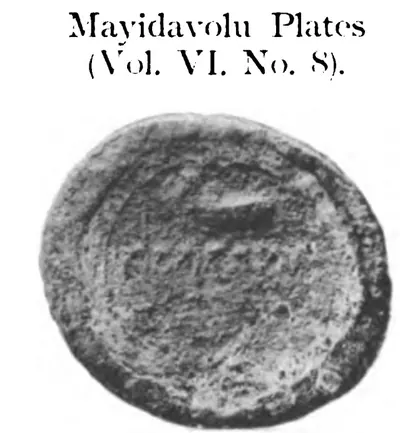 Seal of the Mayidavolu plates of Sivaskandavarman: "Mayidavolu Plates (Vol. VI, No. 8)", from the plate "Seals. Full-size" (Epigraphia Indica VI, plate of seals printed with No. 28 (PDF p. 369 of the archive.org scan EpigraphiaIndicaVol6))Historic photograph · 1901
References
Notes (0)
Sources (6)
Spotted an error on this page? Tell us
Last updated: