Sivaskandavarman (Pallava)
Earliest Pallava king known from his own charters. As crown prince he sent the Mayidavolu plates from Kanchipura to his officer at Dhannakada (Amaravati), granting a village in Andhrapatha, the Telugu country. As king he issued the Hirahadagalli plates and claimed the horse sacrifice. His date is disputed: from the early 3rd century to the middle of the 4th.
Sivaskandavarman is the first Pallava king whose own charters survive. Both are in Prakrit and both were issued from Kanchipura. The first, the Mayidavolu plates, shows the Pallavas ruling the Telugu country as far as the Krishna.1
H. Krishna Sastri drew the same conclusion from his grants.2 In his view the early Pallavas were the political successors of the Satavahanas, with their capital at Kanchi and a kingdom reaching the Krishna.2
Family
Sivaskandavarman’s grants do not give his father’s name. The Mayidavolu plates are dated in the tenth year of a reign that E. Hultzsch referred to “Sivaskandavarman’s unknown predecessor”.1
In the Hirahadagalli plates Sivaskandavarman confirms a gift made by “the great king, the lord Bappa”.34 This Bappa was a giver of many crores of gold and of a hundred thousand ploughs.34 G. Bühler took Bappa to be probably his father.34 R. Gopalan and G. Jouveau-Dubreuil treated Bappa as the father’s name.56
D. C. Sircar pointed out that bappa means “father”.78 Many later kings called themselves devotees of the feet of their bappa, so in Sircar’s view the word need not be a name at all.78
Two scholars have proposed a father for him. Jouveau-Dubreuil suggested in 1917 that the Pallava king had married a daughter of the Satavahana king Sivaskanda Satakarni.910 In this view the crown prince was named after his mother’s father. Jouveau-Dubreuil admitted that the idea rested only on the likeness of names.910
Sircar suggested that the Pallava king Simhavarman of the Manchikallu inscription was Sivaskandavarman’s father.11 See Simhavarman (Manchikallu).
The Mayidavolu plates
As crown prince (yuva-maharaja), Sivaskandavarman of the Bharadvaja gotra (clan) gave an order to his official at Dhannakada, the modern Amaravati.12 The official was to treat the village of Viripara in Andhrapatha as a grant to two Brahmans.12 The prince freed the village from digging for salt, from the entry of soldiers, and from supplying bullocks, rice, water-pots and cots.12 He threatened bodily punishment for anyone who troubled the receivers of the gift.12
Hultzsch could not identify Viripara, but thought it must have lain near Amaravati.1
The Hirahadagalli plates
In the eighth year of his own reign, Sivaskandavarman issued plates from Kanchipura, which were bought at Hirahadagalli in the Bellary district.1314 Here he is “the righteous supreme king of great kings of the Pallavas” and a performer of the Agnishtoma, Vajapeya and Asvamedha sacrifices.1314
Gopalan reasoned that the horse sacrifice, unless an empty boast, implied wide conquests and subordinate kings.15 The plates name a district, Satahani-rattha.2 Krishna Sastri saw in it the Satavahani-hara of a Satavahana inscription from the same region, and so a sign that the Pallavas succeeded the Satavahanas there.2
Date
The date of Sivaskandavarman is one of the most disputed points of early Pallava history.
- Jouveau-Dubreuil compared the letters of the Mayidavolu plates with those of the Kondamudi plates of Jayavarman, and through them with the inscriptions of the last Satavahanas. He concluded in 1917 that the Pallavas reigned at Amaravati in the first half of the 3rd century.1016 His genealogy of 1920 gives Sivaskandavarman 250–275.17
- Gopalan dated him about 220, counting back from Vishnugopa at about 25 years a generation.1819
- Sewell’s chronology of 1932 made him issue the Mayidavolu plates about 234, in the tenth year of his father Bappa.20
- Sircar placed him in the first quarter of the 4th century, after the Ikshvakus, because his Prakrit is later than theirs.21 After new Ikshvaku dates were found, he placed him about the fourth and fifth decades of that century.22
One king or two?
The British Museum grant of Charudevi is dated in the reign of a Pallava king Vijaya-Skandavarman.1823 Gopalan thought him “presumably identical” with Sivaskandavarman, mainly because the letters of the two grants are so alike.1823
Jouveau-Dubreuil, in 1917, thought the identity possible but uncertain.624 He also doubted that the crown prince of Mayidavolu and the king of Hirahadagalli were certainly one man.624 Sircar held that Siva was part of the name, not an honorific, and that the British Museum grant was written later.2526
Footnotes
-
E. Hultzsch, “Mayidavolu Plates of Sivaskandavarman”, Epigraphia Indica VI (1900–01), p. 85 (archive.org (opens in a new tab)). ↩ ↩2 ↩3
-
H. Krishna Sastri, “Two Pallava Copper-plate Grants”, Epigraphia Indica XV (1919–20), p. 247 (archive.org (opens in a new tab)). ↩ ↩2 ↩3 ↩4
-
Bühler, “A Prakrit Grant of the Pallava King Sivaskandavarman” (1892), p. 4 (archive.org (opens in a new tab)). ↩ ↩2 ↩3
-
Bühler, “A Prakrit Grant of the Pallava King Sivaskandavarman” (1892), p. 8, translation (archive.org (opens in a new tab)). ↩ ↩2 ↩3
-
Gopalan, History of the Pallavas of Kanchi (1928), p. 36 (archive.org (opens in a new tab)). ↩
-
Jouveau-Dubreuil, The Pallavas (1917), p. 13 (archive.org (opens in a new tab)). ↩ ↩2 ↩3
-
Sircar, Successors of the Satavahanas (1939), p. 183 (archive.org (opens in a new tab)). ↩ ↩2
-
Sircar, Successors of the Satavahanas (1939), p. 184 (archive.org (opens in a new tab)). ↩ ↩2
-
G. Jouveau-Dubreuil, The Pallavas (1917), p. 2 (archive.org (opens in a new tab)). ↩ ↩2
-
Jouveau-Dubreuil, The Pallavas (1917), p. 3 (archive.org (opens in a new tab)). ↩ ↩2 ↩3
-
D. C. Sircar, “Two Inscriptions from Guntur District”, Epigraphia Indica XXXII (1957–58), p. 89 (archive.org (opens in a new tab)). ↩
-
Hultzsch, “Mayidavolu Plates of Sivaskandavarman” (1901), p. 88, translation (archive.org (opens in a new tab)). ↩ ↩2 ↩3 ↩4
-
G. Bühler, “A Prakrit Grant of the Pallava King Sivaskandavarman”, Epigraphia Indica I (1892), p. 2 (archive.org (opens in a new tab)). ↩ ↩2
-
Bühler, “A Prakrit Grant of the Pallava King Sivaskandavarman” (1892), p. 7, translation (archive.org (opens in a new tab)). ↩ ↩2
-
Gopalan, History of the Pallavas (1928), p. 37 (archive.org (opens in a new tab)). ↩
-
Jouveau-Dubreuil, The Pallavas (1917), p. 4 (archive.org (opens in a new tab)). ↩
-
G. Jouveau-Dubreuil, Ancient History of the Deccan (1920), p. 70, genealogical table (archive.org (opens in a new tab)). ↩
-
R. Gopalan, History of the Pallavas of Kanchi (1928), p. 35 (archive.org (opens in a new tab)). ↩ ↩2 ↩3
-
Gopalan, History of the Pallavas (1928), p. 59 (archive.org (opens in a new tab)). ↩
-
Robert Sewell and S. Krishnaswami Aiyangar, The Historical Inscriptions of Southern India (1932), p. 16 (archive.org (opens in a new tab)). ↩
-
D. C. Sircar, The Successors of the Satavahanas in Lower Deccan (1939), p. 166 (archive.org (opens in a new tab)). ↩
-
D. C. Sircar, “More Inscriptions from Nagarjunikonda”, Epigraphia Indica XXXV (1963–64), p. 6 (archive.org (opens in a new tab)). ↩
-
Gopalan, History of the Pallavas (1928), p. 39 (archive.org (opens in a new tab)). ↩ ↩2
-
Jouveau-Dubreuil, The Pallavas (1917), p. 14 (archive.org (opens in a new tab)). ↩ ↩2
-
Sircar, Successors of the Satavahanas (1939), pp. 166–167 (archive.org (opens in a new tab)). ↩
-
Sircar, Successors of the Satavahanas (1939), p. 168 (archive.org (opens in a new tab)). ↩
Photos
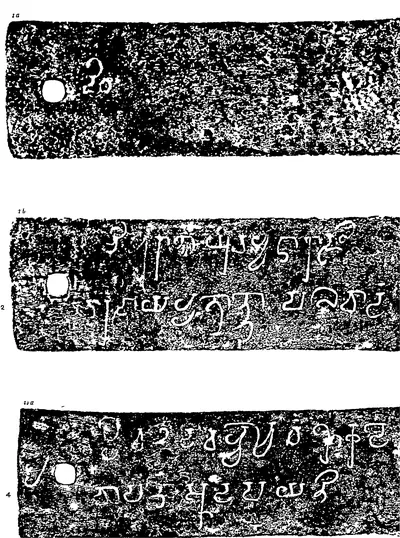 "Mayidavolu Plates of Sivaskandavarman", plates i a, i b and ii a (Epigraphia Indica VI, plate between pp. 84 and 85 (PDF p. 112 of the archive.org scan in.ernet.dli.2015.56212))Inscription rubbing · 1901
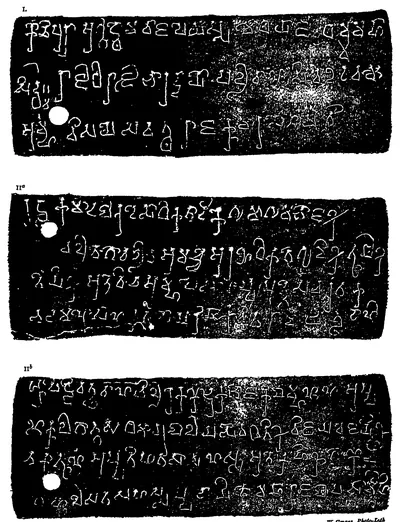 "Pallava Copperplate Grant of Sivaskandavarman" (Hirahadagalli plates), Plate I: plates I, II a and II b (Epigraphia Indica I, Plate I with No. I (PDF p. 20))Inscription rubbing · 1892
Related
Dynasties

References
Notes (0)
Sources (10)
Spotted an error on this page? Tell us
Last updated: