Palvancha
Town in the Khammam district of Telangana. It was first the seat of the Paloncha samasthan, the tributary estate of the Ashwarao rajas in the forests of the Godavari valley. The family traced its title to the Kakatiya Prataparudra, and its grant of the parganas of Hasanabad and Sankargiri to 1324. It received a sanad (charter) from the Nizam in 1798. In 1901 the estate had about 800 square miles and 38,742 people. The seat later moved to Bhadrachalam and then to Ashwaraopet.
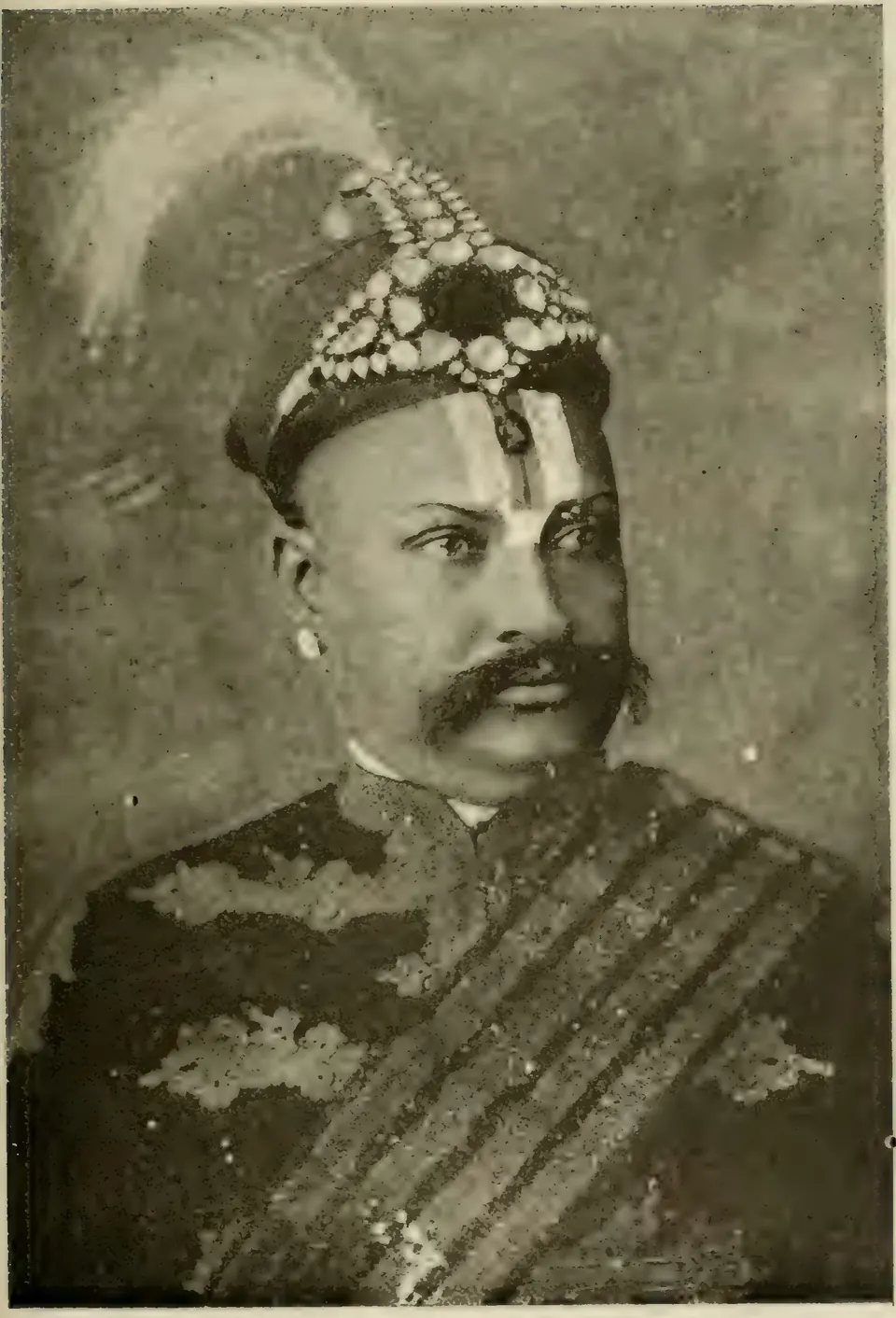
Palvancha (Paloncha) gave its name to one of the five chief samasthans (tributary estates) in the dominions of the Asaf Jahi Nizams.1 The samasthans were the tributary estates of Hindu chiefs.1
The Imperial Gazetteer of 1909 describes the estate as lying in the south-east of the Warangal district.2 It had six sub-taluks, about 800 square miles and 38,742 people in 1901.2 Its revenue was “said to be only Rs. 70,000”, and it paid a tribute of Rs 45,875 to the Nizam.2 The Raja also held the estates of Bhadrachalam and Rekapalli in the Godavari district of Madras.23
The Ashwarao family
The gazetteer gives the family’s history as it was told. Prataparudra of Warangal gave the title Ashwarao “in appreciation of the latter’s horsemanship, ashva in Sanskrit meaning ‘horse’”.3 After the fall of Warangal, the king of Delhi gave the parganas (revenue divisions) of Hasanabad and Sankargiri (Palvancha) to Anappa Ashwarao in 1324.3 The family held them for eighteen generations, until 1698.3
In 1769 Zafar-ud-daula killed Narsinha Ashwarao in battle.3 He plundered the Raja’s treasury and carried off “all the documents and ancient sanads engraved on copper plates”.3 In 1798 the Nizam granted a sanad (charter) to Venkatram Ashwarao.3 The condition was that he kept 2,000 cavalry and 3,000 foot soldiers.3
Quarrels between two branches of the family lasted until 1858.3 In that year the minister Salar Jang settled them with a fresh sanad.3 At the same time the British took over the taluks of Bhadrachalam and Rekapalli, on the left bank of the Godavari.3
These taluks were later given back to the Raja.3 He also recovered six taluks from the Nizam after a long dispute over the estate’s debts to a banker.3 The gazetteer counts twenty-eight Rajas from 1324.3
The seat and the country
The gazetteer says: “Paloncha was originally the head-quarters of the samasthan, after which Bhadrachalam was for some time the residence of the Raja, but Ashwaraopet has now become the capital.”3 The estate was “very unhealthy and malarious”, and much of it was thick jungle.3 The Godavari divided it between Hyderabad and Madras.3
The Palvancha taluk of the Warangal district was separate from the estate.4 It was thinly populated and largely forest, with Gonds and Koyas among its people.4 Fine corundum and garnets were found there.5
Where the sources disagree
- When the British took Bhadrachalam and Rekapalli. The Imperial Gazetteer says that the British took over the two taluks at the same time as Salar Jang’s settlement of 1858.3 The Godavari gazetteer says that the tract became British territory in 1860.6 The Madras administration manual dates the treaty by which the Nizam ceded the two taluks to 26 December 1860.7
Footnotes
-
Imperial Gazetteer: Hyderabad (1909), p. 52 (archive.org (opens in a new tab)). ↩ ↩2
-
Imperial Gazetteer: Hyderabad (1909), p. 297 (archive.org (opens in a new tab)). ↩ ↩2 ↩3 ↩4
-
Imperial Gazetteer: Hyderabad (1909), p. 298 (archive.org (opens in a new tab)). ↩ ↩2 ↩3 ↩4 ↩5 ↩6 ↩7 ↩8 ↩9 ↩10 ↩11 ↩12 ↩13 ↩14 ↩15 ↩16 ↩17 ↩18
-
Imperial Gazetteer: Hyderabad (1909), p. 171 (archive.org (opens in a new tab)). ↩ ↩2
-
Imperial Gazetteer of India: Hyderabad State (1909), p. 40 (archive.org (opens in a new tab)). ↩
-
F. R. Hemingway, Madras District Gazetteers: Godavari, Vol. I (1907), p. 174 (archive.org (opens in a new tab)). ↩
-
C. D. Maclean (ed.), Manual of the Administration of the Madras Presidency, Vol. II (1885), p. 266, chronological annals, 1860 (archive.org (opens in a new tab)). ↩
Photos
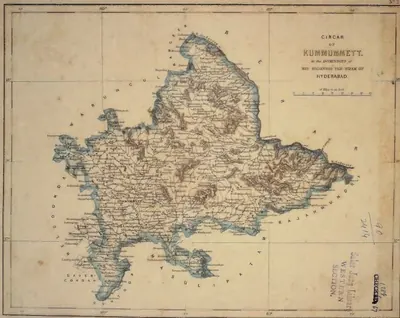 "Circar of Kummumett, in the Dominions of His Highness the Nizam of Hyderabad" (map No. 2 of an atlas presented to the Nizam by S. Veeraragavooloo Naidoo, Arcot, 1865); Kummumett is Khammam (identification ours)Map · 1865
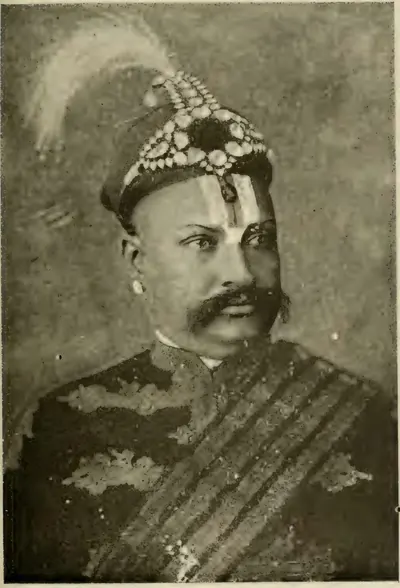 "H. H. The Rajah of Palavancha & Bhadrachalam" (Vadivelu 1903, plate in the section on the Rajah of Palavancha and Bhadrachalam)Historic photograph · 1903
References
Notes (0)
Sources (3)
Spotted an error on this page? Tell us
Last updated: