Bhadrachalam
Temple town on the Godavari, held to be a place where Rama lived after the abduction of Sita. Its temple of Rama is linked with Kancherla Gopanna, remembered as Ramadas, who is said to have spent the revenue on the shrine and to have been imprisoned for it. The Kistna manual (1883) makes him a nephew of Madanna under the last Qutb Shahi king. The Godavari gazetteer (1907) places him about 1725, as an official of the Nizam.
Bhadrachalam stands on the Godavari above the Eastern Ghats. The Godavari gazetteer of 1907 says that it “is considered a holy spot, since Rama is supposed to have lived there for some time after the abduction of Sita”.1 The name means “the hill of Bhadra”.1 It is said to come from a saint who was living there when Rama came, and to whom Rama returned after many years to grant salvation.1
The Kistna district manual of 1883 likewise calls it “one of the halting places of Rama, Sita and Lakshmana in their wanderings”.2 The hut they lived in “is still shown under the name of Parna Salu”.2 The gazetteer adds that the temple of Rama stands “on the top of a small hillock and is not remarkable architecturally”.1
Ramadas
The best-known story of the temple belongs to the Qutb Shahi age, or to just after it, and the sources disagree.21 See Kancherla Gopanna.
- Under Abul Hasan. The Kistna manual tells it as “another legend of this period”, the time of the brothers Madanna and Akkanna.2 It says: “Madanna Pantulu had a nephew, Gopanna, who was appointed Peshkar of the Kammamett Taluq, which includes the village of Bhadrachellam”.2 Gopanna “was so ardent a votary of Rama that he assumed the name of Ramdas and set to work to improve the temple of Rama at Bhadrachellam, using freely the public money that came into his hands”.2 At last he was called to account and thrown into prison.2 See Madanna and Abul Hasan.
- About 1725, under the Nizam. The gazetteer writes: “More authenticated history commences about 1725, when Rama Das, an official of the Nizam’s government, was sent to collect the revenues of this taluk.”1 “Instead of transmitting the money, he spent it in enlarging the shrine”.1 His superiors had him carried to Hyderabad, “where he died after an imprisonment of twelve years”.1 The gazetteer adds that a bairagi (wandering ascetic) had first built a small shrine there and carved a rude image of Rama.1
Both accounts give the same ending from tradition.1 In the gazetteer’s words, Ramadas “was miraculously ransomed by Rama and Lakshmana (who appeared before the then Nizam in person) and returned to Bhadrachalam, where he disappeared and became one with the god”.1 His adventures are the subject of a book of Telugu poems “widely known throughout the country”.1 The Telugu bards (bhagavatas) often sing them.1 The gazetteer’s dating to about 1725 makes the king “the Nizam”, and the manual’s makes him the last king of Golconda. The Qutb Shahis page sets out the disagreement.
The temple after Ramadas
The gazetteer says that his successor, Tumu Lakshminarasimha Rao, sent part of the tribute and spent the rest on finishing the work.13 It tells the story of a rich man of Madras who brought money for the temple and drowned in the Godavari.13
According to the gazetteer, the Nizam first endowed the temple with a lakh of rupees, but this was later reduced.3 In 1840–41 the endowment was fixed at Rs. 19,125 under a sanad (grant).3 The temple’s festival in Chaitra (March–April) was said to draw as many as 20,000 people from all over India.13
Until 1860 Bhadrachalam belonged to the Nizam’s dominions.4 The taluk was then handed over to the British Government.4
Under the British Crown
Maclean’s chronology records a treaty of 26 December 1860.5 By it the Nizam’s debt to the British was cancelled, and “Bhadrachellam and Rekapully talooks are ceded by the Nizam”.5
The Godavari gazetteer says that the tract became British territory in 1860.67 But until 1874 it was governed as part of the Upper Godavari district of the Central Provinces, and it was then transferred to the Godavari district of Madras.67 The rest of the Bhadrachalam zamindari (landholder’s estate) stayed in the Nizam’s Dominions.67
In 1879 the Bhadrachalam and Rekapalle taluks were made part of the Godavari Agency.8 Much of the ordinary law did not run there, and the Collector governed as Agent to the Governor.8 In July of that year the Rampa rebellion spread to the Rekapalle country.9 See Rekapalli and British Crown (Madras Presidency).
Footnotes
-
Hemingway, Godavari, Vol. I (1907), p. 261 (archive.org (opens in a new tab)). ↩ ↩2 ↩3 ↩4 ↩5 ↩6 ↩7 ↩8 ↩9 ↩10 ↩11 ↩12 ↩13 ↩14 ↩15 ↩16
-
Gordon Mackenzie, A Manual of the Kistna District in the Presidency of Madras (1883), p. 37 (archive.org (opens in a new tab)). ↩ ↩2 ↩3 ↩4 ↩5 ↩6 ↩7
-
Hemingway, Godavari, Vol. I (1907), p. 262 (archive.org (opens in a new tab)). ↩ ↩2 ↩3 ↩4 ↩5
-
F. R. Hemingway, Madras District Gazetteers: Godavari, Vol. I (1907), p. 260 (archive.org (opens in a new tab)). ↩ ↩2
-
C. D. Maclean (ed.), Manual of the Administration of the Madras Presidency, Vol. II (1885), p. 266, chronological annals, 1860 (archive.org (opens in a new tab)). ↩ ↩2
-
Hemingway, Godavari, Vol. I (1907), p. 174 (archive.org (opens in a new tab)). ↩ ↩2 ↩3
-
Hemingway, Godavari, Vol. I (1907), p. 175 (archive.org (opens in a new tab)). ↩ ↩2 ↩3
-
Hemingway, Godavari, Vol. I (1907), p. 190 (archive.org (opens in a new tab)). ↩ ↩2
-
Hemingway, Godavari, Vol. I (1907), p. 274 (archive.org (opens in a new tab)). ↩
Photos
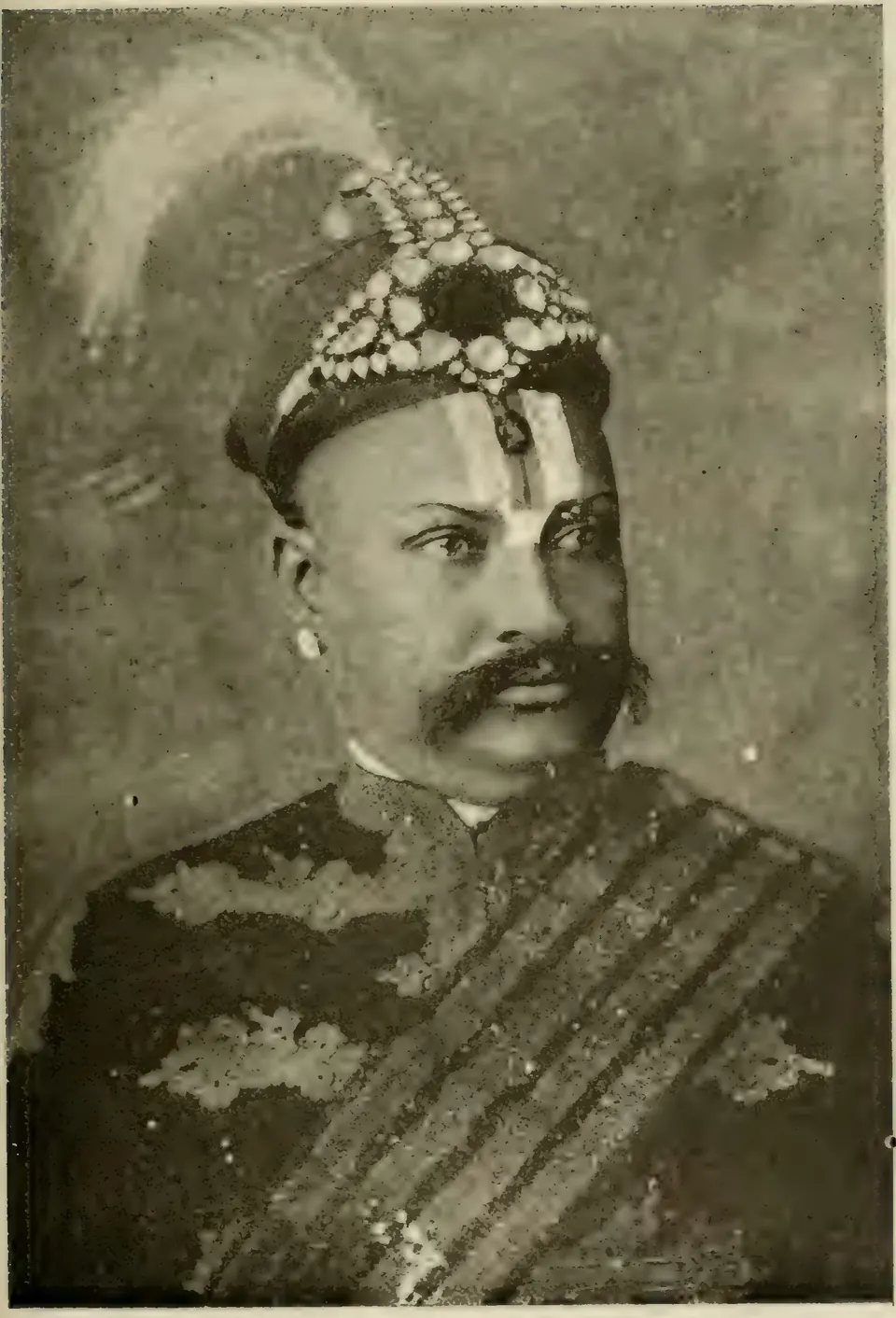
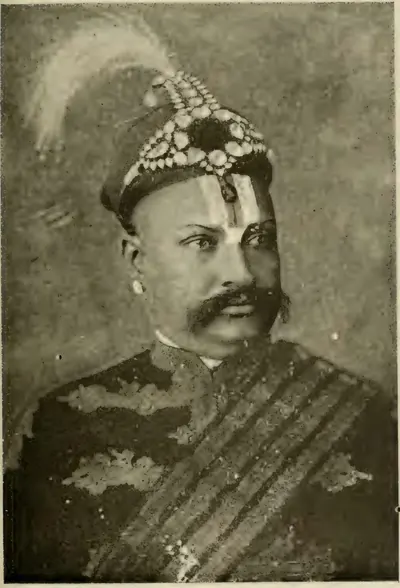 "H. H. The Rajah of Palavancha & Bhadrachalam" (Vadivelu 1903, plate in the section on the Rajah of Palavancha and Bhadrachalam)Historic photograph · 1903
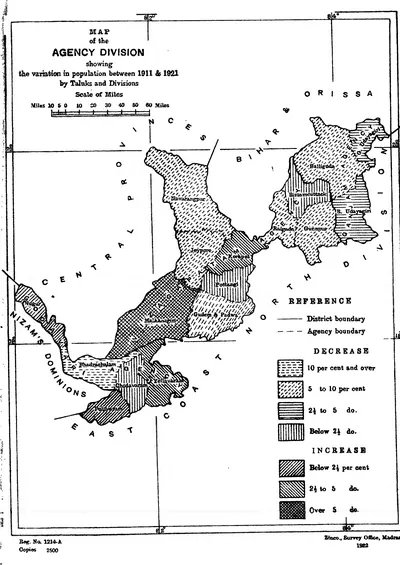 "Map of the Agency Division showing the variation in population between 1911 & 1921 by Taluks and Divisions": the hill tracts of Ganjam, Vizagapatam and Godavari (Census of India 1921, Madras, Part I, 1922)Map · 1922
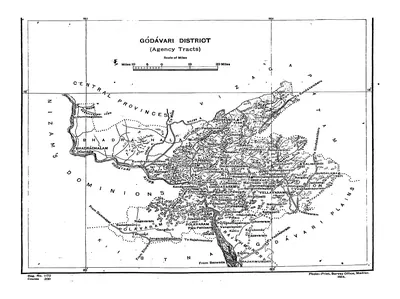 Map of the "Godavari District (Agency Tracts)" (Hemingway 1907, PDF p. 4)Map · 1907
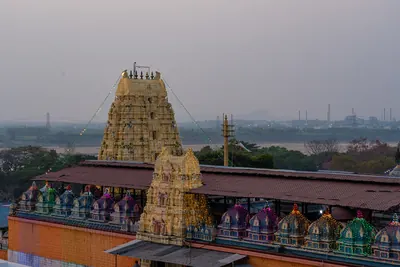 The Sita-Ramachandra temple, BhadrachalamPhotograph · 2024
References
Notes (0)
Sources (3)
Spotted an error on this page? Tell us
Last updated: