Ramatirtham
Village near Vizianagaram, where a family of pandits kept the copper-plate grant of the Vishnukundin king Indravarman. It was published in 1914 as the Ramatirtham plates. The grant itself concerns a village in the Plaki district, which most writers place in the Vizianagaram region.
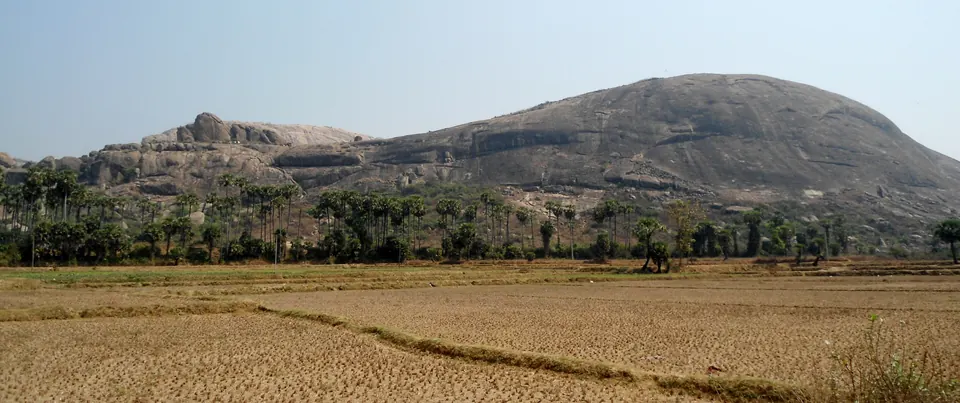
Ramatirtham, near Vizianagaram, gave its name to the only known grant of the Vishnukundin king Indravarman. H. Krishna Sastri reported in 1909 that the plates belonged to “a learned family of Pandits at Rāmatīrtham (near Vizianagrum)”.1 E. Hultzsch edited them from Krishna Sastri’s impressions in 1914.2 See the Ramatirtham plates.
The plates and the place
The plates do not say where they were made or found. They were issued from Puranisangama and grant the village of Peruvataka in the Plaki district.2 Writers have nonetheless used the place where they were kept to judge how far north the Vishnukundins reached. Krishna Sastri noted that the Plaki district is also named in the Chipurupalle plates of the Eastern Chalukya Vishnuvardhana I, and so he placed it in Visakhapatnam (then Vizagapatam) district. He thought the family’s early home had been in that district.1 G. Jouveau-Dubreuil concluded that Indravarman had become master of Visakhapatnam district.3
D. C. Sircar thought a lasting Vishnukundin hold on the Vizianagaram region unlikely, because several local dynasties ruled nearby.456 In his view Indravarman made the grant during a raid.456
Sriparvata?
The Vishnukundin kings call themselves devotees of the lord of Sriparvata, usually taken to be Srisailam in Kurnool district.2 Krishna Sastri argued instead that Sriparvata should be looked for in Visakhapatnam district.1 K. R. Subramanian rejected this. He noted, though, that an old inscription on a seal found at Ramatirtham calls the place a saila (hill).7
Footnotes
-
H. Krishna Sastri, Annual Report on Epigraphy, Southern Circle, for 1908–09 (1909), Part II, para. 62, p. 109 (archive.org (opens in a new tab)). ↩ ↩2 ↩3
-
E. Hultzsch, “Ramatirtham Plates of Indravarman”, Epigraphia Indica XII (1914), pp. 133–134 (archive.org (opens in a new tab)). ↩ ↩2 ↩3
-
G. Jouveau-Dubreuil, Ancient History of the Deccan (1920), p. 91 (archive.org (opens in a new tab)). ↩
-
D. C. Sircar, The Successors of the Satavahanas in Lower Deccan (1939), p. 120 (archive.org (opens in a new tab)). ↩ ↩2
-
Sircar, Successors of the Satavahanas (1939), p. 121 (archive.org (opens in a new tab)). ↩ ↩2
-
Sircar, Successors of the Satavahanas (1939), p. 138 (archive.org (opens in a new tab)). ↩ ↩2
-
K. R. Subramanian, Buddhist Remains in Andhra and the History of Andhra between 225 and 610 A.D. (1932), p. 116, note 2 (archive.org (opens in a new tab)). ↩
Photos
References
Notes (0)
Sources (5)
Spotted an error on this page? Tell us
Last updated: