Yelavarru
Village near Amruthalur in the Repalle country of Guntur district, the Elavarru of a copper-plate grant of the Eastern Chalukya king Amma II (945–970). The grant gives the village itself to a Brahmin treasury official. The plates were dug up there in 1864, hanging from an iron bar across a buried jar.
Yelavarru, which J. F. Fleet spelt Yelivarru, is a small village in the Repalle (Repalli) country, between Inturu and Amartaluru.1 Fleet identified it in 1883 with Elavarru, the village named in a grant of the Eastern Chalukya king Amma II.12 Amma II gave Elavarru as an agrahara (village for Brahmins) in the Velanandu district.12
Fleet also identified Inturu and Amartaluru with Inthuri and Amutunuri, which the grant names among the village’s boundaries.1 He noted that the village was not far from Tsandavole.1 A few years earlier a quantity of gold had been found there, partly melted into a mass and partly in coins.1
The copper plates
The owner of the plates was Mallampati Mangayya of Yelivarru.1 He told Fleet that he had found them in 1864 while building a new house.1 As he was bringing earth, his bullock put its foot into a hole in the path.1 Digging there, he found a large jar with a rusty iron cover, and across the jar an iron bar from which the copper plates hung.1
The grant gives the village to Koramiya, head of the writing office of the king’s gold treasury, on the occasion of the winter solstice.2 Fleet placed the village in the Guntur district in 1883 and in the Krishna (then Kistna) district in 1891.13 See the Yelavarru plates of Amma II.
Footnotes
-
J. F. Fleet, “Sanskrit and Old-Canarese Inscriptions, No. CXXVI”, Indian Antiquary XII (1883), p. 91 (archive.org (opens in a new tab)). ↩ ↩2 ↩3 ↩4 ↩5 ↩6 ↩7 ↩8 ↩9 ↩10 ↩11
-
Fleet, “Sanskrit and Old-Canarese Inscriptions, No. CXXVI” (1883), p. 95, translation (archive.org (opens in a new tab)). ↩ ↩2 ↩3
-
J. F. Fleet, “The Chronology of the Eastern Chalukya Kings”, Indian Antiquary XX (1891), p. 271 (archive.org (opens in a new tab)). ↩
Photos
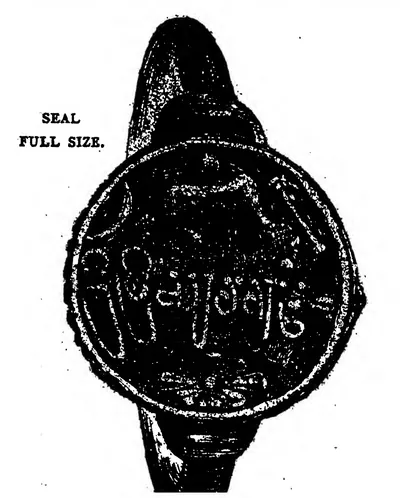 "Seal. Full size." of the Yelavarru Eastern Chalukya grant of Amma II (Indian Antiquary XII, plate at p. 93 (PDF p. 107))Drawing · 1883
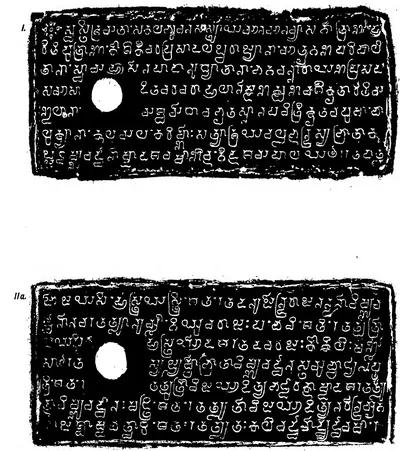 "Yelavarru Eastern Chalukya grant of Amma II.", plates i and ii a (Indian Antiquary XII, plate between pp. 92 and 93 (PDF p. 104))Inscription rubbing · 1883
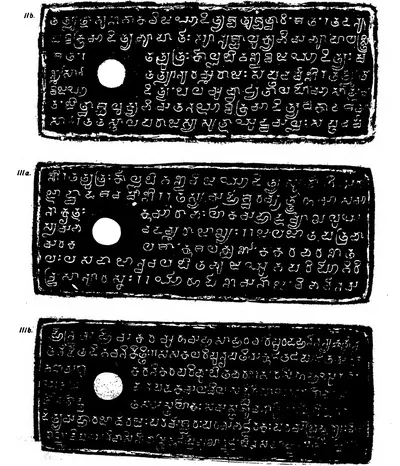 "Yelavarru Eastern Chalukya grant of Amma II.", plates ii b, iii a and iii b (Indian Antiquary XII, plate between pp. 92 and 93 (PDF p. 105))Inscription rubbing · 1883
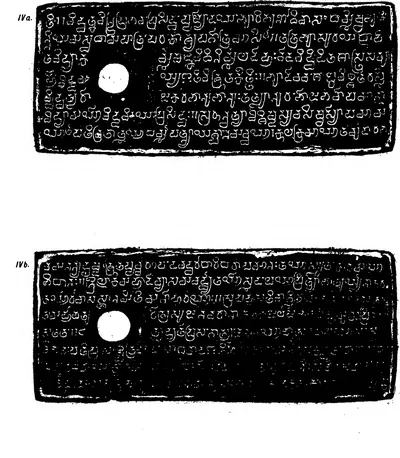 "Yelavarru Eastern Chalukya grant of Amma II.", plates iv a and iv b (Indian Antiquary XII, plate at p. 93 (PDF p. 106))Inscription rubbing · 1883
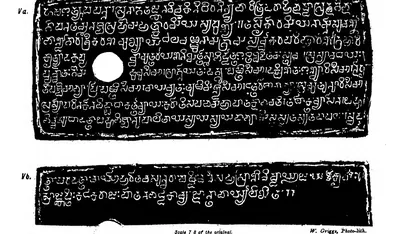 "Yelavarru Eastern Chalukya grant of Amma II.", plates v a and v b (Indian Antiquary XII, plate at p. 93 (PDF p. 107))Inscription rubbing · 1883
References
Notes (0)
Sources (2)
Spotted an error on this page? Tell us
Last updated: