Yelavarru plates of Amma II
Five Sanskrit copper plates of the Eastern Chalukya king Amma II (crowned 945), dug up in 1864 at Yelavarru (Elavarru) near Repalle, the very village they grant. On the winter solstice the king gives Elavarru in the Velanandu district to Koramiya, a Brahmin who headed the writing office of the gold treasury. The king's mother had brought Koramiya up. J. F. Fleet edited the plates in 1883, and parts of them are palimpsests, cut down from two older charters.
This is one of the many copper-plate charters of Amma II, the Eastern Chalukya king who was crowned in 945 and reigned for twenty-five years.12 It is not dated in an era.12 J. F. Fleet, who edited it in 1883, placed it after Saka 867 (945–46; Saka is an Indian way of counting years), the year of the king’s accession given in another of his grants.12
Discovery
The plates belonged to Mallampati Mangayya of Yelivarru, in the Repalli taluk.1 James Burgess obtained them for Fleet’s inspection.1
Fleet was told how they were found.1 In 1864 the owner was building a new house.1 While he was bringing earth, his bullock put its foot into a hole in the path.1 Digging there, he found a large jar with a rusty iron cover.1 Across the jar lay an iron bar from which the copper plates hung.1
Fleet identified Yelivarru with Elavarru, the village granted.1 He identified the neighbouring Inturu and Amartaluru with Inthuri and Amutunuri, two of the villages named in its boundaries.1 He noted that it was not far from Tsandavole.1 A hoard of gold had been found there a few years before, some of it melted into a mass and some in coins.1
Fleet placed the village in the Guntur district in 1883, and in the Krishna (then Kistna) district in his list of 1891.12 See Yelavarru.
Description
There are five plates, each about 7⅜ inches long and a little over 3 inches broad, with raised rims.1 The whole inscription was perfectly preserved.1 The ring had not been cut when Fleet received the plates.1
The round seal carries across the middle the motto Sri-Tribhuvanankusa.1 Above it is a standing boar facing left, with the sun above it, the moon on one side and an elephant-goad on the other.1 Below it is an eight-leaved water-lily.1 The plates weigh 67½ tolas, and the ring and seal 54¼ tolas.1
The grant is partly a palimpsest (written over an older text).1 Three of the plate faces were engraved over a cancelled grant in an older type of letters.1 Its lines had been beaten in so carefully that only scratches remained.1 Fleet could read only a few phrases, among them the name of a village Tungavada.1
Two more faces had been cut down from another grant of about the same period.1 Its lines ran at right angles to the present text, so that only a few letters of each line survived.1 The Vandram plates of the same king are also engraved in part over an earlier grant.3
Content
The inscription opens with the usual Chalukya preamble and the list of kings of Vengi with the length of each reign.45 The list begins with Kubja-Vishnuvardhana, “the brother of Satyasraya-Vallabhendra”, who ruled Vengi for eighteen years.45 It ends with Amma II’s father, Chalukya-Bhima II, who ruled for twelve years.45
For the civil war after 925, it gives these reigns:5
- Talapa, one month, after he expelled the child Vijayaditya5
- Vikramaditya, son of Chalukya-Bhima, eleven months5
- Yuddhamalla, son of Talapa, seven years5
It then calls Bhima the son of Yuddhamalla, though he was really the son of Kollabhiganda-Vijayaditya.5 Fleet explained this as an instance of a custom he had noted elsewhere.5 By this custom, a successor is called the son of the king he followed.5 F. Kielhorn found the lengths of reign substantially the same as in the Masulipatam plates of the same king.6
Amma II bears the titles Samastabhuvanasraya, Maharajadhiraja, Paramesvara and Paramabhattaraka.75 He addresses the householders, headed by the rashtrakutas, of the Velanandu district (vishaya).75
The donee was Koramiya, of the Kasyapa gotra, son of Viddamiya and his wife Anamavva, and grandson of Viddamayya.758 He was the head of the writing office (srikarana) of the treasury of gold.758 The grant says he was brought up “through affection” by “Our mother, Sri-Lokamahadevi”, that is Amma II’s mother.758 It praises him at length for his wit, eloquence and learning.758
On the occasion of the sun’s turning north (the winter solstice), the king gave Koramiya the village of Elavarru as an agrahara (village granted to Brahmins), free of all taxes.8 Its boundaries were:8
- Gomaduvu on the east8
- Daggumbarti on the south-east8
- Inthuri on the south8
- Prempalti on the south-west and west8
- Turimindi on the north-west8
- Amutunuri on the north and north-east8
The executor (ajnapti) was the Kataka-raja.82 Potanabhatta composed the verses, and Jontacharya wrote the plates.82
Later notices
Kielhorn entered the grant as No. 565 of his list of southern inscriptions in 1903, calling the king Ammaraja II Vijayaditya VI.6
E. Hultzsch found in 1908 that the first seventeen lines of the Vandram plates were practically identical with the first twenty-three lines of this grant.3 He also found that its order to the district officers was worded in nearly the same way.3 He noted that the same Jontacharya wrote the Vandram plates and the Padamkaluru grant, which gives Amma II’s coronation date.9 V. Rangacharya, in 1919, described the Vandram grant by its likeness to this one.10
The king’s name and number
Fleet called the donor “Amma II, also called Vijayaditya” in 1883, and Kielhorn numbered him Vijayaditya VI.16 E. Hultzsch’s pedigree of 1890 counted him Vijayaditya V.112 This site calls him Amma II, the name under which Fleet listed this grant in 1891.112
Footnotes
-
J. F. Fleet, “Sanskrit and Old-Canarese Inscriptions, No. CXXVI”, Indian Antiquary XII (1883), p. 91 (archive.org (opens in a new tab)). ↩ ↩2 ↩3 ↩4 ↩5 ↩6 ↩7 ↩8 ↩9 ↩10 ↩11 ↩12 ↩13 ↩14 ↩15 ↩16 ↩17 ↩18 ↩19 ↩20 ↩21 ↩22 ↩23 ↩24 ↩25 ↩26 ↩27 ↩28 ↩29
-
J. F. Fleet, “The Chronology of the Eastern Chalukya Kings”, Indian Antiquary XX (1891), p. 271 (archive.org (opens in a new tab)). ↩ ↩2 ↩3 ↩4 ↩5 ↩6 ↩7 ↩8
-
E. Hultzsch, “Vandram Plates of Ammaraja II”, Epigraphia Indica IX (1907–08), p. 132 (archive.org (opens in a new tab)). ↩ ↩2 ↩3
-
Fleet, “Sanskrit and Old-Canarese Inscriptions, No. CXXVI” (1883), p. 93, text and translation (archive.org (opens in a new tab)). ↩ ↩2 ↩3
-
Fleet, “Sanskrit and Old-Canarese Inscriptions, No. CXXVI” (1883), p. 94, translation and note 10 (archive.org (opens in a new tab)). ↩ ↩2 ↩3 ↩4 ↩5 ↩6 ↩7 ↩8 ↩9 ↩10 ↩11 ↩12 ↩13 ↩14 ↩15 ↩16
-
F. Kielhorn, “A List of the Inscriptions of Southern India”, Appendix to Epigraphia Indica VII (1902–03), p. 96, No. 565 (archive.org (opens in a new tab)). ↩ ↩2 ↩3
-
Fleet, “Sanskrit and Old-Canarese Inscriptions, No. CXXVI” (1883), p. 92, text (archive.org (opens in a new tab)). ↩ ↩2 ↩3 ↩4 ↩5 ↩6
-
Fleet, “Sanskrit and Old-Canarese Inscriptions, No. CXXVI” (1883), p. 95, translation (archive.org (opens in a new tab)). ↩ ↩2 ↩3 ↩4 ↩5 ↩6 ↩7 ↩8 ↩9 ↩10 ↩11 ↩12 ↩13 ↩14
-
Hultzsch, “Vandram Plates of Ammaraja II” (1908), p. 133 and note 8 (archive.org (opens in a new tab)). ↩
-
V. Rangacharya, A Topographical List of the Inscriptions of the Madras Presidency, Vol. II (1919), p. 888, Kistna district, No. 127 (archive.org (opens in a new tab)). ↩
-
E. Hultzsch, South-Indian Inscriptions, Vol. I (1890), p. 32, pedigree of the Eastern Chalukya dynasty (archive.org (opens in a new tab)). ↩ ↩2
Photos
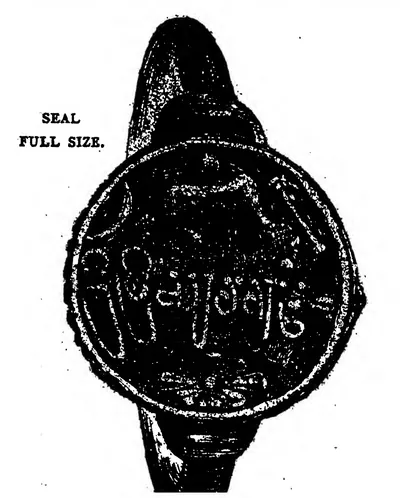 "Seal. Full size." of the Yelavarru Eastern Chalukya grant of Amma II (Indian Antiquary XII, plate at p. 93 (PDF p. 107))Drawing · 1883
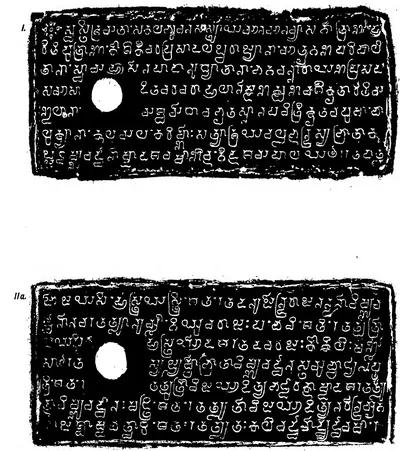 "Yelavarru Eastern Chalukya grant of Amma II.", plates i and ii a (Indian Antiquary XII, plate between pp. 92 and 93 (PDF p. 104))Inscription rubbing · 1883
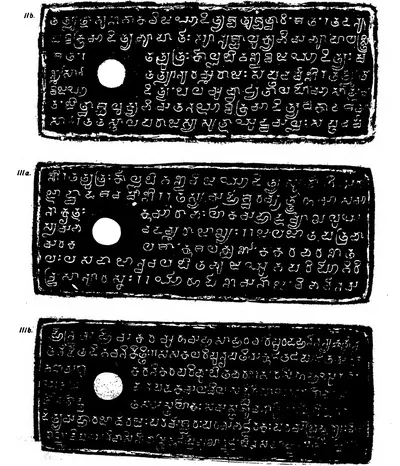 "Yelavarru Eastern Chalukya grant of Amma II.", plates ii b, iii a and iii b (Indian Antiquary XII, plate between pp. 92 and 93 (PDF p. 105))Inscription rubbing · 1883
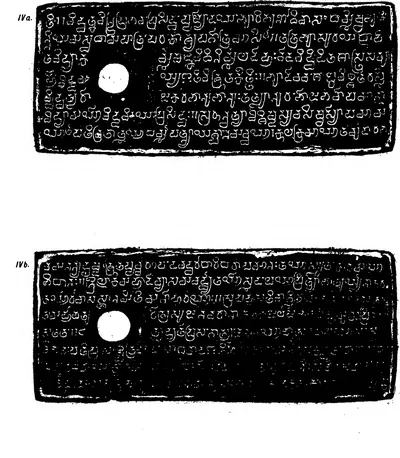 "Yelavarru Eastern Chalukya grant of Amma II.", plates iv a and iv b (Indian Antiquary XII, plate at p. 93 (PDF p. 106))Inscription rubbing · 1883
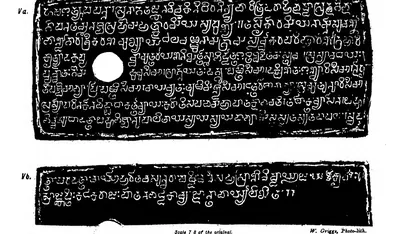 "Yelavarru Eastern Chalukya grant of Amma II.", plates v a and v b (Indian Antiquary XII, plate at p. 93 (PDF p. 107))Inscription rubbing · 1883
References
Notes (0)
Sources (6)
Spotted an error on this page? Tell us
Last updated: