Chamaluru inscription of Vijayaditya Chola
A broken Telugu stone at Chamaluru in the Jammalamadugu country, dated in the 22nd year of Prithivivallabha Vijayaditya Chola, while a Bana king ruled Pambuliggi under him. Its lost lines were restored from an eye-copy (a copy drawn by hand) made by Colin Mackenzie's assistants. Its editors placed the king about 750. They read the record as evidence that the Telugu Cholas had thrown off Chalukya overlordship and subdued the Banas.
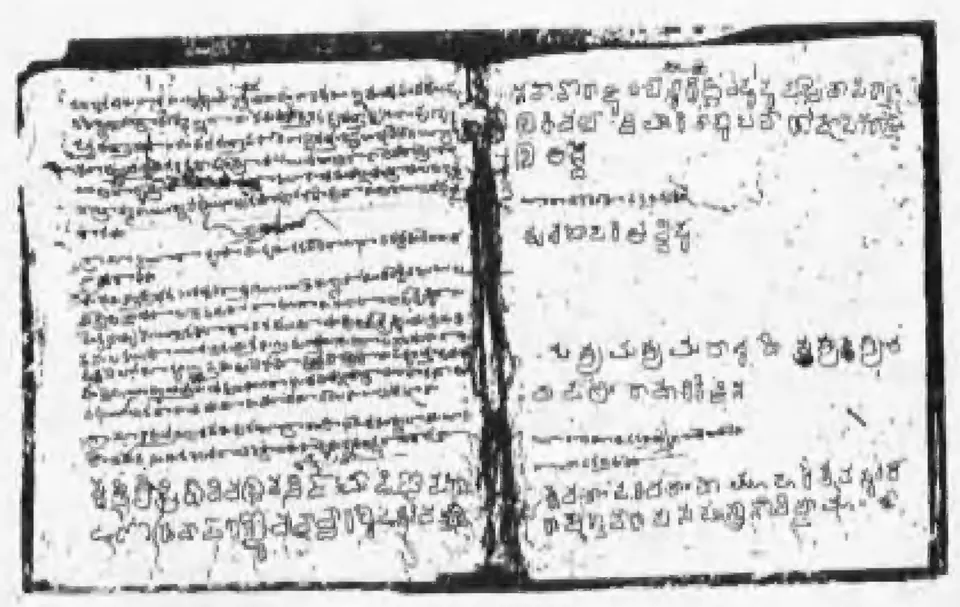
The stone and the Mackenzie copy
The inscription is cut on four sides of a broken stone lying in a field on the edge of Chamaluru, in the Jammalamadugu taluk.12 Colin Mackenzie’s assistants saw it early in the 19th century, when it was better preserved, and made an eye-copy (a copy drawn by hand).12 This copy survives in the Mackenzie manuscripts.12 K. A. Nilakanta Sastri and M. Venkataramayya restored the lost portions of the inscription from that copy, and printed a photograph of it.12
The letters are bold and in a transitional stage between the earlier square forms and the later cursive ones.1
Language
The record is in Telugu, with Telugu and Sanskrit mixed in the sentence describing the donee.1 The editors noted early forms of several Telugu words.1 Among them are ebhadi (modern ebbadi, “fifty”) and penbara, a chief Brahmana.1 Others are words for younger sister or brother and for mother.1
Contents
The inscription seems to record a grant by the mother of the Chola-Maharaja, made while a Bana king was ruling at Pambuliggi.1 It is dated in the 22nd year of king Prithivivallabha Vijayaditya Chola.1
The wording of her relationship to a Pallava king is archaic and unclear.1 She was either the younger sister of Kachapori, apparently the Pallava king’s queen, or the mother of a Chola-Maharaja who was Kachapori’s younger brother.1 Either way, the editors observed, the Telugu Chola and Pallava families were linked by marriage.1
The land, fifty maruturu (a land measure), was given to Aggi Sarmma, son of the chief Brahmana Revasarmma of the Kaundinya-gotra.2
Date and meaning
The editors thought the king was named after the Chalukya Vijayaditya of Badami (696–733).1 So they placed him a generation later, about 750, after Uttamaditya and Satyaditya.1 The letters, though a little archaic, seemed to them to agree.1
The editors pointed to his supreme title Prithivivallabha, and to the Bana king serving under him.3 From these they concluded that he had thrown off Chalukya overlordship.3 In their view he had also brought under his rule the Bana chiefs who had served the Chalukyas in Renandu.3
They identified Pambuliggi with Havalige in the Gooty taluk.32 They identified the Pallava king, probably, with Nandivarman Pallavamalla.32 See Vijayaditya Chola and the Telugu Cholas of Renadu.
Footnotes
-
K. A. Nilakanta Sastri and M. Venkataramayya, “Telugu Chola Records from Anantapur and Cuddapah”, Epigraphia Indica XXVII (1956), p. 242 and notes (archive.org (opens in a new tab)). Paraphrased. ↩ ↩2 ↩3 ↩4 ↩5 ↩6 ↩7 ↩8 ↩9 ↩10 ↩11 ↩12 ↩13 ↩14 ↩15 ↩16 ↩17
-
Nilakanta Sastri and Venkataramayya, “Telugu Chola Records” (1956), p. 244, text and notes (archive.org (opens in a new tab)). Paraphrased. ↩ ↩2 ↩3 ↩4 ↩5 ↩6 ↩7
-
Nilakanta Sastri and Venkataramayya, “Telugu Chola Records” (1956), p. 243 (archive.org (opens in a new tab)). Paraphrased. ↩ ↩2 ↩3 ↩4 ↩5
Photos
 "Telugu Chola Records from Anantapur and Cuddapah (II)", K: the Chamaluru inscription as copied by Colin Mackenzie's assistants (Mackenzie manuscript, photograph) (Epigraphia Indica XXVII, Plate (II) between pp. 236 and 237, lower right (PDF p. 326))Historic photograph · 1956
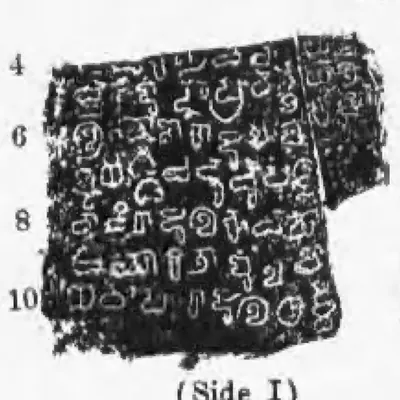 "Telugu Chola Records from Anantapur and Cuddapah (II)", K: the Chamaluru inscription of Prithivivallabha Vijayaditya-Chola, side I (Epigraphia Indica XXVII, Plate (II) between pp. 236 and 237, panel K, side I (PDF p. 326))Historic photograph · 1956
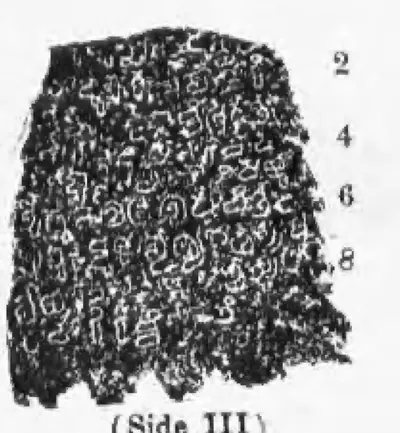 "Telugu Chola Records from Anantapur and Cuddapah (II)", K: the Chamaluru inscription of Prithivivallabha Vijayaditya-Chola, side III (Epigraphia Indica XXVII, Plate (II) between pp. 236 and 237, panel K, side III (PDF p. 326))Historic photograph · 1956
References
Notes (0)
Sources (1)
Spotted an error on this page? Tell us
Last updated: