Kuruvagatta inscription of Biragriha
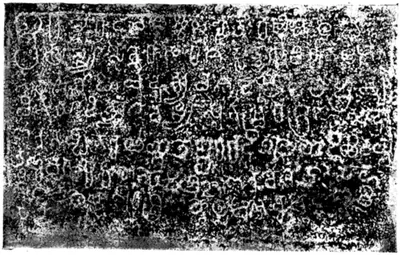
A short undated inscription, with a Sanskrit verse and a Kannada prose passage, cut on a stone in front of an image of the goddess Chaudamba near Kuruvagatta in the old Mahbubnagar district. It praises Biragriha, son of Vinayaditya of the Chalukya family, as a friend of Govinda-vallabha, son of Kalivallabha of the Rashtrakuta family. N. Venkataramanayya identified these two as the Rashtrakuta kings Govinda III and Dhruva. He took the inscription to be the earliest record of the Chalukyas of Vemulavada.
The Kuruvagatta inscription is a short record of Biragriha, a son of Vinayaditya-Yuddhamalla, the founder of the Chalukyas of Vemulavada. N. Venkataramanayya called it the earliest record of the family.12 He used it to date the first generations.12
The stone
The inscription is cut on a stone in front of an image of the goddess Chaudamba.3 The image is carved on a rock between two boulders, on a hillock by the stream Minamba.3 The place is opposite the village of Kuruvagatta, in the Nagarkurnool taluk of the old Mahbubnagar district.3 A ruined Siva shrine stands nearby, but the record mentions neither the shrine nor the goddess.3
The record consists of a Sanskrit verse and a Kannada prose passage, in early Telugu-Kannada letters.31 In his edition, Venkataramanayya dated the letters to about the beginning of the 9th century.31 In his discussion of the sources, he dated them to the latter half of the 8th.31 He published the text and a photograph as Appendix B of his book of 1953.4
Contents
The verse says that Kalivallabha was born in the Rashtrakuta family, and that his son was Govinda-vallabha.45 It says that Biragriha, son of Vinayaditya of the Chalukya family, was Govinda-vallabha’s friend.45 The Kannada passage praises Biragriha’s daring.45 The 1964 catalogue summary says that he lived up to his name by great bravery in many battles.45
Venkataramanayya identified Kalivallabha with the Rashtrakuta king Dhruva (780–793).26 He identified Govinda-vallabha with Dhruva’s son Govinda III (793–814).26 He took Biragriha to be a brother, or half-brother, of Arikesari I.26 He took the Vinayaditya of the record to be Vinayaditya-Yuddhamalla I.26
Other summaries
Epigraphia Telanganica (2023) lists the record twice under the Rashtrakutas.75 One entry is from Inscriptions of Andhra Pradesh, Mahabubnagar District (2003).75 It places the record in front of the Chowdesvara temple at Kuruva Gattupalli, in the Jadcherla taluk.75
The other entry is from a catalogue of inscriptions copied up to 1964, and it places the record at Kuravagattu.75 It adds that the record gives one pannasa of land to Brahmasakti Bhattaraka of Dhammadriparvata for performing fasting rites.75
Venkataramanayya’s edition says only that it records Biragriha’s exploits.3 So does the summary in Kannada Inscriptions of Andhra Pradesh (1961).8 That summary calls the son of Vinayaditya an abode of prowess who distinguished himself in numerous battles.8 It gives the date of Govinda III as 792–814.8 Epigraphia Telanganica also reprints Venkataramanayya’s edition under the Vemulavada Chalukyas.9
Footnotes
-
N. Venkataramanayya, The Chalukyas of L(V)emulavada (1953), p. 1 (archive.org (opens in a new tab)). Paraphrased. ↩ ↩2 ↩3 ↩4 ↩5
-
Venkataramanayya, Chalukyas of L(V)emulavada (1953), p. 10 (archive.org (opens in a new tab)). Paraphrased. ↩ ↩2 ↩3 ↩4 ↩5 ↩6
-
Venkataramanayya, Chalukyas of L(V)emulavada (1953), p. 81, introduction to the Kuruvagatta inscription (archive.org (opens in a new tab)). Paraphrased. ↩ ↩2 ↩3 ↩4 ↩5 ↩6 ↩7 ↩8
-
Venkataramanayya, Chalukyas of L(V)emulavada (1953), p. 82, text, and plate 1 (archive.org (opens in a new tab)). Paraphrased. ↩ ↩2 ↩3 ↩4 ↩5
-
Epigraphia Telanganica I (2023), p. 78. Cite-only; paraphrased. ↩ ↩2 ↩3 ↩4 ↩5 ↩6 ↩7 ↩8 ↩9
-
Venkataramanayya, Chalukyas of L(V)emulavada (1953), p. 19 (archive.org (opens in a new tab)). Paraphrased. ↩ ↩2 ↩3 ↩4
-
Gajjala Vasanta Lakshmi (ed.), Epigraphia Telanganica I: Pre-Kakatiya Telangana (2023), p. 77, Rashtrakuta Nos. 6 and 7. Cite-only; paraphrased. ↩ ↩2 ↩3 ↩4 ↩5
-
Kannada Inscriptions of Andhra Pradesh (Andhra Pradesh Government Archaeological Series 3, 1961), p. 11, No. 29 (archive.org (opens in a new tab)). Paraphrased. ↩ ↩2 ↩3
-
Epigraphia Telanganica I (2023), pp. 90–91, Vemulavada Chalukya No. 7. Cite-only; paraphrased. ↩
Photos
References
Notes (0)
Sources (3)
Spotted an error on this page? Tell us
Last updated: