Alas plates of the Yuvaraja Govinda II
A Sanskrit copper-plate grant dated in 770, issued in the reign of the Rashtrakuta king Krishna I by his son, the crown prince Govinda II. He issued it from a camp 'at the confluence of the Krishnaverna and the Musi', after the army had invaded the Vengi country and humbled its king. It was found at Alas in the Kurundwad State (now Maharashtra) and published by D. R. Bhandarkar in 1901. It is the earliest record of war between the Rashtrakutas and the Eastern Chalukyas. J. F. Fleet held the plates to be a later copy, but probably based on a genuine original.
The Alas plates are a grant of the Rashtrakuta crown prince Govinda II, issued in the reign of his father Krishna I.12 They are the earliest record of the long war between the Rashtrakutas and the Eastern Chalukyas of Vengi.12 They also place a Rashtrakuta camp on the lower Krishna, on the edge of the Telugu country.12
Discovery and description
The plates were found in the village of Alas, in the Kurundwad State of the Bombay Presidency, while an old earth buttress was being dug out.1 The Senior Chief of Kurundwad sent them to R. G. Bhandarkar.1 He passed them to his son D. R. Bhandarkar, who published them in Epigraphia Indica VI (1901).1
There are three plates, held by a ring whose ends are joined by a knob bearing a round seal.1 The first and third plates are written on the inner side, and the second on both sides.1 On the seal is Garuda, seated, “with the palms of his hands joined close to his breast and with his wings raised”, above a floral device.1
The engraving is deep but “not well executed”, and some letters are almost illegible.1 The characters are of the southern type used under the later Chalukyas of Badami, and the language is Sanskrit throughout.1 Most of the verses also occur in other Rashtrakuta grants, and all of them in the Paithan grant of Govinda III of 794.1
Contents
The grant was made by Govindaraja, the son of Krishnaraja (Krishna I), while he was heir-apparent (Yuvaraja).1 It is dated in words: the Saka year 692, the cyclic year Saumya, the seventh day of the bright half of Ashadha.1 The editor equated this with 770.1
In Bhandarkar’s translation, Govinda issued it “from (the camp of) the victorious army that invaded the Vengi-mandala”.3 This was “when the lord of Vengi was humbled by the cession of (his) treasury, (his) forces, and his own country”.3 The camp was “at the confluence of the Krishnaverna and the Musi”.3
The grant gave a village to a Brahmin named Jaggu of the Bharadvaja gotra (clan).3 The village was on the bank of the Prasadini river, south of the Hariyagiri hill, in the Alaktaka district.3 The gift was made at the request of Vijayaditya, son of Dantivarman and grandson of Dhruvaraja, and Srisena wrote the grant.3
Bhandarkar identified Alaktaka with the Alata division of the Kolhapur State.2 He identified the village of Arasiyavada named in the grant with Alas itself.2
The Krishna and the Musi
Bhandarkar noted that the Musi “is the last important feeder of the Krishna”.2 It “joins it on the confines of the modern Kistna district of the Madras Presidency”.2 He drew a conclusion from the grant: hostilities “had sprung up between the two rival dynasties long before the time of Govinda III”.2 His reason was that a prince of Krishna I had already reduced the king of Vengi in 770.2
Robert Sewell placed the camp on the borders of the Palnad taluk, south of the Krishna.4 He took the king of Vengi to be Vishnuvardhana IV, and he took the defeat to be real.4 But he did not think that the Rashtrakutas annexed his country.4 (See Vishnuvardhana IV.)
The grant also names the predecessor of Krishna I as Dantivarman, not Dantidurga.2 According to a grant of 812, Krishna I uprooted a “relative”.2 Bhandarkar used the Alas grant to argue that Dantidurga was not that “relative”.2 His reason was that this grant, of Krishna I’s own reign, has a verse saying that Krishna became king after Dantidurga had gone to heaven.2
Is the record genuine?
J. F. Fleet returned to the plates in 1903.5 He pointed to “the bad formation of the characters, and the occasional very marked irregularity of the lines of the writing”.5 These, he wrote, “suffice to shew that these Alas plates do not contain the original and synchronous official record”.5
He still thought that the record was based on “something genuine”, perhaps a manuscript copy of a lost original.5 He accepted it for the time being as proof that Govinda II was crown prince under Krishna I in 770.5 He did not take it as proof that Govinda later reigned as king.5
Footnotes
-
D. R. Bhandarkar, “Alas Plates of the Yuvaraja Govinda II; Saka-Samvat 692”, Epigraphia Indica VI (1901), p. 208 (archive.org (opens in a new tab)). ↩ ↩2 ↩3 ↩4 ↩5 ↩6 ↩7 ↩8 ↩9 ↩10 ↩11 ↩12 ↩13 ↩14 ↩15
-
Bhandarkar, “Alas Plates” (1901), p. 209 (archive.org (opens in a new tab)). ↩ ↩2 ↩3 ↩4 ↩5 ↩6 ↩7 ↩8 ↩9 ↩10 ↩11 ↩12 ↩13
-
Bhandarkar, “Alas Plates” (1901), p. 213, translation (archive.org (opens in a new tab)). ↩ ↩2 ↩3 ↩4 ↩5 ↩6
-
Robert Sewell, The Historical Inscriptions of Southern India (1932), p. 30 (archive.org (opens in a new tab)). Paraphrased. ↩ ↩2 ↩3
-
J. F. Fleet, “Some Rashtrakuta Records”, Epigraphia Indica VII (1903), p. 231 (archive.org (opens in a new tab)). ↩ ↩2 ↩3 ↩4 ↩5 ↩6
Photos
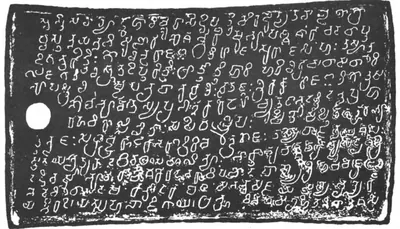 "Alas Plates of the Yuvaraja Govinda II.—Saka-Samvat 692." side i (Epigraphia Indica VI, plate with No. 18; PDF p. 265 of the archive.org scan EpigraphiaIndicaVol6)Inscription rubbing · 1901
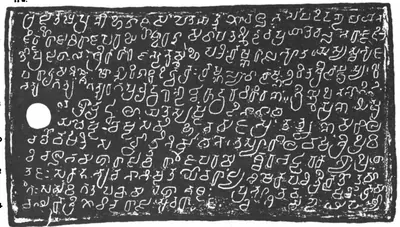 "Alas Plates of the Yuvaraja Govinda II.—Saka-Samvat 692." side iia (Epigraphia Indica VI, plate with No. 18; PDF p. 265 of the archive.org scan EpigraphiaIndicaVol6)Inscription rubbing · 1901
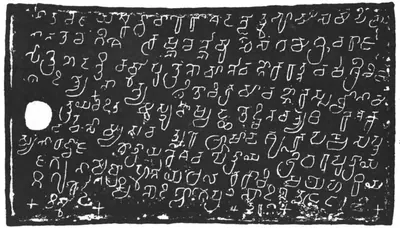 "Alas Plates of the Yuvaraja Govinda II.—Saka-Samvat 692." side iib (Epigraphia Indica VI, plate with No. 18; PDF p. 266 of the archive.org scan EpigraphiaIndicaVol6)Inscription rubbing · 1901
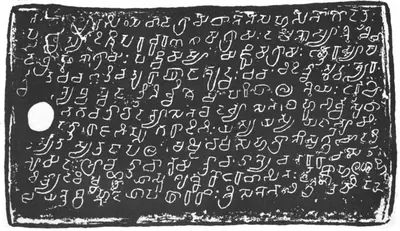 "Alas Plates of the Yuvaraja Govinda II.—Saka-Samvat 692." side iii (Epigraphia Indica VI, plate with No. 18; PDF p. 266 of the archive.org scan EpigraphiaIndicaVol6)Inscription rubbing · 1901
References
Notes (0)
Sources (3)
Spotted an error on this page? Tell us
Last updated: