Chura grant of Vijaya-Vishnugopavarman
A Sanskrit copper-plate grant, with some Telugu words, issued from Palotkata by the Pallava king Vijaya-Vishnugopavarman, son of a Simhavarman. It gives 108 nivartanas in the village of Chura in Karmarashtra to the Brahman Chasamisarman of Kundur. It was obtained at Narasaraopet and edited by C. R. Krishnamacharlu in 1938. It is written in letters of about the 7th century, and he took it to be a copy of an older grant.
The Chura grant adds one more generation to the Pallava line of the Nellore–Guntur country: a king Vijaya-Vishnugopavarman, son of a Simhavarman.12 It was noticed in the Madras epigraphy report for 1914 and edited by C. R. Krishnamacharlu in 1938.23
Discovery and description
The Revenue Divisional Officer of Narasaraopet obtained the plates from Mulla Sheik Miran of Narasaraopet.4 Miran said they had been granted to an ancestor of his as the title deed of a jagir (land grant).4 Krishnamacharlu thought they had probably been found at or near Chura itself.4
There are three plates on a ring, with an oval seal showing a couchant (lying) bull facing right.4 The plates are badly worn.4 With ring and seal they weigh 31 tolas.4
Language
The language is Sanskrit.1 But Krishnamacharlu noted Telugu expressions in the boundaries, such as muyuru-kutuva, “the meeting-place of three villages”, and an old tank called Muditi-tataka.1 He judged from the letters that the plates were a copy made at the beginning of the 7th century.2
Content
The grant was issued from Vijaya-Palotkata.1 The donor was the Dharma-maharaja Vijaya-Vishnugopavarman, son of Simhavarman.1 He was the grandson of the Maharaja Vishnugopavarman and great-grandson of Kandavarman (Skandavarman).1
The king gave one hundred and eight nivartanas (land measures) of land and a house site with a garden in the village of Chura in Karmmarashtra.1 The donee was Chasamisarman, son of Vriddhasarman, of the Kasyapa gotra (clan).1 He was learned in the four Vedas and lived at Kundur.1 The gift was made on the occasion of the winter solstice, with all exemptions.1
The places
Krishnamacharlu identified the boundary villages Lagubamru, Paguhuru and Nagolami with Daggupadu, Pavuluru and Nagulla in the Bapatla taluk of the Guntur district.5 He placed Chura at a deserted village shown on the maps between Nagulla and Daggupadu.5
He noted that Karmmarashtra, the Kamma-nadu of later records, appears much earlier.5 It appears as the province of Kammaka in the Jaggayyapeta inscriptions of the Ikshvaku king Virapurushadatta.5 D. C. Sircar took Palotkata to be the same as Palakkada, the place from which the crown prince Vishnugopa issued the Uruvupalli grant.3
Who was Vijaya-Vishnugopavarman?
Krishnamacharlu and Sircar took him to be the son of the Simhavarman of the Pikira, Mangalur and Omgodu grants.26 They took him to be the grandson of the crown prince Vishnugopa.26
H. Krishna Sastri had first thought him a later member of the line.2 Later he considered the plates untrustworthy for the Pallava succession, because of their late letters.2
Krishnamacharlu suggested a reason why copies were made.2 In his view, the move of the Eastern Chalukyas into Karmmarashtra early in the 7th century may have caused the loss of the original grants.2 G. Jouveau-Dubreuil, using the epigraphy report of 1914, called him king of Palakkada and placed him 525–550 in his family tree of 1920.78
Footnotes
-
Krishnamacharlu, “Chura Grant” (1938), p. 138 (archive.org (opens in a new tab)). ↩ ↩2 ↩3 ↩4 ↩5 ↩6 ↩7 ↩8 ↩9 ↩10
-
Krishnamacharlu, “Chura Grant” (1938), p. 139 and editor’s note (archive.org (opens in a new tab)). ↩ ↩2 ↩3 ↩4 ↩5 ↩6 ↩7 ↩8 ↩9
-
D. C. Sircar, The Successors of the Satavahanas in Lower Deccan (1939), p. 172 (archive.org (opens in a new tab)). ↩ ↩2
-
C. R. Krishnamacharlu, “Chura Grant of Pallava Vijaya-Vishnugopavarman”, Epigraphia Indica XXIV (1937–38), p. 137 (archive.org (opens in a new tab)). ↩ ↩2 ↩3 ↩4 ↩5 ↩6
-
Krishnamacharlu, “Chura Grant” (1938), p. 141 (archive.org (opens in a new tab)). ↩ ↩2 ↩3 ↩4
-
Sircar, Successors of the Satavahanas (1939), p. 173 (archive.org (opens in a new tab)). ↩ ↩2
-
G. Jouveau-Dubreuil, Ancient History of the Deccan (1920), pp. 62–63, 68 (archive.org (opens in a new tab)). ↩
-
G. Jouveau-Dubreuil, The Pallavas (1917), p. 16 (archive.org (opens in a new tab)). ↩
Photos
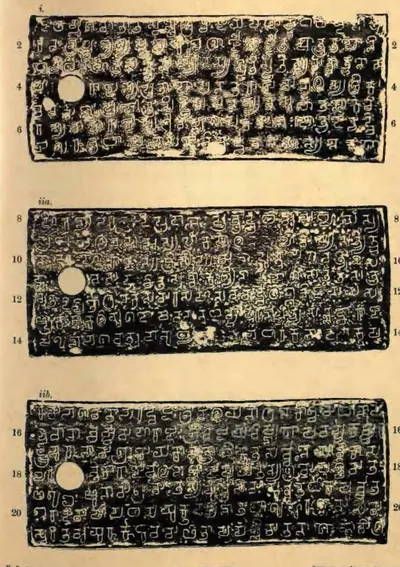 "Chura Grant of Pallava Vijaya-Vishnugopavarman", plates i, ii a and ii b (Epigraphia Indica XXIV, plate with No. 18 (PDF p. 174))Inscription rubbing · 1938
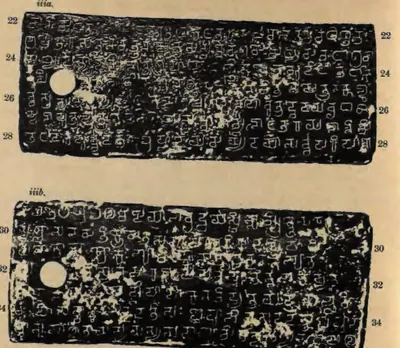 "Chura Grant of Pallava Vijaya-Vishnugopavarman", plates iii a and iii b (Epigraphia Indica XXIV, plate with No. 18 (PDF p. 175))Inscription rubbing · 1938
References
Notes (0)
Sources (4)
Spotted an error on this page? Tell us
Last updated: