Diggubarru grant of Chalukya-Bhima II
Five undated Sanskrit copper plates of the Eastern Chalukya king Chalukya-Bhima II (reigned about 934–945). Sir Walter Elliot obtained them from 'Paganavaram', and they are now in the British Museum. J. F. Fleet edited them in 1884. They give the village of Diggubarru in the Pagunavara district to the Vedic scholar Viddamayya. Their verse account of the civil war after 925 is the only record Fleet knew that names the eight-month king Bhima III.
These plates record a gift by Chalukya-Bhima II, also called Rajabhima, the Eastern Chalukya king who drove out Yuddhamalla II.1 He reigned for twelve years, about 934–945.1 The plates are not dated in an era, and J. F. Fleet placed them in that reign.23 Their main interest lies in the verses that tell how the throne passed from hand to hand after the death of Amma I in 925.41
Discovery and present location
Fleet edited the plates in 1884 from the originals, which had belonged to Sir Walter Elliot.2 Elliot had obtained them through Mr. John Morris from “Paganavaram” in the Madras Presidency.2 He gave them to the British Museum.2 F. Kielhorn’s list of 1903 enters them as the Paganavaram plates, formerly Elliot’s and then in the British Museum.5 None of the editors used here says where Paganavaram is, or where the granted village and its district lay.
Description
There are five plates, each a little over 8 inches long and 4 inches broad.2 Their high rims have kept the writing in excellent condition almost throughout.2 The ring had been cut when the grant came into Fleet’s hands.2 The round seal, about 3 inches across, was very much worn.2 Fleet could make out these marks on it:2
- at the top, the sun and moon and a standing boar facing left2
- across the centre, the legend Sri-Tribhuvanankusa2
- at the bottom, a floral device and apparently an elephant-goad2
The language is Sanskrit throughout.2 Fleet later cited the plates for an old square form of one letter, written with two dots below.6
Content
Fleet summarised the inscription as an Eastern Chalukya record, “not specifically dated, of the time of Bhima II., also called Chalukya-Bhima, Vishnuvardhana, and Ganda-Mahendra”.2 It records “the grant of the village of Diggubarru in the vishaya of Pagunavara, to a Brahman named Viddamayya, the son of Madhava-Somayajin, of the Gautama gotra”.2
Kielhorn’s list describes the king as the son of Vijayaditya IV and Melamba.5 In his chronology of 1891, Fleet noted a new detail in this record.7 It is the first record to say that the founder, Kubja-Vishnuvardhana, the brother of Satyasraya, reigned over the Vengi country (Vengi-mandala).7
The family line gives the reigns of all the earlier kings.5 Kielhorn summarised it as follows:5
- Narendramrigaraja (Vijayaditya II) reigned 48 years.5
- Gunaga-Vijayaditya (III), who killed Mangi and burnt Kiranapura, reigned 44 years.5
- Chalukya-Bhima I, son of the crown prince Vikramaditya, reigned 30 years.5
- Then followed Vijayaditya IV for six months, and his eldest son Amma I for seven years.5
- Taha (Tadapa) drove out Amma’s son Vijayaditya and reigned for a month.5
- Chalukya-Bhima’s son Vikramaditya killed Taha and reigned for eleven months.5
- Amma’s son Bhima defeated Vikramaditya and reigned for eight months.5
- Malla, Taha’s eldest son, killed Bhima and reigned for seven years.5
- Finally the donor, Chalukya-Bhima II, drove out Malla.5
The civil war of 925–934
Fleet used this grant, his record M, as the only source for one of the kings of the civil war.1 He numbered Amma I’s younger son, who reigned for eight months, as Bhima III.1 This reign is “mentioned only in M”.1 The record says that Bhima conquered Vikramaditya II in war and was then killed by Yuddhamalla II, the son of Tadapa.1
The other grants say only that Vikramaditya II conquered Tadapa.41 This one adds that he killed him, and it calls Yuddhamalla simply “Malla”, to fit the metre.41 The later grants pass straight from Tadapa to his son.41 See Yuddhamalla II and the succession wars.
The verse that names Yuddhamalla was later read in two ways.13 In 1891 Fleet noted that this grant and one other call him the eldest son of Tadapa.1 In 1903 he pointed out that the phrase Taha-jyeshtha-suta, “while ordinarily and most naturally meaning ‘eldest son of Taha’”, might also mean “son of an elder brother of Taha”.3
Fleet raised this because the Kaluchumbarru grant seemed to call Yuddhamalla the son of an elder brother of Talapa.3 He decided that the other records were more explicit, and that the Kaluchumbarru composer had made a mistake.3
The man who received the grant
The same Brahmin received another grant from the same king.8 In 1899 Kielhorn edited a grant of Chalukya-Bhima II of a field at Akulamannandu in the Gudravara district.8 He noted that its donee, Viddamayya, was also the donee of the Paganavaram grant.8 In the Paganavaram grant his father’s father is called Turkama, where the other grant has Tyakkiya.8
V. Rangacharya’s list of 1919 describes the donee of the Akulamannandu grant as a scholar of the kramapatha (a way of reciting the Veda).9 It names him as Viddamayya, son of Madhava Somayaji of Vangiparru.9
The king’s number
Fleet’s 1884 edition calls the donor Bhima II, and Kielhorn’s list Chalukya-Bhima II. Fleet’s chronology of 1891 numbers him Chalukya-Bhima II (also Vishnuvardhana VII), and the eight-month king of 926–927 Bhima III. This page follows that numbering, as the site does.251 Robert Sewell’s chronicle of 1932 numbers them the other way round. It calls Amma I’s son, the king killed by Yuddhamalla after eight months, Bhima II.10 It calls the king who later banished Beta-Vijayaditya Chalukya-Bhima III.10
Footnotes
-
Fleet, “The Chronology of the Eastern Chalukya Kings” (1891), p. 269 (archive.org (opens in a new tab)). ↩ ↩2 ↩3 ↩4 ↩5 ↩6 ↩7 ↩8 ↩9 ↩10 ↩11 ↩12 ↩13
-
J. F. Fleet, “Sanskrit and Old-Canarese Inscriptions, No. CXLVIII”, Indian Antiquary XIII (1884), p. 213 (archive.org (opens in a new tab)). ↩ ↩2 ↩3 ↩4 ↩5 ↩6 ↩7 ↩8 ↩9 ↩10 ↩11 ↩12 ↩13 ↩14 ↩15 ↩16
-
Fleet, “Kaluchumbarru Grant” (1903), p. 181 (archive.org (opens in a new tab)). ↩ ↩2 ↩3 ↩4 ↩5
-
J. F. Fleet, “The Chronology of the Eastern Chalukya Kings”, Indian Antiquary XX (1891), p. 268 (archive.org (opens in a new tab)). ↩ ↩2 ↩3 ↩4
-
F. Kielhorn, “A List of the Inscriptions of Southern India”, Appendix to Epigraphia Indica VII (1902–03), p. 95, No. 560 (archive.org (opens in a new tab)). ↩ ↩2 ↩3 ↩4 ↩5 ↩6 ↩7 ↩8 ↩9 ↩10 ↩11 ↩12 ↩13 ↩14
-
J. F. Fleet, “Kaluchumbarru Grant of Vijayaditya-Amma II”, Epigraphia Indica VII (1902–03), p. 178 (archive.org (opens in a new tab)). ↩
-
Fleet, “The Chronology of the Eastern Chalukya Kings” (1891), p. 270 (archive.org (opens in a new tab)). ↩ ↩2
-
F. Kielhorn, “Six Eastern Chalukya Copper-plate Inscriptions”, E: grant of Chalukya-Bhima II, Epigraphia Indica V (1898–99), p. 135 (archive.org (opens in a new tab)). ↩ ↩2 ↩3 ↩4
-
V. Rangacharya, A Topographical List of the Inscriptions of the Madras Presidency, Vol. II (1919), p. 878, Kistna district, Bandar taluk, No. 8 (archive.org (opens in a new tab)). ↩ ↩2
-
Robert Sewell and S. Krishnaswami Aiyangar, The Historical Inscriptions of Southern India (1932), p. 44 (archive.org (opens in a new tab)). ↩ ↩2
Photos
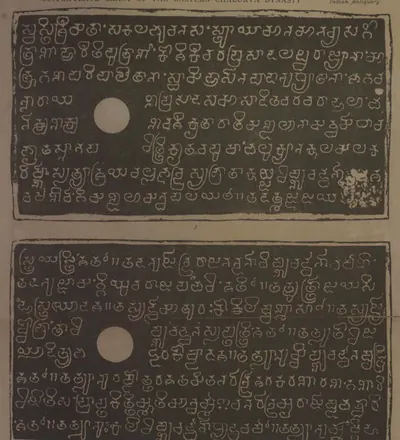 "Copper-plate grant of the Eastern Chalukya dynasty" (Diggubarru grant of Bhima II), plates i and ii a (Indian Antiquary XIII, plates at pp. 214-215 (PDF p. 247))Inscription rubbing · 1884
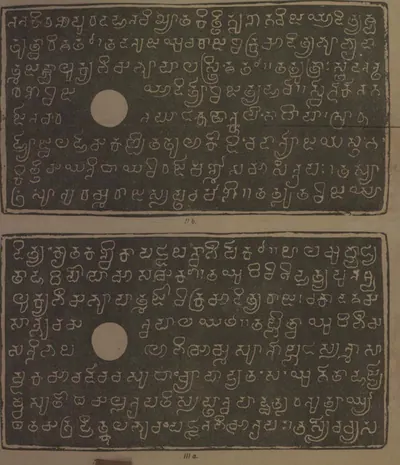 "Copper-plate grant of the Eastern Chalukya dynasty" (Diggubarru grant of Bhima II), plates ii b and iii a (Indian Antiquary XIII, plates at pp. 214-215 (PDF p. 248))Inscription rubbing · 1884
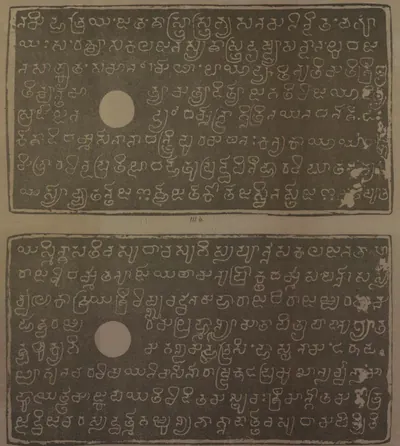 "Copper-plate grant of the Eastern Chalukya dynasty" (Diggubarru grant of Bhima II), plates iii b and iv a (Indian Antiquary XIII, plates at pp. 214-215 (PDF p. 249))Inscription rubbing · 1884
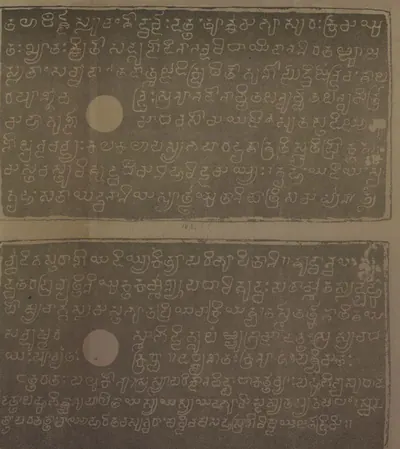 "Copper-plate grant of the Eastern Chalukya dynasty" (Diggubarru grant of Bhima II), plates iv b and v (Indian Antiquary XIII, plates at pp. 214-215 (PDF p. 250))Inscription rubbing · 1884
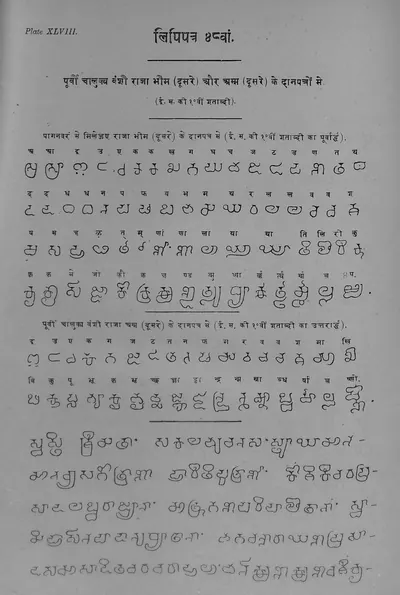 Alphabet table from the grants of the Eastern Chalukya kings Bhima II and Amma II, 10th century CE (Pagunavaram grant of Bhima II) (Ojha, Bharatiya Prachin Lipimala, 1918, Plate 48)Book plate · 1918
References
Notes (0)
Sources (6)
Spotted an error on this page? Tell us
Last updated: