Gundugolanu plates of Amma II
Three Sanskrit copper plates of the Eastern Chalukya king Amma II (crowned 945). They were formerly Sir Walter Elliot's and are now in the British Museum, and where they were found is not known. At the request of the king's parents-in-law, Kama and Nayamamba, they grant a field at the village of Gundugolanu in the Vengi district to a Brahmin. J. F. Fleet edited them in 1884. The grant is notable for leaving Yuddhamalla II out of the list of kings and for saying that Tala imprisoned the boy king Vijayaditya V.
These plates record a small gift by Amma II, the Eastern Chalukya king crowned in 945.1 He made it at the request of his wife’s parents.1 J. F. Fleet edited the plates in 1884.1 He described the inscription as “not specifically dated”, of the time of Amma II, “also called Vijayaditya and Raja-Mahendra”.1
Discovery and description
The plates belonged to Sir Walter Elliot, who presented them to the British Museum.1 Fleet had “no information as to where they were found”.1
There are three plates, each about 8 inches long and 3¾ inches broad, with high raised rims, and the inscription is excellently preserved.1 The ring, about half an inch thick and 4 inches across, had not been cut when Fleet received them.1
The round seal shows the sun, the moon and an elephant-goad at the top, and the legend Sri-Tribhuvanankusa across the centre.1 Below it are a standing boar facing right and a floral design at the bottom.1 The language is Sanskrit throughout.1
The grant
The king addresses the householders of the Vengi-nandu district, headed by the rashtrakutas (district officers).12 Fleet explained that nandu, modern nadu, is an Old-Kannada or Telugu word with the same meaning as the Sanskrit vishaya (district).12 The verse that introduces the request names the king’s father-in-law, king Kama, and his wife Nayamamba.2
At their request Amma II gave a field on the occasion of the winter solstice (uttarayana).34 The field was large enough to be sown with twelve khandikas of seed, measured by the royal measure.34 It lay on the east side of the village of Gundugolanu and was free of all taxes.34
The donee was Vamanasarman, of the Bharadvaja gotra (clan), an inhabitant of the village of Kalluru.12 He was the son of Sivanabhatta and grandson of Vamanabhatta.12 The boundaries of the field are named.34 The executor (ajnapti) was the Kataka-raja, Madhavabhatta composed the verses and Kondacharya wrote the charter.34
Fleet read the name of the village with a query, as Gundugolanu, possibly Guntugolanu, and did not identify it.34 No source used here identifies it or the donee’s village of Kalluru.
The list of kings
The family line follows the usual pattern, but its opening leaves out the words that Kubja-Vishnuvardhana “reigned over the Vengi country”.24 Its account of the years after 925 is told in its own words.52
In F. Kielhorn’s abstract, the line runs:52
- Amma I’s eldest son Vijayaditya (V) reigned for half a month52
- Tala, the son of Yuddhamalla I, then “put him in prison” and reigned for one month52
- Vikramaditya (II) reigned for a year52
- Kollabhiganda’s son Bhima, Chalukya-Bhima II, “surnamed Karayilladata”, reigned for twelve years52
- then came his son Amma II52
Kielhorn’s abstract, like Fleet’s text, passes from Vikramaditya straight to Bhima, without Yuddhamalla II.52 The Yelavarru plates of the same king give Yuddhamalla seven years between Vikramaditya and Bhima.6
E. Hultzsch noted in 1908 that one grant of Chalukya-Bhima II gives Yuddhamalla II a reign of seven years.7 Two others, like the Maliyapundi grant, “take no official notice of his reign”.7 See Yuddhamalla II and Chalukya-Bhima II.
The king’s parents-in-law
In his list of 1891 Fleet summarised the grant as made “at the request of the prince Kama and his wife Nayamamba”.4 He added that they “were the father- and mother-in-law of Amma II”.4 Fleet and Kielhorn both read the names as Kama and Nayamamba.15 The sources used here give no other information about them.
The king’s name and number
Fleet and Kielhorn called the donor Ammaraja II and numbered his second name Vijayaditya VI.58 E. Hultzsch’s pedigree of 1890 numbered it Vijayaditya V.58 Kielhorn’s abstract numbers Amma I’s son Vijayaditya V and Kollabhiganda Vijayaditya IV, as this site does.5
Footnotes
-
J. F. Fleet, “Sanskrit and Old-Canarese Inscriptions, No. CXLIX”, Indian Antiquary XIII (1884), p. 248 and note 1 (archive.org (opens in a new tab)). ↩ ↩2 ↩3 ↩4 ↩5 ↩6 ↩7 ↩8 ↩9 ↩10 ↩11 ↩12 ↩13 ↩14 ↩15 ↩16
-
Fleet, “Sanskrit and Old-Canarese Inscriptions, No. CXLIX” (1884), p. 249, text (archive.org (opens in a new tab)). ↩ ↩2 ↩3 ↩4 ↩5 ↩6 ↩7 ↩8 ↩9 ↩10 ↩11 ↩12 ↩13 ↩14
-
Fleet, “Sanskrit and Old-Canarese Inscriptions, No. CXLIX” (1884), p. 250, text (archive.org (opens in a new tab)). ↩ ↩2 ↩3 ↩4 ↩5 ↩6
-
J. F. Fleet, “The Chronology of the Eastern Chalukya Kings”, Indian Antiquary XX (1891), p. 271 (archive.org (opens in a new tab)). ↩ ↩2 ↩3 ↩4 ↩5 ↩6 ↩7 ↩8 ↩9
-
F. Kielhorn, “A List of the Inscriptions of Southern India”, Appendix to Epigraphia Indica VII (1902–03), p. 96, No. 566 (archive.org (opens in a new tab)). ↩ ↩2 ↩3 ↩4 ↩5 ↩6 ↩7 ↩8 ↩9 ↩10 ↩11 ↩12
-
J. F. Fleet, “Sanskrit and Old-Canarese Inscriptions, No. CXXVI”, Indian Antiquary XII (1883), p. 94, translation (archive.org (opens in a new tab)). ↩
-
E. Hultzsch, “Maliyapundi Grant of Ammaraja II”, Epigraphia Indica IX (1907–08), p. 49 (archive.org (opens in a new tab)). ↩ ↩2
-
E. Hultzsch, South-Indian Inscriptions, Vol. I (1890), p. 32, pedigree of the Eastern Chalukya dynasty (archive.org (opens in a new tab)). ↩ ↩2
Photos
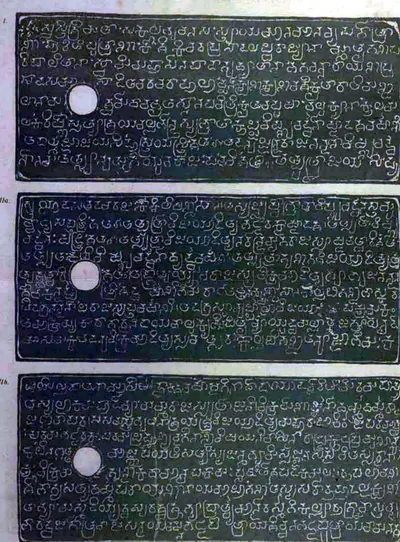 "Eastern Chalukya grant of Amma II.", plates i, ii a and ii b (Indian Antiquary XIII, plate at pp. 248-249 (PDF p. 285))Inscription rubbing · 1884
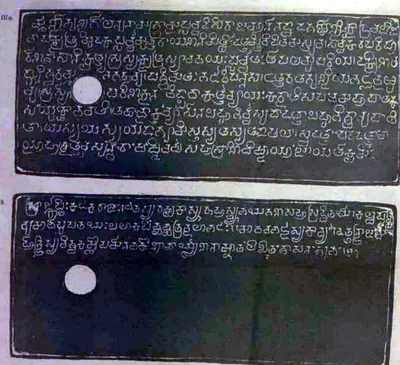 "Eastern Chalukya grant of Amma II.", plates iii a and iii b (Indian Antiquary XIII, plate at pp. 248-249 (PDF p. 286))Inscription rubbing · 1884
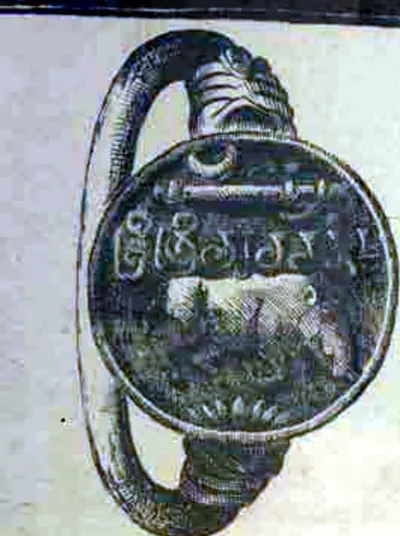 Seal of the "Eastern Chalukya grant of Amma II." (Gundugolanu grant) (Indian Antiquary XIII, plate at pp. 248-249 (PDF p. 286))Drawing · 1884
References
Notes (0)
Sources (6)
Spotted an error on this page? Tell us
Last updated: