Sangli plates of Govinda IV
A Sanskrit copper-plate grant of the Rashtrakuta king Govinda IV, issued at his capital Manyakheta and dated 8 August 933. It is named after the place near which the plates were kept in the 19th century. Its family history says that Amoghavarsha I defeated the Chalukyas at Vingavalli, one of the few battles of the war with Vengi that the Rashtrakuta records name. J. F. Fleet edited it in 1883 with photo-lithographs of the plates.
The Sangli plates are a grant of the Rashtrakuta king Govinda IV.12 Their long genealogy is one of the main sources for the later kings of the dynasty.12 It names Vingavalli as the place where Amoghavarsha I defeated the Chalukyas.12 J. F. Fleet took these Chalukyas to mean the Eastern Chalukyas of Vengi.12
The plates
J. F. Fleet edited the grant in the Indian Antiquary in 1883.3 At that time the plates belonged to a family at Sawantwadi.3 They had first been published by General Sir George LeGrand Jacob, when they belonged to a Brahmin family living near Sangli.3 Fleet concluded that they had been found in that part of the country.3
There are three plates, each about thirteen inches long and nine broad.3 They are inscribed so that “they turn over like the pages of an English book”.3 They have no raised rims, but the writing is perfectly preserved.3 The plain ring had been cut and soldered again, and no seal survives.3 Plates and ring weigh 13 pounds 3 ounces.3 The language is Sanskrit throughout.3
Contents
Fleet noted that this was the first inscription to place the Rashtrakuta family in the lineage of the Yadus.341 The family tree runs from Dantidurga through Krishna I, Govinda, Nirupama (Dhruva) and Jagattunga (Govinda III) to Amoghavarsha I.341 It goes on to Akalavarsha (Krishna II), his son Jagattunga, Jagattunga’s son Indra III and Indra’s son Govinda IV, the donor.341
The grant claims that Govinda IV showed “no forbidden cruelty” towards his elder brother.15 Fleet later read this as a sign that Govinda set aside the elder brother, Amoghavarsha II, who did not reign.15 It says that the rivers Ganga and Yamuna “do service to his palace”.3 Fleet took this as a figure of speech recalling Govinda III’s capture of the Ganga and Yamuna emblems from the Chalukyas, “whether Western or Eastern”.3
The grant was made while the king was “permanently settled at his capital of Manyakheta”.367 It gave a village in the Ramapuri seven-hundred to a Brahmin named Kesava-dikshita, whose father had come from the city of Pundravardhana.367 It is dated on the full-moon day of Sravana in the Saka year 855, the cyclic year Vijaya, a Thursday.367 Fleet later gave the equivalent as Thursday, 8 August 933.367
Vingavalli
In Fleet’s translation of 1883, the verse speaks of “the restraint of pleasure that had been caused by the incomparable Chalukyas and Abhyushakhas and others”.1 Amoghavarsha I is the king “by whom” this restraint “was angrily allayed at Vingavalli”.1
In 1896 Fleet summarised the same verse.2 He said that Amoghavarsha “conquered the Chalukyas,—i.e. the Vengi branch of the family,—at a place named Vingavalli”.2
The Cambay plates of 930, another grant of Govinda IV, contain the same verse.8 D. R. Bhandarkar translated it as Amoghavarsha gratifying Yama (the god of death) at Vingavalli “with unprecedented morsels of cakes (which were) the Chalukyas”.8 The place has not been identified.2
Govinda IV and Vengi
In his edition, Fleet set beside the Sangli grant an Eastern Chalukya grant, then owned by Sir Walter Elliot.9 It says that Chalukya-Bhima II, unaided, slew a list of enemies.9 Among them was “the terrible and fierce army that was despatched by Govindaraja”.9 Fleet identified this Govindaraja with Govinda IV.9 (See the Kaluchumbarru grant.)
Footnotes
-
Fleet, “Rashtrakuta grant of Govinda-Suvarnavarsha” (1883), p. 253, translation (archive.org (opens in a new tab)). ↩ ↩2 ↩3 ↩4 ↩5 ↩6 ↩7 ↩8 ↩9 ↩10 ↩11
-
J. F. Fleet, “Dynasties of the Kanarese Districts”, Gazetteer of the Bombay Presidency I, pt. II (1896), p. 402 (archive.org (opens in a new tab)). ↩ ↩2 ↩3 ↩4 ↩5 ↩6 ↩7
-
J. F. Fleet, “Sanskrit and Old-Canarese Inscriptions”: Rashtrakuta grant of Govinda-Suvarnavarsha, Saka 855, Indian Antiquary XII (1883), p. 248 (archive.org (opens in a new tab)). ↩ ↩2 ↩3 ↩4 ↩5 ↩6 ↩7 ↩8 ↩9 ↩10 ↩11 ↩12 ↩13 ↩14 ↩15 ↩16 ↩17 ↩18 ↩19
-
Fleet, “Rashtrakuta grant of Govinda-Suvarnavarsha” (1883), p. 252, translation (archive.org (opens in a new tab)). ↩ ↩2 ↩3
-
Fleet, “Dynasties of the Kanarese Districts” (1896), p. 416 (archive.org (opens in a new tab)). ↩ ↩2
-
Fleet, “Dynasties of the Kanarese Districts” (1896), p. 417 (archive.org (opens in a new tab)). ↩ ↩2 ↩3 ↩4
-
Fleet, “Dynasties of the Kanarese Districts” (1896), p. 418 (archive.org (opens in a new tab)). ↩ ↩2 ↩3 ↩4
-
D. R. Bhandarkar, “Cambay Plates of Govinda IV; Saka-Samvat 852”, Epigraphia Indica VII (1903), p. 43, translation of verse 12 (archive.org (opens in a new tab)). ↩ ↩2
-
Fleet, “Rashtrakuta grant of Govinda-Suvarnavarsha” (1883), p. 249 (archive.org (opens in a new tab)). ↩ ↩2 ↩3 ↩4
Photos
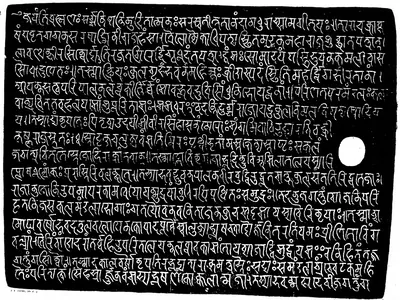 "Rashtrakuta grant of Govinda-Suvarnavarsha.—Saka 855." (the Sangli plates of Govinda IV, A.D. 933), side i (Indian Antiquary XII, plate 15 (sides I–IIa), facing p. 250, first page; PDF p. 282 of the archive.org scan in.ernet.dli.2015.176349)Inscription rubbing · 1883
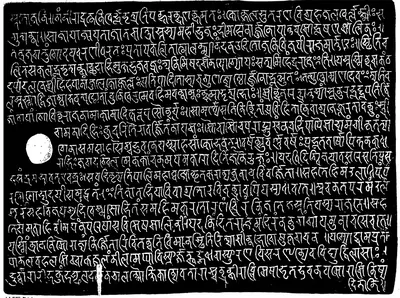 "Rashtrakuta grant of Govinda-Suvarnavarsha.—Saka 855." (the Sangli plates of Govinda IV, A.D. 933), side iia (Indian Antiquary XII, plate 15 (sides I–IIa), facing p. 250, second page; PDF p. 283 of the archive.org scan in.ernet.dli.2015.176349)Inscription rubbing · 1883
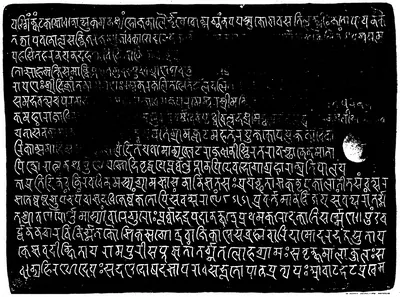 "Rashtrakuta grant of Govinda-Suvarnavarsha.—Saka 855." (the Sangli plates of Govinda IV, A.D. 933), side iib (Indian Antiquary XII, plate 16 (sides IIb and III), facing p. 251, first page; PDF p. 284 of the archive.org scan in.ernet.dli.2015.176349)Inscription rubbing · 1883
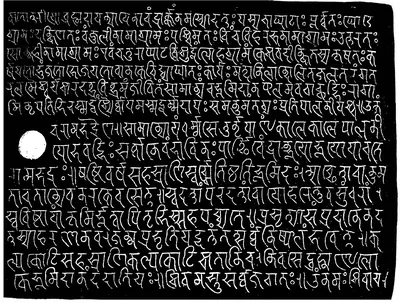 "Rashtrakuta grant of Govinda-Suvarnavarsha.—Saka 855." (the Sangli plates of Govinda IV, A.D. 933), side iii (Indian Antiquary XII, plate 16 (sides IIb and III), facing p. 251, second page; PDF p. 285 of the archive.org scan in.ernet.dli.2015.176349)Inscription rubbing · 1883
References
Notes (0)
Sources (3)
Spotted an error on this page? Tell us
Last updated: