Rajula-Mandagiri inscription of Asoka
A badly weathered 15-line copy of Asoka's Minor Rock Edicts I–II on a rock beside the Ramalingesvara temple at Rajula-Mandagiri near Pattikonda, Kurnool district. A Mackenzie surveyor copied part of it around 1800, and the stone was found again in 1953.
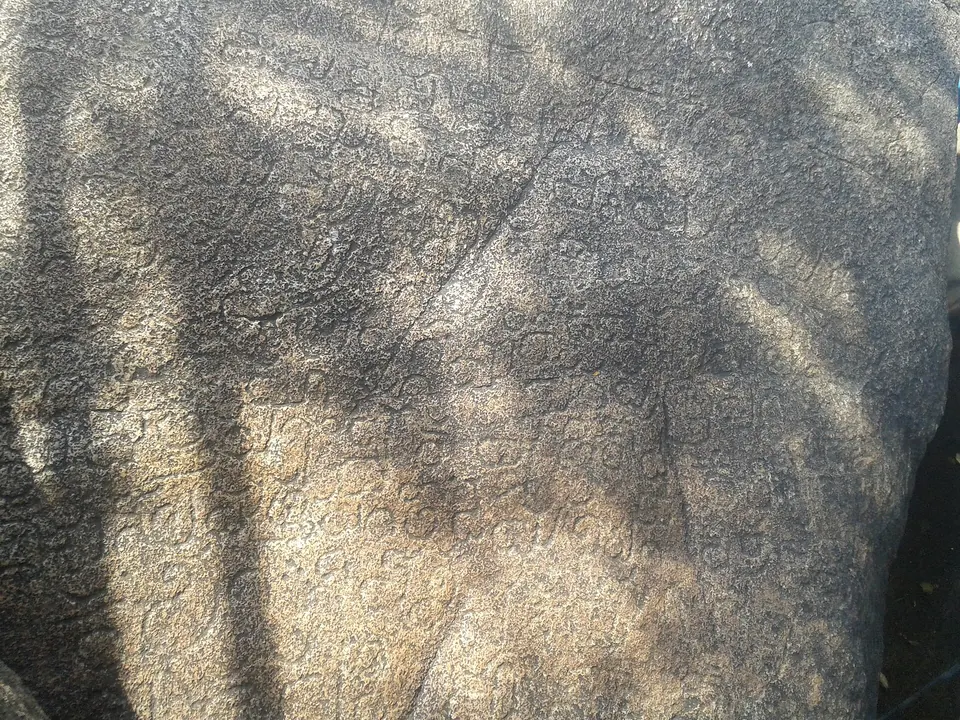
The Rajula-Mandagiri inscription is a second copy of Asoka’s Minor Rock Edicts I and II in Kurnool district. It was found about 20 miles from the fuller set of edicts at Erragudi, and its text closely follows the Erragudi copy.1
An inscription found twice
The record was first noticed by the survey of Colin Mackenzie (1754–1821), the first Surveyor-General of India. Mackenzie collected manuscripts and copies of inscriptions across South India. One volume of his “Local Records”, later kept in the Government Oriental Manuscripts Library at Madras, contains a hand-drawn copy (an “eye-copy”) of the start of an old inscription. The volume describes it as standing opposite the west gateway of the Pedda Ramalinga temple at a village called Rajula-Mandagiri, in a “Panchapalayam” district. D. C. Sircar thought the copy was made about the beginning of the 19th century.2
In 1946–47 the Madras lawyer and historian T. G. Aravamuthan sent this eye-copy to the Government Epigraphist and traced it to the Mackenzie volume. He noticed that some letters looked like those of Asoka’s edicts. The copyist had drawn only the letters he could see clearly and had left no gaps for damaged ones, so the copy could not be read. No village of that name appeared in the official list of villages, and Aravamuthan suggested Mandigiri in Adoni taluk, Bellary district. A later search of that village did not find the inscription.2
In December 1952 M. Venkataramayya of the epigraphy department heard of a place called Rajula-Mandagiri near Pattikonda. He returned the next year and found the inscription there on 26 December 1953. It was clearly the record Mackenzie’s copyist had seen.21
Setting and condition
The inscription is cut into the surface of a rock about ten yards from the entrance of the Ramalingesvara temple, which stands on the same rock. Four other early and medieval inscriptions were found nearby.1
It has 15 lines and begins with a three-armed symbol, a triskeles, which also appears on some uninscribed cast coins of ancient India. The same symbol stands at the start of the Erragudi copy, where it had earlier been misread as a letter.13 The writing is very poorly preserved. Every line has damaged letters, most of them beyond recognition.1
Script and language
The script is Brahmi, with rounded, carelessly engraved letters very like those at Erragudi. Unlike the Erragudi Minor Rock Edicts, every line reads from left to right and no groups of letters are out of place.1 The language is Prakrit. Sircar regarded the text as a close copy of the Erragudi version. Both copies use the unusual form hevaha for “thus says”, and both keep the sound r rather than changing it to l.14
Content
Because the two texts are so close, Sircar restored most of the lost letters from the Erragudi copy. In some places the Rajula-Mandagiri copy in turn helps fill gaps at Erragudi.13 In Minor Rock Edict I, Asoka says he has been a lay follower of the Buddha for over two and a half years, and for more than a year has worked hard for dhamma. Rich and poor alike can reach heaven by effort. The proclamation is issued after 256 days on tour.35
Minor Rock Edict II passes the king’s orders down a chain of officials: from the mahamatras to the Rajjuka, and then to the people and the Rashtrikas. Sircar thought the mahamatras were in charge of provinces or groups of districts, and that the Rajjukas and Rashtrikas governed districts and their subdivisions. The people are told to obey their parents and elders, be kind to living beings and speak the truth, and teachers are to pass these duties on to their pupils.56
Significance
With Erragudi, the inscription shows that Asoka’s Minor Rock Edicts were set up at more than one place in the Pattikonda area. It is also an example of how early surveys preserved evidence. Mackenzie’s copyist recorded the inscription about a century and a half before epigraphists found the stone again. Sircar published the inscription in Epigraphia Indica XXXI.2
Footnotes
-
D. C. Sircar, “Rajula-Mandagiri Inscription of Asoka”, Epigraphia Indica XXXI (1960), p. 212 (archive.org (opens in a new tab)). ↩ ↩2 ↩3 ↩4 ↩5 ↩6 ↩7 ↩8
-
D. C. Sircar, “Rajula-Mandagiri Inscription of Asoka”, Epigraphia Indica XXXI (1960), p. 211 (archive.org (opens in a new tab)). ↩ ↩2 ↩3 ↩4
-
D. C. Sircar, “Rajula-Mandagiri Inscription of Asoka”, Epigraphia Indica XXXI (1960), p. 213 (archive.org (opens in a new tab)). ↩ ↩2 ↩3
-
D. C. Sircar, “Erragudi Edicts of Asoka”, Epigraphia Indica XXXII (1959), p. 4 (archive.org (opens in a new tab)). ↩
-
D. C. Sircar, “Rajula-Mandagiri Inscription of Asoka”, Epigraphia Indica XXXI (1960), p. 214 (archive.org (opens in a new tab)). ↩ ↩2
-
D. C. Sircar, “Rajula-Mandagiri Inscription of Asoka”, Epigraphia Indica XXXI (1960), p. 215 (archive.org (opens in a new tab)). ↩
Photos
References
Notes (0)
Sources (2)
Spotted an error on this page? Tell us
Last updated: