Ganapesvaram inscription of Jaya
A Sanskrit and Telugu inscription of April 1231 on Divi island in the Krishna delta. It records the Shiva temple that Ganapatideva's general Jaya (Jayapa) built and named Ganapeshvara after his king.
What it is
This inscription records the founding of a Shiva temple on the island of Divi, at the mouth of the Krishna.1 The founder was Jaya, also called Jayana or Jayapa-nayaka, a general of the Kakatiya king Ganapatideva.1 Jaya named the temple Ganapeshvara (or Ganapatishvara) in honour of his king.1 The hamlet of Ganapesvaram takes its name from it.1 The record is also an important source for the Kakatiya family history and for Ganapatideva’s conquest of the coast.23
The pillar
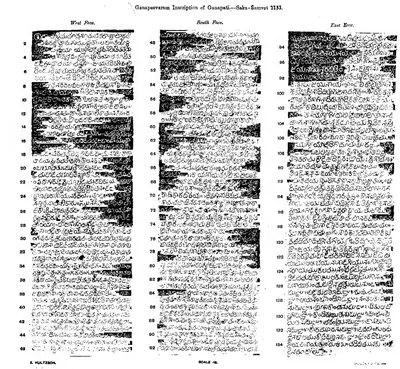
In 1894–95 the text stood on three faces of a stone pillar in front of the Durgamba temple at Ganapesvaram.2 Ganapesvaram is a hamlet near Talagada-Divi in the Bandar (Machilipatnam, then Masulipatam) taluk of Krishna (then Kistna) district.2 The same pillar carries four later inscriptions:2
- one below Ganapati’s record on the east face, dated Saka 1693 (Saka is an Indian way of counting years)2
- three on the north face, which the first engraver left blank, dated Saka 1235, 1268 and 16052
Before E. Hultzsch edited it, Gordon Mackenzie’s Kistna District Manual and Robert Sewell’s Lists of Antiquities had noticed the inscription.2 The script is Telugu, and lines 1 to 121 are Sanskrit verse and lines 121 to 135 are Telugu prose.2
Contents
The text opens with prayers to Vishnu, Shiva and Ganesha.2 Verses 4–14 then give a short Kakatiya family line that begins with Prola, who lived at Anmakonda (Hanamkonda).2
One verse sums up Prola’s wars:34
- some kings, like Manthena-Gunda, he killed with the sword34
- some, like Tailapadeva, he let go34
- some, like Govinda-dandesha, he drove from the field34
- some, like Chododaya, he put back on their thrones34
Prola’s son Rudra is said to have settled the people of towns he had destroyed in Orungallu (Warangal).3 He is also said to have built new settlements, with temples of Rudreshvara, on the sites of those towns.3 Rudra was followed by his brother Mahadeva, whose son by Bayyambika was Ganapati.3
Verses 15–43 trace Jaya’s own family, the Ayya chiefs of Divi.3 Jaya’s grandfather Narayana is said to have fortified the island and built tanks and temples there for a king named Chodi.3
According to the inscription, Ganapati defeated the kings of the Chola, Kalinga, Sevana (Yadava), Karnata and Lata countries.1 He conquered Velanadu together with Divi.1 He then married Jaya’s two sisters, Narama and Perama.1 He took Jaya into his service and made him a general.1
Jaya had earlier defeated an enemy known by the title Vairigodhumagharatta, roughly “grindstone of enemies as if they were wheat”.1 L. D. Barnett identified this enemy with the Godhumarati named in the Uparpalli inscription.5
The temple was consecrated on the tithi (lunar day) of Gauri in the bright half of Vaisakha, Saka 1153, the year Khara.1 A colleague of Hultzsch, Mr. Dikshit, worked out that this fell on 7 or 8 April 1231.1
The Telugu section records that every boat touching at a place called Hangegadda was to pay dues to the temple.1 Jayapa-nayaka also gave the revenue of several villages to it.1 He gave 25 cows whose milk would supply ghee for a lamp that was never to go out.1
Significance
P. V. Parabrahma Sastry used the record to reconstruct the Kakatiya conquest of Divi. On his account, the general Malyala Chaunda took the island early in Ganapatideva’s reign. Ganapati then left the Ayya family in place as subordinates.67 He took the young Jaya into his service.67
Parabrahma Sastry also cited the record for the resettlement around Orugallu.8 He noted that some quarters of Warangal still bear the names of towns Rudra captured.8 Jaya governed Velanadu for Ganapati from 1213.679 He wrote the Nrittaratnavali, a Sanskrit book on dance.679
Editions
The standard edition is Hultzsch’s, with text and summary, in Epigraphia Indica III (1894–95) as No. 15.2
Footnotes
-
E. Hultzsch, Ganapesvaram Inscription of the Time of Ganapati, Epigraphia Indica III (1894–95), p. 84 (archive.org (opens in a new tab)). ↩ ↩2 ↩3 ↩4 ↩5 ↩6 ↩7 ↩8 ↩9 ↩10 ↩11 ↩12 ↩13 ↩14
-
Hultzsch, Ganapesvaram Inscription (1894–95), p. 82 (archive.org (opens in a new tab)). ↩ ↩2 ↩3 ↩4 ↩5 ↩6 ↩7 ↩8 ↩9 ↩10 ↩11
-
Hultzsch, Ganapesvaram Inscription (1894–95), p. 83 (archive.org (opens in a new tab)). ↩ ↩2 ↩3 ↩4 ↩5 ↩6 ↩7 ↩8 ↩9 ↩10 ↩11
-
P. V. Parabrahma Sastry, The Kakatiyas of Warangal (1978), p. 76. ↩ ↩2 ↩3 ↩4 ↩5
-
L. D. Barnett (ed.), Inscriptions at Palampet and Uparpalli (1919), p. 14 (archive.org (opens in a new tab)). ↩
-
Parabrahma Sastry, The Kakatiyas of Warangal (1978), pp. 107–108. ↩ ↩2 ↩3 ↩4
-
Parabrahma Sastry, The Kakatiyas of Warangal (1978), pp. 116–117. ↩ ↩2 ↩3 ↩4
-
Parabrahma Sastry, The Kakatiyas of Warangal (1978), p. 101. ↩ ↩2
-
Parabrahma Sastry, The Kakatiyas of Warangal (1978), pp. 294–295. ↩ ↩2
Photos
References
Notes (0)
Sources (3)
Spotted an error on this page? Tell us
Last updated: