Upparapalli pillar inscription of Kataya
A Telugu verse and prose inscription of 24 January 1236 on a pillar at Upparapalli near Warangal. It records the temple gifts of Kataya, son of Recherla Rudra's Brahman minister Raje-nayaka, made with Ganapatideva's approval. It names Recherla Rudra's parents and Raje-nayaka's campaigns from Bhokkera to Daksharama.
What it is
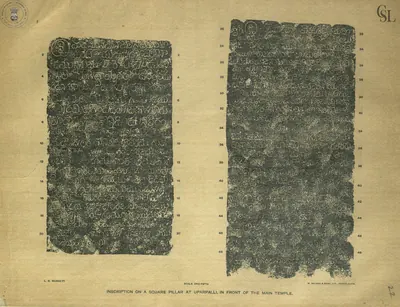
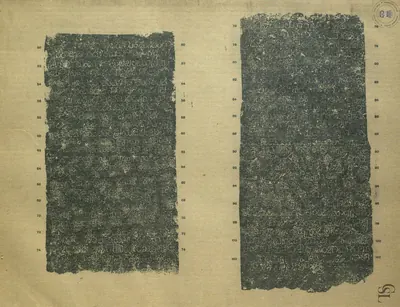
This inscription is on a square pillar in front of the main temple at Upparapalli (Uparpalli).1 It records gifts of land to the temple by a Brahman officer named Kataya.1 He made them with the approval of the Kakatiya king Ganapatideva.1 It was published in 1919 together with the Palampet pillar inscription, from ink impressions that G. Yazdani took in December 1916.2 The Nizam’s government noted that it “gives the origin of Recherla Rudra”, the general who founded the Ramappa temple.2
The pillar and its language
The text covers all four sides of the pillar, in a regular and well-formed Telugu script of the period.1 Unlike most Kakatiya records of its kind, the language is Telugu throughout, partly verse and partly prose.1 Barnett thought its verse passages “well deserve the attention of specialists in Telugu literature”.1 P. V. Parabrahma Sastry cites it as an example of ornate court poetry composed in Telugu prose and verse.3
Contents
The record opens with five verses asking Ganesha, Durga, Vishnu, Shiva and the Sun to bless Kataya.1 Its prose then describes Ganapatideva, son of King Rudra, ruling from Anumakonda, “that ornament of the Andhra country”.4 Ganapati’s high minister was Recherla Rudra, son of the Kad-reddi (Kata-reddi) and of Bejjamamba.14 Rudra, in the record’s words, bore “the burden of the Kakate realm”.14
Rudra’s own minister was the Brahman Raje-nayaka.14 Raje-nayaka’s deeds were these:14
- he defeated warriors at Bhokkera14
- he broke the head of one Godhumarati14
- he took Udayagiri and routed ten kings14
- he set up lamps that were never to go out for the god Bhimeshvara at Daksharama14
Raje-nayaka’s son by his wife Ravvamamba was Kataya.15 Kataya rose high in Ganapatideva’s favour.15 He planted groves, and built tanks and Shiva temples.15
The grant itself sets out the lands Kataya gave, tax-free, for the god’s worship, offerings, lamps and ranga-bhoga (temple entertainment).5 They lay at Pincharapalli.5 They did not include the estates already held there by the temples of the Five Lingas and by Brahmans.5 The gift included plots measured in martus under several canals and tanks, among them tanks named after Raje-nayaka and Ravvasani.56 It also included mango, tamarind and palmyra groves and the tax on shops.56
The record ends: “All this is the gift bestowed by the Maharaja Ganapatideva.”5 Among the landmarks it names is a hillock called Eruvaka-gubbali.7 Parabrahma Sastry took this to be the hill where villagers held the Eruvaka ploughing festival at the start of the sowing season.7
Date
The date is given as Saka 1157 (Saka is an Indian way of counting years), the cyclic year Manmatha, the fifteenth day of the bright half of Magha, a Thursday.8 Barnett, helped by Robert Sewell, calculated it as Thursday, 24 January 1236.8 The 1956 Corpus gives the same Christian date, but its English note prints the Saka year as 1187.9 Its own text of line 76 has 1157, so 1187 is a misprint.910
Recherla Rudra’s parents
The Upparapalli and Palampet records disagree about the family of Recherla Rudra.111 The Palampet inscription of 1213 makes him the son of the general Kataya II and his wife Kamamba.11 The Upparapalli record calls his father the Kad-reddi and his mother Bejjamamba.14 Barnett, who edited both, simply says that here “we learn his origin”.1 The 1956 Corpus follows him, without discussing the difference.19
Parabrahma Sastry cites two of Rudra’s titles, Kakati-rajya-samartha and Kakatiya-rajya-bharadhaureya.12 They appear in this record and in Raje-nayaka’s Daksharama inscription.12 He takes them as evidence that Rudra held the kingdom together when Ganapatideva came to the throne.12
Raje-nayaka’s campaigns
Barnett identified Godhumarati with the “Vairigodhuma-gharatta” of the Ganapesvaram inscription.1 He took Bhokkera to be perhaps Bokkara in the Aska taluk of Ganjam district.1 A battle might have been fought there during Ganapatideva’s wars with Kalinga.1 He read Udagiri as a mistake for Udayagiri, the fortress in Nellore district.1 The 1956 Corpus accepts both identifications and calls the record important for the Kakatiya expansion.13
Parabrahma Sastry identified this Udayagiri instead with the place of that name in the Pedakimidi agency, in Kalinga.14 He dated Raje-nayaka’s lamp at Daksharama to Saka 1134 (1212).1514 He placed the campaign in Ganapati’s attempt to take the Kalinga region, led by Indulur Soma-mantri and Raje-nayaka.1514 He judged that Ganapati’s Kalinga wars, mentioned at Ganapesvaram, Upparapalli and Motupalli, brought him no lasting gain.16
Ganapati as “son of Rudra”
Ganapatideva was the son of Rudradeva’s brother Mahadeva, yet this record calls him the son of King Rudra.174 Parabrahma Sastry suggested that Ganapati may have been Rudradeva’s son by adoption.18 The Yadava writer Hemadri calls the Kakatiya killed by the Yadavas Raudra, “son of Rudra”.18 Parabrahma Sastry thought Hemadri meant Mahadeva.18 In his view Hemadri confused Mahadeva with Ganapati, who had gone with Mahadeva on that campaign.18
Footnotes
-
Barnett, Inscriptions at Palampet and Uparpalli (1919), p. 14 (archive.org (opens in a new tab)). ↩ ↩2 ↩3 ↩4 ↩5 ↩6 ↩7 ↩8 ↩9 ↩10 ↩11 ↩12 ↩13 ↩14 ↩15 ↩16 ↩17 ↩18 ↩19 ↩20 ↩21 ↩22 ↩23 ↩24 ↩25 ↩26
-
L. D. Barnett (ed.), Inscriptions at Palampet and Uparpalli (1919), p. v (archive.org (opens in a new tab)). ↩ ↩2
-
Parabrahma Sastry, The Kakatiyas of Warangal (1978), p. 296. ↩
-
Barnett, Inscriptions at Palampet and Uparpalli (1919), p. 18, translation (archive.org (opens in a new tab)). ↩ ↩2 ↩3 ↩4 ↩5 ↩6 ↩7 ↩8 ↩9 ↩10 ↩11
-
Barnett, Inscriptions at Palampet and Uparpalli (1919), p. 19, translation (archive.org (opens in a new tab)). ↩ ↩2 ↩3 ↩4 ↩5 ↩6 ↩7 ↩8 ↩9
-
Barnett, Inscriptions at Palampet and Uparpalli (1919), pp. 16–17, text lines 72–103 (archive.org (opens in a new tab)). ↩ ↩2
-
Parabrahma Sastry, The Kakatiyas of Warangal (1978), p. 210. ↩ ↩2
-
Barnett, Inscriptions at Palampet and Uparpalli (1919), p. 15 (archive.org (opens in a new tab)). ↩ ↩2
-
P. Sreenivasachar (ed.), A Corpus of Inscriptions in the Telingana Districts of Andhra Pradesh, Part III (1956), pp. 166–167, No. Wg. 19 (archive.org (opens in a new tab)). Paraphrased. ↩ ↩2 ↩3
-
Sreenivasachar, Corpus, Part III (1956), p. 169, text line 76 (archive.org (opens in a new tab)). ↩
-
Barnett, Inscriptions at Palampet and Uparpalli (1919), p. 2 (archive.org (opens in a new tab)). ↩ ↩2
-
Parabrahma Sastry, The Kakatiyas of Warangal (1978), p. 144. ↩ ↩2 ↩3
-
Sreenivasachar, Corpus, Part III (1956), p. 167 (archive.org (opens in a new tab)). Paraphrased. ↩
-
Parabrahma Sastry, The Kakatiyas of Warangal (1978), p. 110. ↩ ↩2 ↩3
-
Parabrahma Sastry, The Kakatiyas of Warangal (1978), p. 109. ↩ ↩2
-
Parabrahma Sastry, The Kakatiyas of Warangal (1978), p. 112. ↩
-
P. V. Parabrahma Sastry, The Kakatiyas of Warangal (1978), p. 36. ↩
-
Parabrahma Sastry, The Kakatiyas of Warangal (1978), p. 100. ↩ ↩2 ↩3 ↩4
Photos
References
Notes (0)
Sources (3)
Spotted an error on this page? Tell us
Last updated: