Ganapesvaram
Hamlet near Talagada-Divi on Divi island in the Krishna delta. It is named after the Ganapeshvara temple that the Kakatiya general Jaya built there in 1231 in honour of his king Ganapatideva.
Place and name
Ganapesvaram is a hamlet near Talagada-Divi on the island of Divi, near the mouth of the Krishna.1 In the 1890s it lay in the Bandar (Machilipatnam, then Masulipatam) taluk of Krishna (then Kistna) district.2 It takes its name from a temple of Shiva called Ganapeshvara or Ganapatishvara.3 The Kakatiya general Jaya built the temple and named it after his king, Ganapatideva.3
Hultzsch explained the name Divi as the Telugu form of the Sanskrit dvipa, the word the inscription uses for the island.3
Kakatiya history
Before the Kakatiyas, a family of local chiefs, the Ayyas, held Divi.41 According to Jaya’s inscription, his grandfather Narayana fortified the island for a king called Chodi.4 Narayana also built tanks and temples there.4
P. V. Parabrahma Sastry writes that early in Ganapatideva’s reign a Kakatiya army under the general Malyala Chaunda captured the island fortress. Ganapati left the Ayya family in place as his subordinates and took the young Jaya (Jayapa) into his service.1 The inscription says that Ganapati married Jaya’s two sisters, Narama and Perama, and made Jaya a general.3
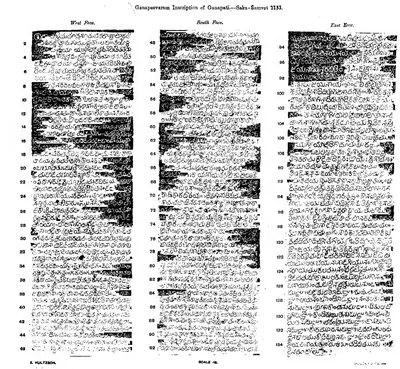
Jaya’s temple was consecrated in April 1231.3 Its Telugu inscription granted the temple dues from boats, village revenues and 25 cows for a lamp that would always burn.3 Parabrahma Sastry notes that Divi had been a port under the Velanati chiefs before Ganapatideva conquered it.5
Later inscriptions
In the 1890s the pillar that carries Jaya’s record stood in front of the village’s Durgamba temple.2 It also bears four later inscriptions, dated between Saka 1235 (Saka is an Indian way of counting years) and 1693.2 One of them refers to a linga (stone emblem of Shiva) named after Ganapati at the place where the river meets the sea.2 Another refers to the god Ganapeshvara “in the beautiful Peda-Divipura”.2
South-Indian Inscriptions IV prints the Telugu text of the later records on the same pillar.6 One of them is dated Saka 1268 (1346–47).678 In it one of the servants of the Musunuri chief Kapaya Nayaka made a gift to the god for Kapaya’s merit.678 The record calls Kapaya lord of the city of Arumanamganti.678
Footnotes
-
P. V. Parabrahma Sastry, The Kakatiyas of Warangal (1978), pp. 107–108. ↩ ↩2 ↩3
-
E. Hultzsch, Ganapesvaram Inscription of the Time of Ganapati, Epigraphia Indica III (1894–95), p. 82 (archive.org (opens in a new tab)). ↩ ↩2 ↩3 ↩4 ↩5
-
Hultzsch, Ganapesvaram Inscription (1894–95), p. 84 (archive.org (opens in a new tab)). ↩ ↩2 ↩3 ↩4 ↩5 ↩6
-
Hultzsch, Ganapesvaram Inscription (1894–95), p. 83 (archive.org (opens in a new tab)). ↩ ↩2 ↩3
-
Parabrahma Sastry, The Kakatiyas of Warangal (1978), p. 257. ↩
-
H. Krishna Sastri (ed.), South-Indian Inscriptions (Texts), Vol. IV (1923), pp. 311–312, Nos. 948–950 (archive.org (opens in a new tab)). Telugu text. ↩ ↩2 ↩3 ↩4
-
N. Venkataramanayya and M. Somasekhara Sarma, “Vilasa Grant of Prolaya-nayaka”, Epigraphia Indica XXXII (1957–58), p. 256 (archive.org (opens in a new tab)). Paraphrased. ↩ ↩2 ↩3
-
M. Somasekhara Sarma, “Kapaya Nayaka”, Journal of the Andhra Historical Research Society V (1931), p. 218 (archive.org (opens in a new tab)). Cite-only; paraphrased. ↩ ↩2 ↩3
Photos
References
Notes (0)
Sources (5)
Spotted an error on this page? Tell us
Last updated: