Warangal toll inscription of Ganapatideva
A damaged Telugu pillar inscription of July 1228 near the entrance to Warangal fort. It lists the dues that native and foreign merchants paid to the god Virabhadreshvara on dozens of goods, from areca nuts and salt to camphor, musk, silk and pearls. It is the fullest early record of trade and units of measure in the Kakatiya capital.
The pillar
The inscription is cut on a stone pillar not far from the entrance to the fort of Warangal.1 When P. Sreenivasachar recorded it, the pillar stood in a grove called the Khan Saheb Gardens.1 He edited it in 1940 as No. 14 of his Corpus of Inscriptions in the Telingana Districts. The beginning is lost, and the rest is in Telugu.12
The king’s titles
The surviving text begins with the end of a list of titles of the Kakatiya king Ganapati.2 He is mahamandaleshvara (great provincial lord) and worshipper of the god Svayambhunatha.2 Sreenivasachar noted that this opening is very like that of a Telugu inscription of the same year at Mattewada in Warangal (No. 10), except for one new title. Here Ganapati is called lord of the excellent city of Kakatiya.1
The Mattewada record gives him titles such as destroyer of the Lata, Choda and Kataka kings, and the seventh emperor.3 P. V. Parabrahma Sastry took the Mattewada inscription to credit Ganapati with plundering a Chola capital, probably Kanchi.4
The dues
The record is dated in the year Sarvadhari, on the fifth day of the bright half of Shravana, a Thursday. It lists the dues (ayamu) given for worship to the god Virabhadreshvara.5 Most of the dues were paid by traders of two kinds, native (svadesi) and foreign (paradesi).51 The surviving lines include, among many others, these rates:5
- areca nuts: a quarter of a thousand for every lakh of nuts5
- betel leaves: one pack for each large bag (peruka)5
- vegetables, coconuts, mangoes, tamarind and other fruit: a quarter for each cart-load5
- sesamum, wheat, green gram, paddy and other grain, oil and ghee: one mana for each cart-load5
- salt: one mana for every ten bags5
- tin, lead, copper and all other metals: one pala for each tula5
- sandalwood: one pala for each tula5
- camphor: two sinnas for each visa5
- musk: two sinnas for each hundred5
- silk yarn: one chinna for each tula5
- ivory and silks: a quarter for each kode5
- coral: one chinna for each visa5
- pearls, beads and precious stones: one visa for each mada5
- turmeric and ginger: two visas for each mada5
The whole merchant body (nakharamu) also gave a quarter measure of rice from every house for the clock.5 The merchants of the market (santa) gave a measure of pounded rice a day from every shop.5
Units of measure
Sreenivasachar used the record to sort out Kakatiya units. The cart-load (bhandi) was the basis for charging most goods, among them fruit, grain, oil and ghee. The bag (peruka) was used for salt and husked grain, and the tula, a weight, for sandal, metals and grain. The mada was used for musk-civet (javadi), madder and similar goods, the kode for ivory and silks, and the malaga for yarn and piece-goods.1
He noted that the record keeps the rates for foreign and native merchants apart.1 He judged it of great value for the economic history of the period.1
Date
Sreenivasachar dated the record probably to 7 July 1228, a Friday. On that day the fifth of the bright half began in the morning and ran on into the next day.6 So he took the Thursday of the record to be a mistake.6
Context
Parabrahma Sastry noted that one Warangal inscription treats the capital complex of Anumakonda, Matiyavada and Orugallu as a single sthala.7 A sthala was a revenue unit of about twenty villages.7 He described svadesi and paradesi merchants as the two broad classes of traders in the kingdom: those of the kingdom, and travelling ones.8 For the king, see Ganapatideva; for a coastal counterpart, the port dues of the Motupalli pillar inscription.
Editions
The text and translation are in Sreenivasachar’s Corpus, Part II (1940), pp. 57–61. The date is on p. 179 and the list entry on p. 187. The Mattewada inscription is No. 10, pp. 50–52.126
Footnotes
-
P. Sreenivasachar (ed.), A Corpus of Inscriptions in the Telingana Districts, Part II (1940), p. 187, list of inscriptions, No. 14 (archive.org (opens in a new tab)). Paraphrased. ↩ ↩2 ↩3 ↩4 ↩5 ↩6 ↩7 ↩8 ↩9
-
Sreenivasachar, Corpus, Part II (1940), p. 60, translation, lines 1–29 (archive.org (opens in a new tab)). Paraphrased. ↩ ↩2 ↩3 ↩4
-
Sreenivasachar, Corpus, Part II (1940), p. 186, list of inscriptions, No. 10 (archive.org (opens in a new tab)). Paraphrased. ↩
-
P. V. Parabrahma Sastry, The Kakatiyas of Warangal (1978), p. 109. ↩
-
Sreenivasachar, Corpus, Part II (1940), p. 61, translation, lines 29–122 (archive.org (opens in a new tab)). Paraphrased. ↩ ↩2 ↩3 ↩4 ↩5 ↩6 ↩7 ↩8 ↩9 ↩10 ↩11 ↩12 ↩13 ↩14 ↩15 ↩16 ↩17 ↩18 ↩19
-
Sreenivasachar, Corpus, Part II (1940), p. 179, appendix of dates, No. 10 (archive.org (opens in a new tab)). Paraphrased. ↩ ↩2 ↩3
-
Parabrahma Sastry, The Kakatiyas of Warangal (1978), p. 192. ↩ ↩2
-
Parabrahma Sastry, The Kakatiyas of Warangal (1978), p. 241. ↩
Photos
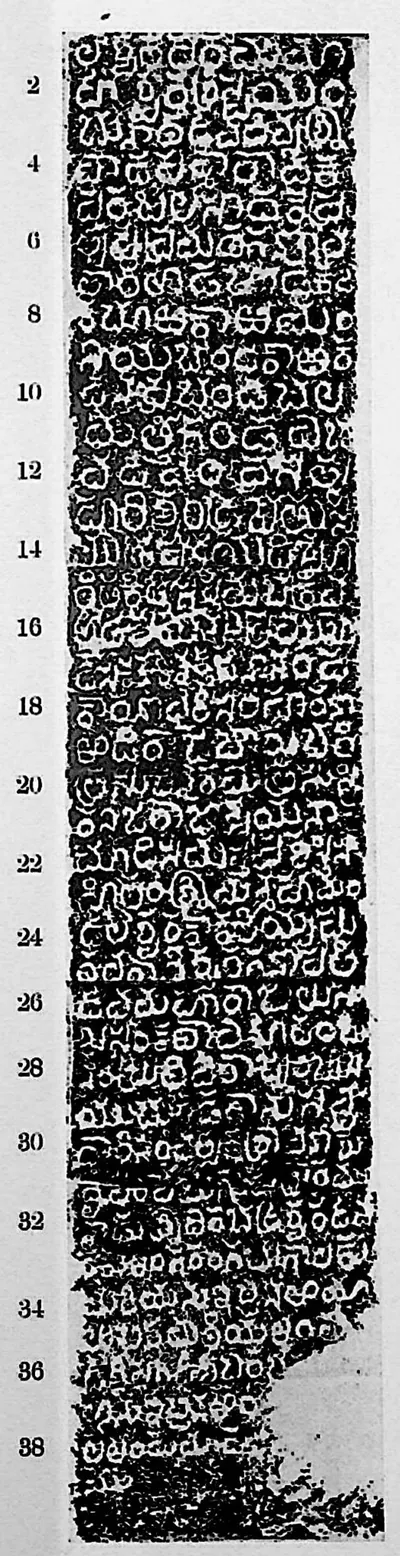 "Warangal inscription at Khan Saheb Gardens", face I (Sreenivasachar, Corpus of Inscriptions in the Telingana Districts II, Plate 19 (PDF p. 258))Inscription rubbing · 1940
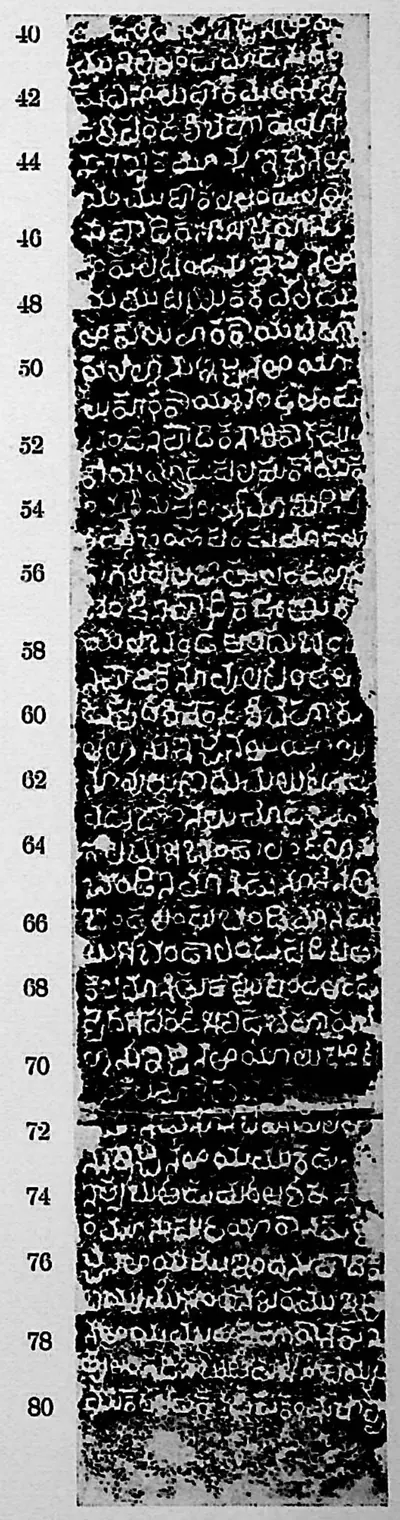 "Warangal inscription at Khan Saheb Gardens", face II (Sreenivasachar, Corpus of Inscriptions in the Telingana Districts II, Plate 19 (PDF p. 258))Inscription rubbing · 1940
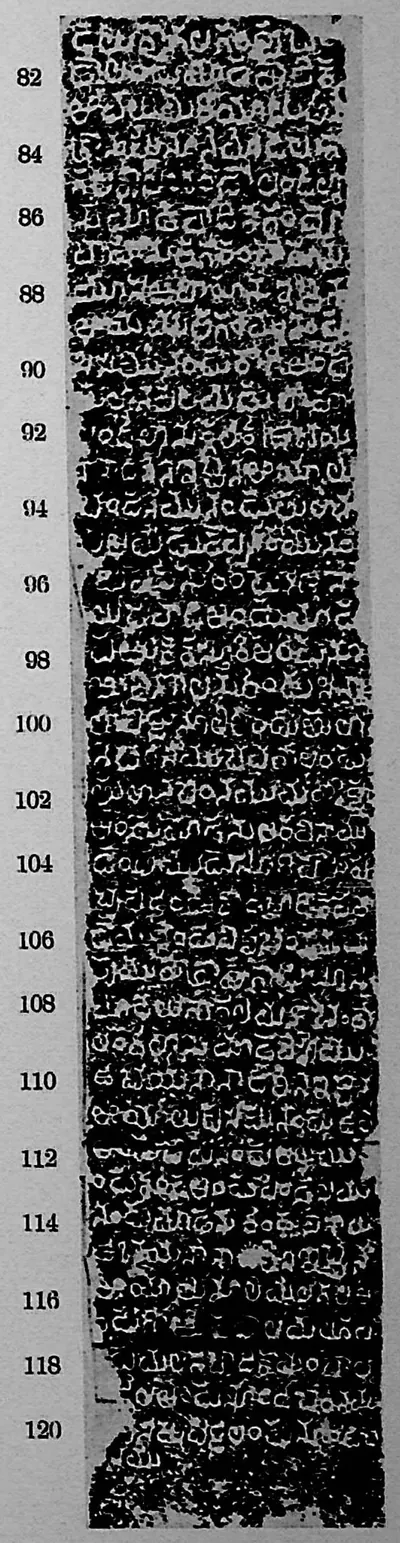 "Warangal inscription at Khan Saheb Gardens", face III (Sreenivasachar, Corpus of Inscriptions in the Telingana Districts II, Plate 19 (PDF p. 258))Inscription rubbing · 1940
References
Notes (0)
Sources (2)
Spotted an error on this page? Tell us
Last updated: