Gudur pillar inscriptions of the Viriyala family
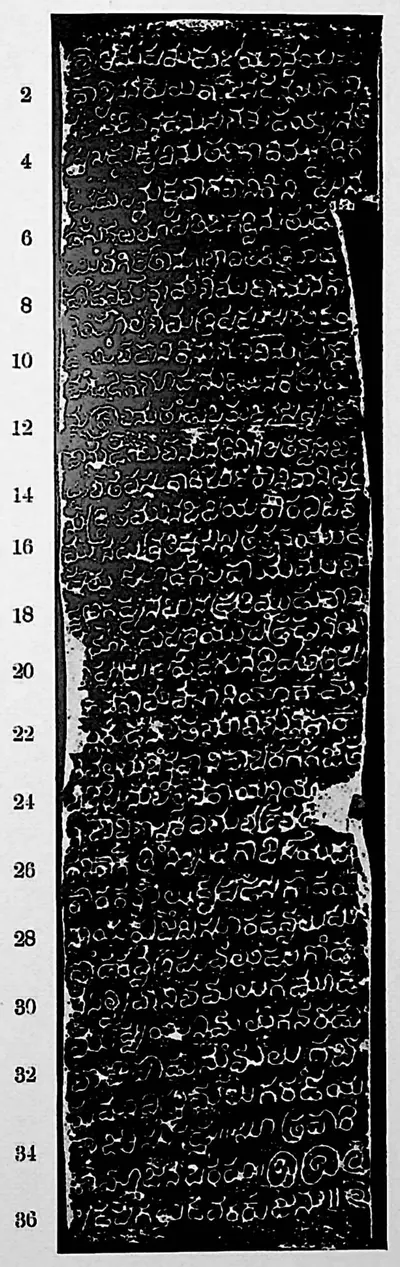
Undated Telugu verses on a pillar at Gudur near Jangaon, a pillar that also carries a Kannada record of 1124. They tell how the Viriyala chief Erra and the lady Kamasani restored the boy Beta, the Kakatiya chief, to his position. It is the only early account of the near-collapse of the Kakatiya family in the late tenth century.
The pillar
A stone pillar in a street of Gudur, near the house of the village headman (patel), carries several inscriptions.1 In 1940 the village lay in the Jangaon taluk of the Nalgonda district.1
P. Sreenivasachar edited two of them in his Corpus of Inscriptions in the Telingana Districts.12 One is a Telugu poem about the Viriyala chief Erra (No. 23).12 The other is a Kannada record of the chief Malla (No. 24).12 The Kannada record of Malla says that Malla built a Shiva temple called Malleshvara, a tank and a large well at Gumudur.3
A Kannada inscription at Gudur of the Western Chalukya prince Someshvara is dated in the 49th year of the Chalukya-Vikrama era.4 This corresponds to 24 December 1124.4 It records his gift of the village of Bammarige to the god Malleshvara of Gumudur.4 He made the gift at the request of his officer Savipayya, who governed the Kollipake (Kolanupaka) two-thousand district.4
P. V. Parabrahma Sastry treated the Telugu verses as the Telugu part of this record of 1124.5
The Telugu verses
Sreenivasachar thought the Telugu record unusual in both form and content.1 It gives no date and does not say what was given.1 It is mainly a eulogy (praise) of the deeds of Erra.1
It traces his family from the line of Durjaya through Boranti Venna, Era and Viriyala Bhima to Erra himself.61 Three verses describe his deeds.6
- He took up the cause of the boy Bottu Beta and killed his enemy.6 He set the boy up in the Koravi country and ruled there in the boy’s name.6
- He took charge of the young Kakati lord Beta.62 For the sake of the lady Kamama-sani, he met the Pallava-raya, the emperor, on Beta’s behalf and re-established the house of Kakati.62
- He killed Kadaya-nayaka, installed a king in Velupugonda and received villages from him.6
The sculptor who cut the letters signs as Kommojana Baraha.6
Who was Kamasani?
The verse about Kamasani can be read in more than one way. In Sreenivasachar’s 1940 translation, Erra himself took the boy under his care.62 He did so because Beta was the refuge of the maiden Kamama-sani.62
Parabrahma Sastry read the lady as Erra’s wife, Kamavasani.7 In his account she took up the cause of the young Garuda Beta, approached the emperor and restored the Kakatiya line.7 Perhaps, he thought, she did so because she was related to the family, while her husband had earlier harmed it.7
He noted that the late family chronicle Siddheshvara-charitra gives a similar role to a lady regent.7 He thought this chronicle unreliable in several respects.7
Two Betas
The record names two young chiefs called Beta. Parabrahma Sastry’s book of 1978 distinguished them.589 He took Bottu Beta, set up at Koravi, to be a chief of the Mudigonda Chalukyas.589 He took the Kakati Beta to be Garuda Beta, that is Beta I, who had to take on his responsibilities while still young.589
He also pointed out that the verses tell of events four generations before Malla, the donor of 1124.58 He placed Malla as Erra’s great-grandson.58
In his edition of the Bayyaram tank inscription, reprinted in Epigraphia Telanganica, he read the Telugu verses differently.10 There he read them as naming a Garumdani Beta, whom he identified with Garuda Beta of Bayyaram.10 He took the word Bottu, young Beta, as a description of the same chief.10
Epigraphia Telanganica also uses the Gudur verses to argue that Beta I came to power young.11 In its view, this helps to explain the long gap between his father Gunda IV, named in a grant of about 956, and Beta’s own record of 1051.11
Editions
The Telugu verses and Malla’s Kannada record were edited, with translations, as Nos. 23 and 24 of Sreenivasachar’s Corpus, Part II (1940), pp. 78–82.63 Prince Someshvara’s record of 1124 is summarised as No. 44 in Kannada Inscriptions of Andhra Pradesh (1961).4
Footnotes
-
P. Sreenivasachar (ed.), A Corpus of Inscriptions in the Telingana Districts, Part II (1940), p. 189, list of inscriptions, No. 23 (archive.org (opens in a new tab)). Paraphrased. ↩ ↩2 ↩3 ↩4 ↩5 ↩6 ↩7 ↩8 ↩9
-
Sreenivasachar, Corpus, Part II (1940), p. 190, list of inscriptions, Nos. 23–24 (archive.org (opens in a new tab)). Paraphrased. ↩ ↩2 ↩3 ↩4 ↩5 ↩6 ↩7
-
Sreenivasachar, Corpus, Part II (1940), p. 81, translation of No. 24, verses 2–7 (archive.org (opens in a new tab)). Paraphrased. ↩ ↩2
-
P. B. Desai, introduction to P. Sreenivasachar, Kannada Inscriptions of Andhra Pradesh (Andhra Pradesh Government Archaeological Series 3, 1961), p. 16, No. 44 (archive.org (opens in a new tab)). Paraphrased. ↩ ↩2 ↩3 ↩4 ↩5
-
P. V. Parabrahma Sastry, The Kakatiyas of Warangal (1978), p. 54. ↩ ↩2 ↩3 ↩4 ↩5 ↩6
-
Sreenivasachar, Corpus, Part II (1940), p. 79, translation of No. 23 (archive.org (opens in a new tab)). Paraphrased; the names are those of the inscription. ↩ ↩2 ↩3 ↩4 ↩5 ↩6 ↩7 ↩8 ↩9 ↩10 ↩11
-
Parabrahma Sastry, The Kakatiyas of Warangal (1978), p. 43. ↩ ↩2 ↩3 ↩4 ↩5
-
Parabrahma Sastry, The Kakatiyas of Warangal (1978), p. 55. ↩ ↩2 ↩3 ↩4 ↩5
-
Parabrahma Sastry, The Kakatiyas of Warangal (1978), p. 34. ↩ ↩2 ↩3
-
Gajjala Vasanta Lakshmi (ed.), Epigraphia Telanganica, vol. 2 (2023), p. 322, reprinting P. V. Parabrahma Sastry, “Bayyaram Tank Inscription of Kakati Mailama”. ↩ ↩2 ↩3
-
Epigraphia Telanganica, vol. 2 (2023), p. 25, reprinting P. V. Parabrahma Sastry, “Sanigaram Epigraphs of the Early Kakatiyas”, Epigraphia Andhrica IV (1975). ↩ ↩2
Photos
References
Notes (0)
Sources (4)
Spotted an error on this page? Tell us
Last updated: