Beta I
Early Kakatiya chief (c. 996–1051), also called Garuda Beta. As a boy he lost his father in war, and later he won back the family's position. His one known record, an inscription of 1051 at Sanigaram, is the oldest Kakatiya record after the Mangallu grant.
Family
Beta I was the son of Gunda IV, a Kakatiya general in the service of the Rashtrakuta kings, and the father of Prola I.1 The Bayyaram tank inscription of Ganapatideva’s reign calls him Garudanka Beta, and the Gudur inscription of 1124 calls him Garuda Beta. P. V. Parabrahma Sastry thought the name set him apart from Bottu Beta, a chief of the neighbouring Mudigonda Chalukya family.2 The numbering of the early Betas varies. Parabrahma Sastry’s 1978 book keeps the older numbering and calls Garuda Beta Beta I.34 His 1975 thesis also counted an earlier Betiya, named in the Mangallu grant, and so called Garuda Beta Beta II.34
Loss and recovery
The Rashtrakuta kingdom collapsed in 973. Parabrahma Sastry argues that Gunda IV then tried to hold his small territory in the Koravi region on his own. A chief named Viriyala Erra, supported by the new Chalukya king Tailapa II, killed Gunda in battle and restored Bottu Beta at Koravi. Parabrahma Sastry dates this to the last decade of the tenth century.5 According to Parabrahma Sastry, the young Beta lost everything his father had won, and the family nearly lost its standing. The Gudur inscription says that Erra’s wife, Kamavasani, took up the cause of the young Garuda Beta.6
Kamavasani appealed to the emperor and re-established the line of Kakati.6 Parabrahma Sastry compared this with the Siddheshvara-charitra, a late family chronicle, in which a lady named Kuntaladevi acts as regent for a young heir. He considered that chronicle unreliable in several respects.6
In his thesis Parabrahma Sastry noted what the Bayyaram inscription says of Garuda Beta. It credits him with killing Anuma and Konda and making Anumakonda (Hanamkonda) his capital. Parabrahma Sastry took Beta to be the first of the family to settle at Anumakonda as a Chalukya subordinate.7 His 1978 book credits Beta’s son Prola I with obtaining the Anumakonda district as a permanent fief (land held from a king).8
Wars and records
The Kazipet Darga inscription of 1098 opens by praising Beta, lord of the city of Kakati.9 It calls him one who churned the ocean of the Chola armies.9 Earlier writers linked this to the Chalukya king Someshvara I’s expedition against Kanchi in about 1052. Parabrahma Sastry pointed out that Beta could have fought the Cholas in any of their many earlier wars with the Chalukyas.10
The Palampet inscription of 1213 says that Brahma, the first general of the Recherla family, took Kanchi and won victory for his Kakatiya master.11 L. D. Barnett, who published it in 1919, thought this master was probably Prola I.11 In 1978 Parabrahma Sastry identified him as Beta I, and the occasion as Someshvara I’s invasion of Kanchi in 1052.12
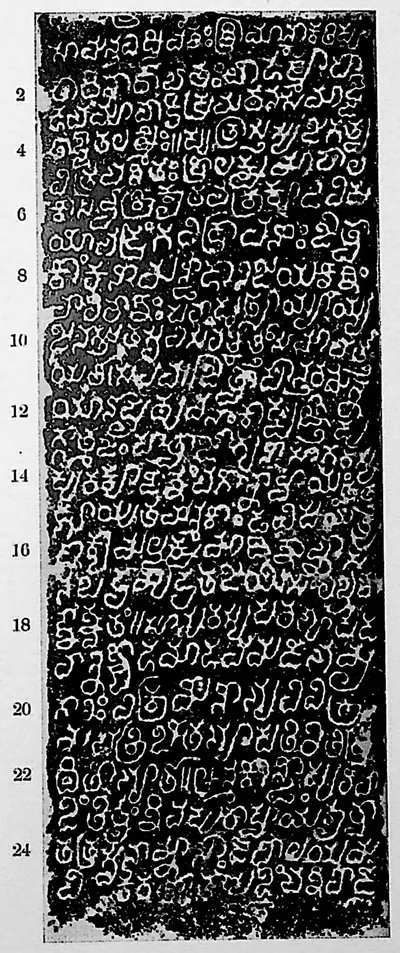
Beta’s only known record is a Kannada inscription at Sanigaram near Karimnagar. It is dated Saka 973 (December 1051; Saka is an Indian way of counting years). It names the Chalukya king Trailokyamalla (Someshvara I) as overlord, and Beta as his mahasamanta, a feudatory (subordinate ruler). In it Beta’s minister Naranayya, son of Vaijaraja, renovated the Yuddhamalla Jinalaya, a Jain temple at Sanigaram, and gave it a water-lift.13
Parabrahma Sastry held that a Yuddhamalla of the Chalukyas of Vemulavada, who once ruled this region, had built the temple.14 He saw the gift as one sign that the early Kakatiyas followed Jainism.15
Dates
Parabrahma Sastry’s genealogical table gives Beta I the years 996–1051.16 These years are an estimate. The Mangallu grant of about 956 names Beta’s father Gunda IV, and the Sanigaram record of 1051 names Beta. Parabrahma Sastry gave Gunda IV the years about 955–995, and Beta the rest of the period up to 1051–52.17
In his 1975 article he suggested that Beta was born about 970, came to power young, and lived to about eighty.18 An inscription of his son Prola I dated 1053 shows that Beta had died by then.17
Footnotes
-
P. V. Parabrahma Sastry, The Kakatiyas of Warangal (1978), pp. 31, 36, 40–41. ↩
-
Parabrahma Sastry, The Kakatiyas of Warangal (1978), p. 42. ↩
-
Parabrahma Sastry, The Kakatiyas of Warangal (1978), pp. 31–32. ↩ ↩2
-
P. V. Parabrahma Sastry, The Kakatiyas and Their Times (PhD thesis, Karnatak University, 1975), pp. 42–43. ↩ ↩2
-
Parabrahma Sastry, The Kakatiyas of Warangal (1978), pp. 41–42. ↩
-
Parabrahma Sastry, The Kakatiyas of Warangal (1978), pp. 42–43. ↩ ↩2 ↩3
-
Parabrahma Sastry, The Kakatiyas and Their Times (1975), pp. 97–98. ↩
-
Parabrahma Sastry, The Kakatiyas of Warangal (1978), p. 45. ↩
-
P. Sreenivasachar (ed.), A Corpus of Inscriptions in the Telingana Districts, Part II (1940), p. 29 (archive.org (opens in a new tab)). ↩ ↩2
-
Gajjala Vasanta Lakshmi (ed.), Epigraphia Telanganica, vol. 2 (2023), pp. 24, 26, reprinting P. V. Parabrahma Sastry, “Sanigaram Epigraphs of the Early Kakatiyas”, Epigraphia Andhrica IV (1975). ↩
-
L. D. Barnett (ed.), Inscriptions at Palampet and Uparpalli (1919), p. 1 (archive.org (opens in a new tab)). ↩ ↩2
-
Parabrahma Sastry, The Kakatiyas of Warangal (1978), p. 143. ↩
-
Epigraphia Telanganica, vol. 2 (2023), pp. 23–24. ↩
-
Parabrahma Sastry, The Kakatiyas of Warangal (1978), p. 46. ↩
-
Parabrahma Sastry, The Kakatiyas of Warangal (1978), pp. 272–273. ↩
-
Parabrahma Sastry, The Kakatiyas of Warangal (1978), p. 36. ↩
-
Parabrahma Sastry, The Kakatiyas of Warangal (1978), pp. 34–35. ↩ ↩2
-
Epigraphia Telanganica, vol. 2 (2023), p. 25. ↩
Photos
Related
Dynasties

References
Notes (0)
Sources (5)
Spotted an error on this page? Tell us
Last updated: