Panugallu inscription of Mailamba
A Sanskrit and Telugu inscription of Saka 1046 (1124) at Panugallu near Nalgonda. It records that Mailamba, wife of a Kandur Choda king, gave an agrahara (Brahmin village) named Choda-Bhima-Narayana-pura to 108 Brahmans, for the welfare of her son Bhima. It names her three sons, Udayaditya, Bhima and Gokarna.
What it is
The inscription was published as No. 36 in Part II of P. Sreenivasachar’s Corpus of Inscriptions in the Telingana Districts (1940), with a plate.1 It is cut on three sides of a stone at Panugallu. Its opening is damaged, and the name of the king whose wife made the grant is lost.12
Contents
The Sanskrit verses describe Mailamba, or Mailambika, the daughter of a king and his queen Bedaga.2 She was the wife of a king whose name is lost.2 The verses praise her as a mother of warriors.2 Her three sons were king Udayaditya, king Bhima and king Gokarna.2 The poem singles out Bhima for the strength of his arms.2
In Saka 1046 (Saka is an Indian way of counting years), the year Krodhi, on the day of a solar eclipse, Mailamba made her gift.2 She gave an agrahara (village granted to Brahmans) named Choda-Bhima-Narayana-pura to 108 Brahmans, with all its rights, for the welfare of her son Bhima.2
The Telugu passages that follow list dues on goods brought to the town, such as salt, grain, areca-nuts, pepper, ginger, turmeric, cotton, jaggery and saris.23 They also give house and shop taxes.23 They give land to the god, the priests and the sculptors, including plots behind the tanks called Bhima-samudram and Choda-samudram.23 The editor’s appendix of dates found the date probably to be 11 August 1124, since only one solar eclipse fell in that year.4
Interpretation
P. V. Parabrahma Sastry, who cited the record as Corpus II pp. 105 ff., made Mailamba the wife of the Kandur Choda Tondaya II. He took the Bhima of the grant to be Bhima Choda III, then king of Panugallu.56 He took Gokarna to be the Gokarna Choda later killed by his brother.56 He also argued that, since Mailamba issued it, the record need not belong to Tondaya’s own reign.5 See the Kandur Chodas.
Footnotes
-
P. Sreenivasachar (ed.), A Corpus of Inscriptions in the Telingana Districts of H.E.H. the Nizam’s Dominions, Part II (1940), pp. 105–108, No. 36 (archive.org (opens in a new tab)). Paraphrased. ↩ ↩2
-
Sreenivasachar, Corpus, Part II (1940), p. 108, translation (archive.org (opens in a new tab)). Paraphrased. ↩ ↩2 ↩3 ↩4 ↩5 ↩6 ↩7 ↩8 ↩9 ↩10 ↩11
-
Sreenivasachar, Corpus, Part II (1940), p. 109 (archive.org (opens in a new tab)). Paraphrased. ↩ ↩2 ↩3
-
Sreenivasachar, Corpus, Part II (1940), appendix on chronology, p. 181, No. 27 (archive.org (opens in a new tab)). Paraphrased. ↩
-
P. V. Parabrahma Sastry, The Kakatiyas of Warangal (1978), p. 65. ↩ ↩2 ↩3
-
Parabrahma Sastry, The Kakatiyas of Warangal (1978), p. 66. ↩ ↩2
Photos
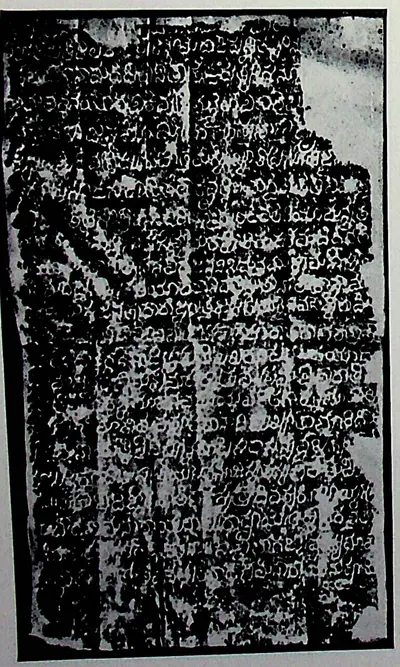 Panugal inscription of Mailamba, side I (A Corpus of Inscriptions in the Telingana Districts, Part II, Plate 35 (PDF p. 290))Inscription rubbing · 1940
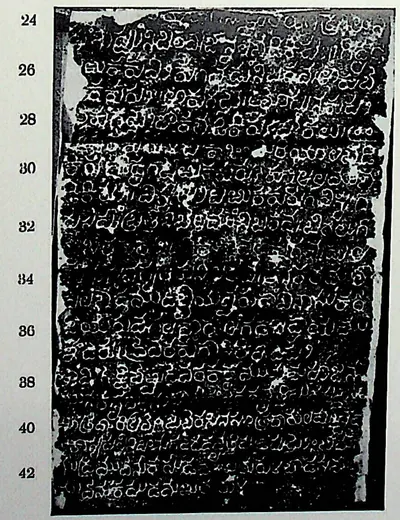 Panugal inscription of Mailamba, side II (A Corpus of Inscriptions in the Telingana Districts, Part II, Plate 35 (PDF p. 290))Inscription rubbing · 1940
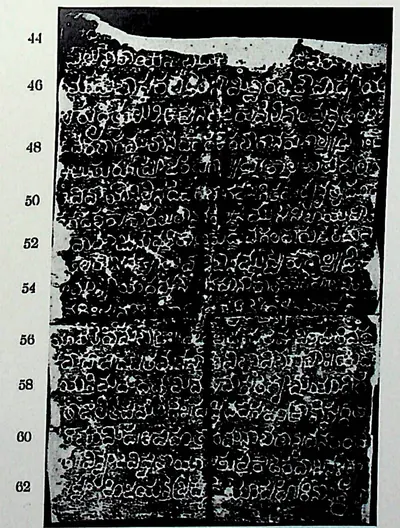 Panugal inscription of Mailamba, side III (A Corpus of Inscriptions in the Telingana Districts, Part II, Plate 35 (PDF p. 290))Inscription rubbing · 1940
References
Notes (0)
Sources (2)
Spotted an error on this page? Tell us
Last updated: