Gunupadu inscription of Nallasiddha
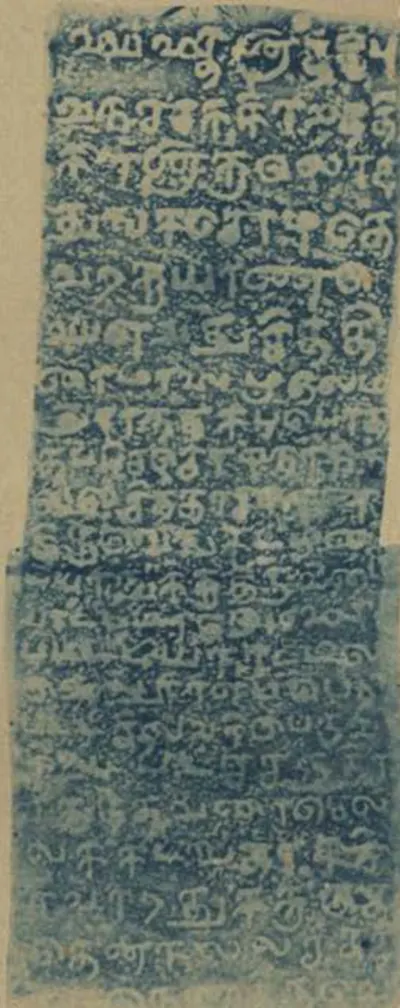
Tamil inscription on a pillar of the mandapa of the Puttanathasvami temple at Gunupadu, in the Gudur taluk of the Nellore district, dated in the 27th year of a Chola emperor Kulottunga, probably Kulottunga III. It records the gift of the village of Velur to the god at Tiruvengadam by the Telugu Choda chief Madhurantaka-Pottapi-Chola, alias Nallasiddha. A photograph of part of it was published in 1905.
This Tamil inscription at Gunupadu, in the Nellore country, records a gift by a Telugu Choda chief.1 He dated it in the 27th year of a Chola emperor named Kulottunga.1 So the chief still named the Chola king when he dated his grant.1
The record
The inscription is on a pillar of the mandapa (pillared hall) of the Puttanathasvami temple at Gunupadu, in the Gudur taluk of the Nellore district.1 A. Butterworth and V. Venugopaul Chetty published it in 1905 as Gudur No. 34.1 They printed a photograph of part of it facing page 406.2 V. Rangacharya listed it in 1919 in the same terms.3
Their translation begins “in the 27th year of the reign of the emperor of the three worlds, the glorious Kulottungacholadeva”.1 The donor is “Madurantakapottapichola alias Nallasidharasa”.1 He gave the village of Velur, free of tax, to “the God at Tiruvengadam”.1
The donor and the king
Madhurantaka-Pottapi-Chola was the title of the Telugu Choda chiefs of Pottappi.4 E. Hultzsch noted in 1899 an inscription about “the town of Pottappi, which Madhurantaka, an ancestor of Tammusiddhi, founded in the Andhra (Telugu) country”.4 See the Telugu Chodas of Pottapi and Nellore.
The record does not say which Kulottunga is meant.1 Robert Sewell found Nallasiddha in the Kadapa (then Cuddapah) district in 1192.5 He also found a Madhurantaka-Pottapi-Chola making a grant in the Nellore district in 1193, with the Chola king as overlord.6 Both fall in the reign of Kulottunga III.56 See Kulottunga III.
Footnotes
-
A. Butterworth and V. Venugopaul Chetty, A Collection of the Inscriptions on Copper-Plates and Stones in the Nellore District, Part I (1905), p. 406, Gudur No. 34 (archive.org (opens in a new tab)). ↩ ↩2 ↩3 ↩4 ↩5 ↩6 ↩7 ↩8 ↩9
-
Butterworth and Venugopaul Chetty, Nellore District, Part I (1905), plate “Part of Gudur No. 34”, facing p. 406 (archive.org (opens in a new tab)). ↩
-
V. Rangacharya, A Topographical List of the Inscriptions of the Madras Presidency, Vol. II (1919), p. 1071, Nellore No. 184 (archive.org (opens in a new tab)). ↩
-
E. Hultzsch, South-Indian Inscriptions, Vol. III, pt. I (1899), p. 33, note (archive.org (opens in a new tab)). ↩ ↩2
-
Robert Sewell and S. Krishnaswami Aiyangar, The Historical Inscriptions of Southern India (1932), p. 125 (archive.org (opens in a new tab)). Paraphrased. ↩ ↩2
-
Sewell and Aiyangar, Historical Inscriptions of Southern India (1932), p. 126 (archive.org (opens in a new tab)). Paraphrased. ↩ ↩2
Photos
References
Notes (0)
Sources (4)
Spotted an error on this page? Tell us
Last updated: