Arulala-Perumal inscription of Tammusiddhi, 1205–06
A Sanskrit inscription in Grantha letters on the base of the platform called 'the mountain' in the Arulala-Perumal (Varadaraja) temple at Kanchipuram. It records that in Saka 1127 (1205–06) the Telugu Choda king Tammusiddhi, having been anointed at Nellore, gave the village of Muttiyampakka to the god. It names his father's surname, Ganda-Gopala, and the place of his anointment.
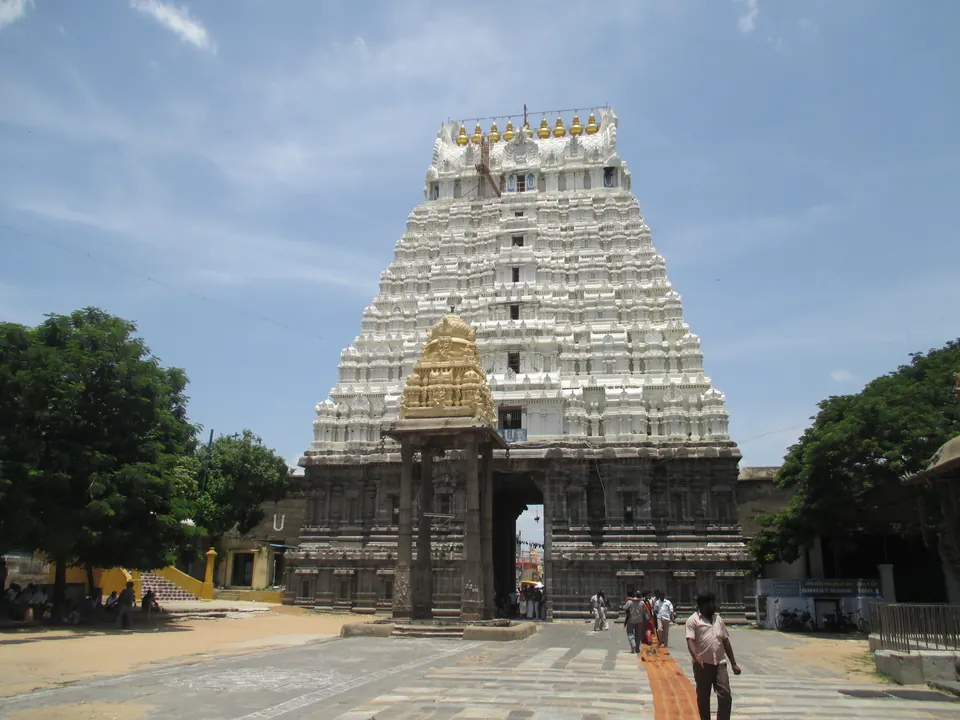
The inscription
The record is engraved at the base of the north wall of the stone platform called “the mountain” (malai).1 The platform is in the Arulala-Perumal temple at Kanchipuram (then Conjeeveram).1 The record is No. 35 of the Madras epigraphical collection for 1893.1
It is written in Grantha letters, from half an inch to an inch and three-quarters high.1 Its language is Sanskrit, all in verse except for a short passage.1 H. Lüders edited it in 1903 from inked estampages (ink copies) supplied by E. Hultzsch.1
Contents
Lüders summarised its value.1 It “enriches our knowledge by incidentally mentioning the surname of Tammusiddhi’s father, Êrasiddhi, and the time and place of Tammusiddhi’s inauguration”.1
In the Saka year 1127 (1205–06), king Tammusiddhi “presented the village of Muttiyampâkka, the head-quarters of Paṇṭarâshṭra, to the god, the lord of Hastiśaila”.1 This god is the god of the Arulala-Perumal temple.1 The record calls Tammusiddhi “the son of Gaṇḍagôpâla and Śrîdêvî, the younger brother of the great king Manmasiddhi”.1 He made the gift “having performed his anointment in the town of Nellûr”.1 Lüders could not identify Muttiyampakka or Pantarashtra.1
The genealogy
Apart from these facts, Lüders found little new.1 Four verses praise mythical ancestors: Brahman, Sagara, Bhagiratha and Kusa.1 The genealogy leaves out Tilungavidya and Nallasiddhi, and the name Betta is spelt Vetta throughout.1
Hultzsch, in the same volume, listed this record with one of Saka 1156 (Saka is an Indian way of counting years) in the same temple.2 That record belongs to Chola-Tikka, a later chief of the same family.2
Significance
The inscription is the evidence for Tammusiddhi’s anointment at Nellore. So it is also the evidence for Nellore as the seat of his family by 1205. Sewell’s chronicle cites it for Tammusiddhi’s coronation at Nellore.13 See Tammusiddhi, Nellore and the Telugu Chodas of Pottapi and Nellore.
Footnotes
-
H. Lüders, “Two Further Inscriptions of Tammusiddhi”, Epigraphia Indica VII (1903), p. 152 (archive.org (opens in a new tab)). ↩ ↩2 ↩3 ↩4 ↩5 ↩6 ↩7 ↩8 ↩9 ↩10 ↩11 ↩12 ↩13 ↩14 ↩15 ↩16 ↩17
-
E. Hultzsch, “Arulala-Perumal Inscription of Prataparudra; Saka-Samvat 1238”, Epigraphia Indica VII (1903), p. 129 (archive.org (opens in a new tab)). ↩ ↩2
-
Robert Sewell, The Historical Inscriptions of Southern India (1932), p. 129 (archive.org (opens in a new tab)). Paraphrased. ↩
Photos
References
Notes (0)
Sources (2)
Spotted an error on this page? Tell us
Last updated: