Telugu Chodas of Pottapi and Nellore
A family of Telugu chiefs who called themselves Madhurantaka Pottapi-Cholas and Ganda-Gopalas and claimed descent from the Chola king Karikala. They ruled the Pakanadu country of Nellore and southern Kadapa (Cuddapah) from Pottapi and then Nellore, from the early 12th century to about 1316. First vassals of the Cholas, they took Kanchi under Tikka I and his successors. They then passed under the Kakatiyas, who restored Manumasiddhi II, the patron of the poet Tikkana. A related branch ruled Konidena in the Guntur country.
Swipe sideways to see the whole chart; tap a bar for details.
Each bar is a ruling power in its region; time runs left to right. Dashed = approximate dates. Select a bar for details.
Show as a list
Eastern Chalukyas & the Deccan powers 624–1163 CE
- Telangana
- Chalukyas of Mudigonda (c. 890–1218 CE) · Western Chalukyas of Kalyani (c. 973–1163 CE) · Kakatiyas (c. 1052–1162 CE) · Telugu Chodas of Kanduru (c. 1060–1160 CE)
- Coastal Andhra
- Eastern Gangas of Kalinga (c. 537–1434 CE) · Cholas of Tanjore (c. 999–1135 CE) · Eastern Chalukyas of Vengi (c. 999–1077 CE) · Kotas of Dharanikota (c. 1100–1276 CE) · Haihayas of Kona and Palnadu (c. 1073–1364 CE) · Telugu Chodas of Pottapi and Nellore (c. 1106–1316 CE) · Velanati Chodas (c. 1118–1209 CE) · Western Chalukyas of Kalyani (c. 1118–1126 CE)
- Rayalaseema
- Cholas of Tanjore (c. 985–1268 CE) · Western Chalukyas of Kalyani (c. 1000–1190 CE) · Telugu Chodas of Pottapi and Nellore (c. 1120–1268 CE)
Kakatiyas 1163–1323 CE
- Telangana
- Chalukyas of Mudigonda (c. 890–1218 CE) · Kakatiyas (c. 1163–1323 CE)
- Coastal Andhra
- Eastern Gangas of Kalinga (c. 537–1434 CE) · Kakatiyas (c. 1185–1323 CE) · Kotas of Dharanikota (c. 1100–1276 CE) · Haihayas of Kona and Palnadu (c. 1073–1364 CE) · Telugu Chodas of Pottapi and Nellore (c. 1106–1316 CE) · Velanati Chodas (c. 1118–1209 CE) · Pandyas (c. 1260–1264 CE) · Cholas of Tanjore (c. 1135–1264 CE)
- Rayalaseema
- Cholas of Tanjore (c. 985–1268 CE) · Pandyas (1285–1293 CE) · Western Chalukyas of Kalyani (c. 1000–1190 CE) · Kakatiyas (c. 1250–1323 CE) · Telugu Chodas of Pottapi and Nellore (c. 1120–1268 CE) · Hoysalas (c. 1178–1342 CE)
Nayakas, Reddis & Bahmanis 1323–1518 CE
- Telangana
- Delhi Sultanate (Tughluqs) (c. 1323–1336 CE) · Bahmani Sultanate (c. 1347–1518 CE) · Musunuri Nayakas (c. 1336–1368 CE) · Recherla Velamas (Padmanayakas) (c. 1361–1475 CE)
- Coastal Andhra
- Eastern Gangas of Kalinga (c. 537–1434 CE) · Reddis of Kondaveedu (c. 1325–1424 CE) · Delhi Sultanate (Tughluqs) (c. 1323–1326 CE) · Vijayanagara Empire (c. 1350–1579 CE) · Haihayas of Kona and Palnadu (c. 1073–1364 CE) · Reddis of Rajahmundry (c. 1386–1448 CE) · Musunuri Nayakas (c. 1325–1346 CE)
- Rayalaseema
- Vijayanagara Empire (c. 1336–1646 CE) · Reddis of Kondaveedu (c. 1346–1386 CE) · Hoysalas (c. 1178–1342 CE)
Vijayanagara & the Qutb Shahis 1336–1687 CE
- Telangana
- Bahmani Sultanate (c. 1347–1518 CE) · Musunuri Nayakas (c. 1336–1368 CE) · Recherla Velamas (Padmanayakas) (c. 1361–1475 CE)
- Coastal Andhra
- Eastern Gangas of Kalinga (c. 537–1434 CE) · Reddis of Kondaveedu (c. 1325–1424 CE) · Vijayanagara Empire (c. 1350–1579 CE) · Haihayas of Kona and Palnadu (c. 1073–1364 CE) · Reddis of Rajahmundry (c. 1386–1448 CE) · Musunuri Nayakas (c. 1325–1346 CE)
- Rayalaseema
- Vijayanagara Empire (c. 1336–1646 CE) · Reddis of Kondaveedu (c. 1346–1386 CE) · Hoysalas (c. 1178–1342 CE)
Kingdoms and empires
Chalukyas of Mudigonda
Open page- Telangana: c. 890–1218 CE (c. 328 years)
Partial: Mudigonda (Khammam), the Manchikonda district and the Koravi (Kuravi) country, later the Visuru-nadu on the Godavari; feudatories of the Eastern Chalukyas, later of the Chalukyas of Kalyani. No record of the family is dated: start from Kusumayudha I's part in Chalukya-Bhima I's coronation (892), end from Parabrahma Sastry's identification of Kusumaditya and Nagati in a record of 1218. Driven out by the Kakatiyas (Recherla Rudra; Ganapatideva).
Rulers (13)
- Kokiraja (c. 865–890 CE)
- Kusumayudha I (c. 890–915 CE)
- Bijayita (c. 915–940 CE)
- Kusumayudha II (c. 940–965 CE)
- Vijayaditya (c. 965–990 CE)
- Kusumayudha III (c. 990–1015 CE)
… and 7 more
- Nijjiyaraja (c. 1015–1040 CE)
- Kusumayudha IV (Chalukya of Mudigonda) (c. 1040–1065 CE)
- Beta (c. 1065–1090 CE)
- Kusumayudha V (c. 1090–1110 CE)
- Bottu-Beta (c. 1110–1140 CE)
- Kusumaditya (Chalukya of Mudigonda) (c. 1140–1165 CE)
- Nagati (c. 1165–1196 CE)
Capitals
Inscriptions
Sources (4)
Sultanates
Delhi Sultanate (Tughluqs)
Open page- Telangana: c. 1323–1336 CE (c. 13 years)
Province of Tilang after Ulugh Khan (Muhammad bin Tughluq) took Warangal and renamed it Sultanpur (1321 by Barani's date for the campaign, 1323 in Haig and the editors of the Vilasa grant). Earlier Khalji campaigns (1303, 1309-10, 1318) ended in failure or tribute and are not drawn. Lost to a Hindu rising under Kanya Naik (Kapaya Nayaka) soon after the cholera of 1335 (Barani), about 1336-37 (modern historians) or in 1343-44 (Ferishta)
- Coastal Andhra: c. 1323–1326 CE (c. 3 years)
Brief hold on the Godavari delta and the coast: mosque at Rajahmundry built in 1324 by Ulugh Khan's servant Salar Ulwi; the coast retaken by Prolaya Nayaka and his allies between 1325 and 1326
Rulers
- Ala-ud-din Khalji (1296–1316 CE)
- Qutb-ud-din Mubarak Shah (1316–1320 CE)
- Ghiyas-ud-din Tughluq (1320–1325 CE)
- Muhammad bin Tughluq (1325–1351 CE)
Sources (7)
Sultanates
Bahmani Sultanate
Open page- Telangana: c. 1347–1518 CE (c. 171 years)
Western Telangana from 1347 (Kaulas taken or ceded; Bhongir taken late in Bahman Shah's reign, the province of Bidar reaching east to Bhongir); Golconda ceded under Muhammad Shah I (1362 Bilgrami; 1364-65 Haig, IG); Warangal taken in AH 828 (end of 1424 per Haig, 1422 per IG, 1425 per the Kistna Manual) and the rayas of Devarakonda and Rachakonda made tributary. Partial afterwards (Telugu chiefs regained districts under Ahmad I; Devarakonda relieved by Orissa 1459; Warangal held by the Gajapatis 1460 and by Shitab Khan from 1504). Governed for Mahmud Shah by Sultan Quli from 1495-96 until his independence (1512 per Haig; 1518 per Bilgrami, from the Golconda mosque inscription of AH 924)
- Coastal Andhra: c. 1471–1489 CE (c. 18 years)
Rajahmundry and Kondapalli (Ferishta) or Kondavidu (Haig, Burhan-i Ma'asir) taken by Malik Hasan Bahri in AH 876 (1471-72), on the invitation of a claimant to the Orissan throne (the Godavari gazetteer says Purushottama ceded the two districts); Muhammad Shah III at Rajahmundry for nearly three years after his Orissa campaign of 1478, and raided Masulipatam and Kanchi in 1481; Telingana split into the provinces of Rajahmundry and Warangal; Rajahmundry still Bahmani in 1486; the Godavari-Krishna country recovered by the Gajapati Purushottama by 1489
Rulers (18)
- Ala-ud-din Hasan Bahman Shah (1347–1358 CE)
- Muhammad Shah I (1358–1375 CE)
- Mujahid Shah (1375–1378 CE)
- Daud Shah (1378 CE)
- Muhammad Shah II (1378–1397 CE)
- Ghiyas-ud-din (1397 CE)
… and 12 more
- Shams-ud-din Daud (1397 CE)
- Firuz Shah (1397–1422 CE)
- Ahmad Shah I (1422–1435 CE)
- Ala-ud-din Ahmad Shah II (1435–1458 CE)
- Humayun Shah (1458–1461 CE)
- Nizam Shah (1461–1463 CE)
- Muhammad Shah III (1463–1482 CE)
- Mahmud Shah Bahmani (1482–1518 CE)
- Ahmad Shah (c. 1518–1521 CE)
- Ala-ud-din (c. 1521–1523 CE)
- Wali-ullah Shah (c. 1523–1525 CE)
- Kalim-ullah Shah (c. 1525–1527 CE)
Inscriptions
Sources (12)
Kingdoms and empires
Western Chalukyas of Kalyani
Open page- Telangana: c. 973–1163 CE (c. 190 years)
Restored 973 (Korapolu, Medak district, inscription of Ahavamalla Taila II, April 973; earliest near Anumakonda Jammikunta 995). Held through feudatories (Kakatiyas, Polavasa chiefs, Kandur Chodas, Mudigonda chiefs) and the Kollipake (Kolanupaka) province under royal governors and princes; Taila III's death is recorded at Anumakonda in January 1163, when the Kakatiyas became sovereign
- Rayalaseema: c. 1000–1190 CE (c. 190 years)
11th-12th centuries in Anantapur (Vikramaditya VI's inscriptions at Gooty; records of 1113 and 1121), Kurnool (1122) and Tripurantakam (1122, 1126); a Chola chief governed Renadu (Cuddapah) under Vikramaditya VI in 1124; overthrown c. 1189 by the Hoysalas and Yadavas
- Coastal Andhra: c. 1118–1126 CE (c. 8 years)
Vengi: after the Chola viceroy Vikrama Chola left in 1118, Vikramaditya VI ruled "the Vengi 14000 country" (Sewell) through his general Anantapala; records at Draksharama 1120-1124; the Godavari gazetteer has him "undisputed king of Vengi" 1120-1124. Vikrama Chola was again supreme south of the Krishna by 1127. Earlier, only single records (Satyasraya at Chebrolu, 1006)
Rulers (11)
- Taila II (973–997 CE)
- Satyasraya (c. 997–1008 CE)
- Vikramaditya V (c. 1008–1015 CE)
- Jayasimha II (Western Chalukya) (c. 1015–1042 CE)
- Somesvara I (c. 1042–1068 CE)
- Somesvara II (1068–1076 CE)
… and 5 more
- Vikramaditya VI (1076–1126 CE)
- Somesvara III (1126–1138 CE)
- Jagadekamalla II (1138–1150 CE)
- Taila III (c. 1150–1162 CE)
- Somesvara IV (c. 1183–1189 CE)
Capitals
Inscriptions (9)
Sources (9)
Kingdoms and empires
Musunuri Nayakas
Open page- Coastal Andhra: c. 1325–1346 CE (c. 21 years)
Prolaya Nayaka recovered the coast from Delhi in 1325-26 and ruled from Rekapalli on the Godavari (Vilasa grant, about 1330); latest dated Musunuri records on the coast are Kapaya's Guraja grant (February 1346) and his Ganapesvaram inscription (1346-47). Partial: the Reddis of Addanki and the Korukonda chiefs held parts of the coast as Kapaya's kinsmen and subordinates
- Telangana: c. 1336–1368 CE (c. 32 years)
Kapaya Nayaka took Warangal about 1336-37 (Ferishta: 1343-44) and ruled as "lord of the Andhra country" (Pillalamarri inscription, 1357); ceded Kaulas and then Golconda (1364-65) to the Bahmanis; overthrown by the Recherla chief Anapota about 1368 (Kapaya named in the Akkalapundi grant of 1368; Anapota ruling Orugallu in July 1369)
Rulers
Capitals
Inscriptions
Sources (9)
Kingdoms and empires
Kakatiyas
Open page- Telangana: c. 1052–1162 CE (c. 110 years)
Partial: feudatory chiefs of Anumakonda (Hanamkonda) under the Chalukyas of Kalyani. Prola I received the Anumakonda district as a permanent fief from Someshvara I (record of 1053); Prola II's last record as a subordinate is of 1149; Rudradeva subdued the other Telangana chiefs c. 1157–62 (Parabrahma Sastry). Earlier members served the Rashtrakutas (Mangallu grant, c. 956) according to Parabrahma Sastry, a link rejected by Venkataramanayya and Somasekhara Sarma (1960).
- Telangana: c. 1163–1323 CE (c. 160 years)
Sovereign from Rudradeva's Anumakonda inscription of January 1163; capital moved to Orugallu (Warangal) under Ganapatideva. Warangal taken by Ulugh Khan in 1323 (Parabrahma Sastry, after Isami); Barani and the Imperial Gazetteer give 1321.
- Coastal Andhra: c. 1185–1323 CE (c. 138 years)
Rudradeva subdued the Kotas of Dharanikota and the Kondapadumatis (Tripurantakam grant 1185); Ganapatideva annexed Divi (1203) and Velanadu (records from 1209; Jaya governor 1213) and held the coast from the Godavari to the Penna; Kakatiya records at Draksharama from 1212, but the Eastern Gangas held the region north of the Godavari c. 1230–33 and again c. 1262–78; the Telugu Chodas of Nellore were allies; Nellore was lost to the Pandyas c. 1263 and recovered under Prataparudra.
- Rayalaseema: c. 1250–1323 CE (c. 73 years)
Through the Kayastha chiefs (Gangaya Sahini, bahattara-niyogadhipati c. 1250, capital Valluru in Cuddapah); Ambadeva independent c. 1272–1291, until Prataparudra's armies retook Tripurantakam (between 13 June and 11 August 1291) and the Kayastha lands within about eight years.
Rulers (11)
Capitals
Monuments (16)
Inscriptions (36)
- Kazipet Dargah pillar inscription
- Matedu inscription of Vemabola Malle-nayaka
- Gudur pillar inscriptions of the Viriyala family
- Thousand Pillar Temple inscription of Rudradeva
- Karimnagar inscription of Gangadhara
- Warangal fort inscription of Rudradeva
… and 30 more
- Pillalamarri inscription of Recherla Nami-reddi
- Kondaparti inscription of Malyala Chaunda
- Inugurti pillar inscription of Natavadi Rudra
- Bayyaram tank inscription of Mailama
- Chebrolu inscription of Jaya
- Palampet pillar inscription of Recherla Rudra
- Ganapavaram inscription of Devapala
- Warangal toll inscription of Ganapatideva
- Ganapesvaram inscription of Jaya
- Upparapalli pillar inscription of Kataya
- Motupalli pillar inscription of Ganapatideva
- Pakhal lake inscription of Jagadala Mummadi
- Rayaparti fragment of Saka 1169
- Ekamranatha temple inscription of Ganapati
- Nayanapalle inscription of Ganapatideva
- Durgi inscription of Gangaya-sahini
- Sarngapuram plates of Sarngadhara
- Bothpur tank inscription of Malyala Gunda
- Garavapadu plates of Ganapatideva
- Malkapuram pillar inscription of Rudramadevi
- Kotagiri plates of Viryala Sura
- Kolanupaka inscription of Rudramadevi's reign
- Chandupatla inscription
- Panugallu inscription of Immadi Mallikarjuna-nayaka
- Tripurantakam inscription of Ambadeva
- Raichur fort inscription of Gona Vithala
- Mellacheruvu inscription of Prataparudra's reign
- Srirangam inscription of Prataparudra
- Dharmasagar inscription of the minister Malla
- Hanamkonda inscription of Gangadhara
Sources (7)
Kingdoms and empires
Recherla Velamas (Padmanayakas)
Open page- Telangana: c. 1361–1475 CE (c. 114 years)
Anapota at Rachakonda (Rajukonda) and Mada at Devarakonda after their victories of 1361 (family chronicle); Rachakonda fortified in August 1365; Warangal, Bhongir and Rachakonda ruled by July 1369 (Inavolu inscription). The rayas of Devarakonda and Rachakonda paid tribute to Ahmad Shah Bahmani after his capture of Warangal (end of 1424); Devarakonda routed a Bahmani army with Orissan help in 1459; last dated record of the Rachakonda line 1464. End about 1475 per the list of rulers in Epigraphia Telanganica; no source dates the annexation
Rulers (7)
- Singama Nayaka (Recherla) (c. 1336–1361 CE)
- Anapota Nayaka (Recherla) (c. 1361–1384 CE)
- Mada Nayaka (Recherla) (c. 1361–1384 CE)
- Singabhupala (Recherla) (c. 1384–1399 CE)
- Peda Vedagiri (Recherla) (c. 1384–1410 CE)
- Lingama Nayaka (Recherla) (c. 1427–1475 CE)
… and 1 more
- Singama Nayaka, 'Sarvajna' (Rachakonda) (c. 1430–1475 CE)
Capitals
Monuments
Inscriptions
Sources (7)
Kingdoms and empires
Telugu Chodas of Kanduru
Open page- Telangana: c. 1060–1160 CE (c. 100 years)
Partial (Kandurunadu: the Jadcharla and Achampet areas of Mahbubnagar and the Nalgonda and Miryalaguda areas of Nalgonda), ruled from Kodur and Panugallu as feudatories of the Chalukyas of Kalyani; Tondarasa of Kandur governed the Kollipake province in 1088. Prola II restored Udaya Choda at Panugallu about 1131; Rudradeva drove out Bhima and annexed the country in the 1150s (last record of Bhima 1157). The family then held fiefs under the Kakatiyas, with a last record in 1282.
Rulers
- Tondaya II (Tondarasa) of Kandur (1088–1091 CE)
- Bhima Choda III of Kandur (c. 1105–1157 CE)
- Gokarna Choda I (c. 1124–1128 CE)
- Udaya Choda II of Kandur (1136–1176 CE)
- Bhima IV and Gokarna II (1178 CE)
Capitals
Inscriptions
Sources (5)
Kingdoms and empires
Eastern Gangas of Kalinga
Open page- Coastal Andhra: c. 537–1434 CE (c. 897 years)
Partial: only the far north coast (the old Ganjam and Vizagapatam districts, now Srikakulam-Vizianagaram- Visakhapatnam), capital Kalinganagara (Mukhalingam). Earliest dated grant: Jirjingi, near Tekkali, Ganga year 39 (c. 537 on Mirashi's epoch of 498; Fleet put the early grants in the 7th century and Sewell used an epoch of 877-78; the Imperial Gazetteer, the 7th century). Later line in power from the end of the 9th century (Vizagapatam gazetteer): Vajrahasta III crowned 1038; Anantavarman Chodaganga 1078-1146, with records at Mukhalingam, Srikurmam, Simhachalam and Visakhapatnam. South of the Godavari only records and raids (Draksharama 1128-1274; Bendapudi). Ended 1434, when the minister Kapilesvara founded the Gajapati line
Rulers (15)
- Vajrahasta III (Eastern Ganga) (1038–1070 CE)
- Rajaraja I (Eastern Ganga) (1070–1078 CE)
- Anantavarman Chodaganga (c. 1078–1146 CE)
- Madhu-Kamarnava (c. 1146–1152 CE)
- Raghava (c. 1152–1166 CE)
- Rajaraja II (c. 1166–1192 CE)
… and 9 more
- Aniyanka-Bhima (c. 1192–1202 CE)
- Anangabhima III (c. 1219–1253 CE)
- Narasimha I (Eastern Ganga) (c. 1253–1256 CE)
- Bhanudeva I (c. 1256–1275 CE)
- Narasimha II (c. 1275–1306 CE)
- Bhanudeva II (c. 1306–1323 CE)
- Narasimha III (c. 1323–1346 CE)
- Bhanudeva III (c. 1346–1378 CE)
- Narasimha IV (c. 1378–1397 CE)
Capitals
Monuments
Inscriptions (8)
Sources (10)
Kingdoms and empires
Cholas of Tanjore
Open page- Rayalaseema: c. 985–1268 CE (c. 283 years)
Rajaraja I (from 982/985) claims Nulambapadi and had the Vaidumbas of Cuddapah as feudatories. Chola inscriptions in Kurnool are dated 1108 and 1123. The east of Cuddapah (Pottapi-nadu) stayed under Chola suzerainty through the Telugu Chodas until Rajendra III's death in 1268. IG Madras has Cuddapah Chola from the 11th to the 13th century.
- Coastal Andhra: c. 999–1135 CE (c. 136 years)
Overlords of the Eastern Chalukya kings from 999; Kulottunga I's sons ruled Vengi as viceroys 1077-1118; Vengi was lost to the Western Chalukyas after Vikrama-Chola left in 1118, and his records reappear at Chebrolu (1127) and Nidubrolu (1135). Nellore stayed under Chola suzerainty into the 13th century (IG Madras)
- Coastal Andhra: c. 1135–1264 CE (c. 129 years)
Partial (Nellore). After Vengi was lost, Nellore stayed under the Cholas until their 13th-century decline: Rajaraja III is recognised there in 1237 and Rajendra III in 1253, with the Telugu Choda chiefs ruling locally as their vassals. A Tamil record at Punjulurupadu, in the Gudur country, is still dated in the 20th year of Rajendra III, Saka 1185 (1263-64).
Rulers (14)
- Rajaraja I (Chola) (985–1016 CE)
- Rajendra I (Chola) (1012–1043 CE)
- Rajadhiraja I (Chola) (1018–1052 CE)
- Rajendradeva (1052–1063 CE)
- Virarajendra (Chola) (1063–1070 CE)
- Adhirajendra (1070 CE)
… and 8 more
- Kulottunga I (1070–1118 CE)
- Vikrama-Chola (1118–1133 CE)
- Kulottunga II (Chola) (1133–1146 CE)
- Rajaraja II (Chola) (1146–1163 CE)
- Rajadhiraja II (1163–1178 CE)
- Kulottunga III (Chola) (1178–1216 CE)
- Rajaraja III (1216–1246 CE)
- Rajendra III (Chola) (1246–1267 CE)
Capitals
Inscriptions (10)
Sources (9)
Kingdoms and empires
Reddis of Kondaveedu
Open page- Coastal Andhra: c. 1325–1424 CE (c. 99 years)
Capital Addanki, then (from Anavema, after 1361) Kondavidu. Coast south of the Krishna and at times the Godavari delta (Anavema's grants at Vanapalli, Nadupuru, Palivela, Draksharama 1374-81). Start: Mallavaram record of 1325 (Somasekhara Sarma); the Kistna manual says 1328, the Godavari gazetteer has the earliest record in 1344. End disputed: Vijayanagara conquest by 1424 (Somasekhara Sarma), Racha Vema killed 1428 (Kistna manual), overthrown 1427 (Sewell 1884), a Gajapati conquest c. 1420 (village chronicles). From c. 1386 the Godavari country belonged to the separate Rajahmundry kingdom
- Rayalaseema: c. 1346–1386 CE (c. 40 years)
Partial: the Srisailam plateau and the Markapur taluk (records at Tripurantakam, 1346 and 1347; Anavema's Viramantapa at Srisailam, 1378); Prolaya Vema's steps at Srisailam and Ahobilam
Rulers
Capitals
Monuments
Inscriptions (8)
Sources (8)
Kingdoms and empires
Eastern Chalukyas of Vengi
Open page- Coastal Andhra: c. 615–973 CE (c. 358 years)
Vengi, between the Godavari and the Krishna, with the Vizagapatam country to the north (Chipurupalle grant of 632) and Karmarashtra, the Ongole-Guntur country, to the south (grants of 664 and 673). Kubja Vishnuvardhana was installed as yuvaraja in 615 (Fleet) and was independent by 632; others date the start about 605 (Hultzsch 1890, Mackenzie), after 631 (Kopparam plates, Hultzsch 1926) or in 624-25 (Rama Rao 1964). The line of kings from the grants ends with Danarnava (970-973).
- Telangana: c. 935–973 CE (c. 38 years)
Partial: the Chalukya chiefs of Mudigonda and Koravi (Khammam and Warangal) owed allegiance to Vengi rather than to the Rashtrakutas, in Parabrahma Sastry's account; ended after the death of Danarnava in 973.
- Coastal Andhra: c. 999–1077 CE (c. 78 years)
After an interval that the grants call twenty-seven years without a ruler, Saktivarman I was restored about 999 with the help of the Chola Rajaraja I, "as king (or perhaps feudatory)" in the Godavari gazetteer's words. His successors married Chola princesses; Rajendra II, heir to Vengi in 1063, became the Chola emperor Kulottunga I in 1070. His uncle Vijayaditya VII governed Vengi until he died in 1077 (1076 in Sewell's table), after which Vengi was ruled for the Cholas by viceroys.
Rulers (29)
- Kubja Vishnuvardhana (c. 615–633 CE)
- Jayasimha I (c. 633–663 CE)
- Indra-Bhattaraka (c. 663 CE)
- Vishnuvardhana II (Eastern Chalukya) (c. 663–672 CE)
- Mangi-yuvaraja (c. 672–696 CE)
- Jayasimha II (Eastern Chalukya) (c. 696–709 CE)
… and 23 more
- Kokkili (c. 709 CE)
- Vishnuvardhana III (Eastern Chalukya) (c. 709–746 CE)
- Vijayaditya I (c. 746–764 CE)
- Vishnuvardhana IV (Eastern Chalukya) (c. 764–799 CE)
- Vijayaditya II Narendra-mrigaraja (c. 799–843 CE)
- Kali-Vishnuvardhana V (c. 843–844 CE)
- Gunaga Vijayaditya III (c. 844–888 CE)
- Chalukya-Bhima I (c. 888–918 CE)
- Vijayaditya IV (Kollabhiganda) (c. 918 CE)
- Amma I (c. 918–925 CE)
- Beta-Vijayaditya V (c. 925 CE)
- Tadapa (c. 925 CE)
- Vikramaditya II (c. 926 CE)
- Bhima III (c. 926–927 CE)
- Yuddhamalla II (c. 927–934 CE)
- Chalukya-Bhima II (c. 934–945 CE)
- Amma II (945–970 CE)
- Danarnava (970–973 CE)
- Saktivarman I (c. 999–1011 CE)
- Vimaladitya (1011–1022 CE)
- Rajaraja Narendra (1022–1063 CE)
- Kulottunga I (c. 1063–1070 CE)
- Vijayaditya VII (c. 1063–1076 CE)
Capitals
Monuments
Inscriptions (36)
- Satara grant of Vishnuvardhana I
- Timmapuram plates of Vishnuvardhana I
- Chipurupalle plates of Vishnuvardhana I
- Pedda-Vegi plates of Jayasimha I
- Niduparu grant of Jayasimha I
- Pulibumra plates of Jayasimha I
… and 30 more
- Gudivada plates of Jayasimha I (three grants)
- Chendalur plates of Sarvalokasraya (Mangi-yuvaraja)
- Penukaparu grant of Jayasimha II
- Ipur plates of Vishnuvardhana III
- Ederu plates of Vijayaditya II
- Addanki inscription of Pandaranga
- Masulipatam (?) plates of Vijayaditya III
- Bezwada plates of Chalukya-Bhima I
- Bezwada pillar inscription of Yuddhamalla
- Chevuru plates of Amma I
- Ederu plates of Amma I
- Diggubarru grant of Chalukya-Bhima II
- Gundugolanu plates of Amma II
- Kaluchumbarru grant of Amma II
- Maliyapundi grant of Amma II
- Masulipatam plates of Amma II
- Padamkaluru grant of Amma II
- Vandram plates of Amma II
- Vemalurpadu plates of Amma II
- Yelavarru plates of Amma II
- Arumbaka plates of Badapa
- Mangallu grant of Amma II
- Sripundi plates of Tala II
- Tandikonda grant of Amma II
- Ranastipundi grant of Vimaladitya
- Kalidindi grant of Rajaraja I
- Korumelli plates of Rajaraja I
- Nandamapundi grant of Rajaraja Narendra
- Teki plates of Rajaraja-Chodaganga
- Chellur plates of Vira-Choda
Sources (10)
Kingdoms and empires
Kotas of Dharanikota
Open page- Coastal Andhra: c. 1100–1276 CE (c. 176 years)
Partial (the Six-thousand country, Konnatavadi, south of the Krishna about Amaravati–Dharanikota and the Sattenapalle taluk). Line from Bhima I (c. 1100, Sewell); Keta II from about 1182; subdued by the Kakatiya Rudradeva about 1185 and thereafter Kakatiya subordinates and relatives by marriage (Ganapamba, widow of Kota Beta, ruled in the 1250s); last record of a Kota Rudra 1275–76.
Rulers
- Kota Keta II (c. 1182–1209 CE)
- Manma-Keta (Keta III) (c. 1234–1240 CE)
- Kota Beta (c. 1250–1251 CE)
- Ganapamba (c. 1251–1257 CE)
- Bhima IV (1265 CE)
Capitals
Inscriptions
Sources (5)
Kingdoms and empires
Vijayanagara Empire
Open page- Rayalaseema: c. 1336–1646 CE (c. 310 years)
Founded c. 1335-36; Bukka I held Penukonda and Gooty (records of 1352 and a Gooty rock inscription) and his minister built the Bukkarayasamudram tank near Anantapur in 1364; Cuddapah in the 14th century; Kurnool wholly annexed under Krishnadeva Raya. After Talikota (1565) the kings ruled from Penukonda, which held out against Bijapur in 1577 and Golconda in 1589; the country north of Penukonda was lost after Sriranga I's capture (c. 1579-80); Venkatapati II moved to Chandragiri c. 1592; Golconda held the Cuddapah district and took Chandragiri (Chittoor) in 1646. Bijapur and Golconda took most of the region piecemeal after 1565
- Coastal Andhra: c. 1350–1579 CE (c. 229 years)
Vijayanagara officers kept Guntur (Kondavidu, Vinukonda, Bellamkonda) and the governor of Udayagiri kept Nellore after Talikota; Golconda took Kondavidu in April 1579 (Kistna Manual) or 1580 (a Guntur record of 1592 cited by Sewell), though Sewell thinks Guntur was already under Muslim rule by 1576 and the Nellore Manual says the Muslims held Nellore from 1565.
- Telangana: c. 1563–1565 CE (c. 2 years)
To end the confederate invasion of Golconda, Ibrahim Qutb Shah let Rama Raja keep the forts of Ghanpur and Panagal (Mahbubnagar) until Talikota; Ferishta places this after the Kalyani campaign of the early 1560s, the Kistna Manual dates it to 1557.
Rulers (24)
- Harihara I (Vijayanagara) (c. 1336–1355 CE)
- Bukka I (Vijayanagara) (1355–1377 CE)
- Harihara II (1377–1404 CE)
- Bukka II (1404–1406 CE)
- Deva Raya I (1406–1422 CE)
- Vijaya (Bukka III) (1422 CE)
… and 18 more
- Deva Raya II (Vijayanagara) (1422–1446 CE)
- Mallikarjuna (1446–1465 CE)
- Virupaksha (1465–1485 CE)
- Saluva Narasimha (1485–1492 CE)
- Immadi Narasimha (1492–1505 CE)
- Narasa Nayaka (c. 1505 CE)
- Vira Narasimha (1505–1509 CE)
- Krishnadeva Raya (1509–1529 CE)
- Achyuta Raya (1529–1542 CE)
- Venkata I (1542 CE)
- Sadasiva (c. 1542–1569 CE)
- Tirumala (Aravidu) (c. 1569–1572 CE)
- Sriranga I (1572–1586 CE)
- Venkatapati II (Vijayanagara) (1586–1614 CE)
- Sriranga II (1614 CE)
- Rama Deva (1614–1630 CE)
- Pedda Venkata (1630–1642 CE)
- Sriranga III (c. 1642–1670 CE)
Monuments (7)
- Penukonda fort and Gagan Mahal
- Kalahastisvara temple, Srikalahasti
- Virabhadra temple, Lepakshi
- Chandragiri fort and Raja Mahal
- Gooty fort
- Narasimha temples, Ahobilam
… and 1 more
Inscriptions (14)
- Penukonda fort inscription (1354)
- Gooty rock inscription of Bukka I
- Bitragunta grant of Sangama II (1356)
- Bukkarayasamudram tank inscription (1364)
- Tirumala inscriptions of Krishnadeva Raya and his queens (1513–1514)
- Amaravati inscription of Krishnadeva Raya (1515)
… and 8 more
- Mangalagiri and Kaza pillar inscriptions (1515–1518)
- Simhachalam inscriptions of Krishnadeva Raya (1516–1519)
- Srikalahasti inscription of Krishnadeva Raya (1516)
- Kondavidu pillar inscription of Nadindla Gopa (1520)
- Lepakshi temple inscriptions of Achyuta Raya's reign (1533–1538)
- Kanuma grant of Sadasiva (1548)
- Penukonda inscription of Channappa Nayudu (1577)
- Ahobilam inscription of Sriranga I (1584)
Sources (20)
Kingdoms and empires
Haihayas of Kona and Palnadu
Open page- Coastal Andhra: c. 1073–1364 CE (c. 291 years)
Partial. Kona chiefs of Konamandala (the Godavari delta, Amalapuram taluk), with records at Draksharama and Palakol from Saka 995 (1073) to 1364–65, dependent on the Chola–Chalukya kings and the Velanati Chodas, later on the Kakatiyas; Haihaya chiefs of the Chagi family in the Palnadu (Macherla 1111, Gurazala 1129) as feudatories of the Chalukyas of Kalyani; the Palnadu war of the ballads is undated (proposals 1080–1386).
Rulers
- Rajendra Choda I of Kona (1128 CE)
- Mummadi-Bhima II and Satya I (1135 CE)
- Bhima III (c. 1153–1168 CE)
- Mallideva of Kona (c. 1155–1207 CE)
- Ganapatideva of Kona (c. 1262–1300 CE)
- Bhima-Vallabha (1318 CE)
Inscriptions
Sources (5)
Kingdoms and empires
Reddis of Rajahmundry
Open page- Coastal Andhra: c. 1386–1448 CE (c. 62 years)
Partial: the Godavari delta and the coast north to Simhachalam, capital Rajahmundry. Kataya Vema, minister of Kumaragiri, received "the eastern country" by 1386 (Ramayya; Sewell c. 1380); after his death (c. 1414-16) Allada Reddi, then Allada's sons Allaya Vema and Virabhadra (records 1423-1437, a record of 1444). Godavari gazetteer: family in the Draksharama inscriptions until 1447; a Gajapati record of 1448 at Penugonda marks the end (Somasekhara Sarma); Kapilesvara's minister ruling at Rajahmundry in 1458
Rulers
- Kataya Vema (c. 1386–1415 CE)
- Allada Reddi (c. 1416–1420 CE)
- Allaya Vema and Virabhadra (c. 1423–1448 CE)
Capitals
Inscriptions
Sources (6)
Kingdoms and empires
Telugu Chodas of Pottapi and Nellore
Open page- Coastal Andhra: c. 1106–1316 CE (c. 210 years)
Konidena branch in the Guntur country from 1106 to about 1150; the main line at Nellore (Vikramasimhapura) from Tammusiddhi's anointment in 1205-06, under the Cholas and then the Kakatiyas, who restored Manumasiddhi II; held Kanchi under Tikka I (1209/1223-1248/1250) and Manmasiddhi III. Last date 1316 (Sewell); the Nellore gazetteer finds no Telugu Choda record in Nellore after 1305.
- Rayalaseema: c. 1120–1268 CE (c. 148 years)
Pottapinadu (Pullampet country of Cuddapah), seat of the Madhurantaka Pottapi-Cholas under the Chola emperors: Betta 1120-21, Vimaladitya c. 1125; Pottapi remained their seat until Tikka I moved to Nellore; Manumasiddhi II recorded at Pottapi 1258-59; the country passed to the Kayastha Ambadeva after 1268.
Rulers
- Tammusiddhi (c. 1205–1209 CE)
- Tikka I (Telugu Choda of Nellore) (c. 1209–1248 CE)
- Manumasiddhi II (c. 1248–1290 CE)
- Manmasiddhi III (c. 1290–1316 CE)
Capitals
Inscriptions
Sources (5)
Kingdoms and empires
Velanati Chodas
Open page- Coastal Andhra: c. 1118–1209 CE (c. 91 years)
Chiefs of Velanadu (the Chandavolu country, western Krishna delta), officers of Kulottunga I from 1076 (Gonka I at Chebrolu); Choda (Rajendra Choda I), adopted by Kulottunga, governed Vengi from between 1100 and 1112 and went over to Vikramaditya VI when the Chola viceroy left in 1118. Gonka II claimed rule from Kalahasti to the Mahendra mountain; Rajendra Choda II (1163–1181) held the coast from Darsi to Simhachalam after 1172 (Parabrahma Sastry). Last ruler Prithvisvara (1186; last record 1206); Velanadu Kakatiya by 1209.
Rulers
Capitals
Inscriptions
Sources (7)
Kingdoms and empires
Pandyas
Open page- Coastal Andhra: c. 1260–1264 CE (c. 4 years)
Partial (Nellore). Jatavarman Sundara Pandya I beat the Telugus at Mudugur, drove them to the Krishna and was crowned at Nellore (Aiyangar, from his records); Sewell dates the march to 1260, Parabrahma Sastry the battle to 1263. Aiyangar says the conquest was not permanent and the Nellore gazetteer says Ganapati recovered Nellore almost at once, so the span is short. A later Jatavarman Sundara Pandya, crowned at Nellore after 1276 (Nellore gazetteer), endowed a hall in the Ranganayaka temple there; no source gives the length of this second hold, so it has no span.
- Rayalaseema: 1285–1293 CE (8 years)
Partial (Nandalur, east Cuddapah). Jatavarman Sundara Pandya II has dated records at Nandalur in 1285, 1286 and 1293, six in all from 1286-1293, as Pandya power spread north after the Chola collapse.
Rulers
- Jatavarman Sundara Pandya I (c. 1251–1268 CE)
- Maravarman Kulasekhara I (1268–1311 CE)
- Jatavarman Sundara Pandya (crowned at Nellore) (c. 1276–1293 CE)
Inscriptions
Sources (5)
Kingdoms and empires
Hoysalas
Open page- Rayalaseema: c. 1178–1342 CE (c. 164 years)
Partial (south and west Anantapur: Hemavati, Madakasira, Penukonda, Gooty claim; Rayachoti taluk in the later 13th century). A record at Parigi (Hindupur taluk) of Saka 1100 (1178) shows Ballala II ruling at Dorasamudra; he took Nolambavadi, and his inscription of 1205-06 is at Hemavati. A record at Kodigepalle of 1328 shows Ballala III's minister ruling at Penugonda. Ballala III's inscriptions in Anantapur district run from 1317 through 1320 and 1323 to 1340. He was killed fighting the Sultan of Madurai on 8 September 1342.
Rulers
- Ballala II (Hoysala) (1173–1220 CE)
- Narasimha II (1220–1235 CE)
- Somesvara (1233–1254 CE)
- Narasimha III (1254–1291 CE)
- Ballala III (Hoysala) (1291–1342 CE)
- Ballala IV (Virupaksha) (1342–1343 CE)
Capitals
Sources (6)
Reigns
Each bar is one ruler’s reign; time runs left to right. c. = approximate date.
- Tammusiddhic. 1205–1209 CE · c. 4 yrs
- Tikka I (Telugu Choda of Nellore)c. 1209–1248 CE · c. 39 yrs
- Manumasiddhi IIc. 1248–1290 CE · c. 42 yrs
- Manmasiddhi IIIc. 1290–1316 CE · c. 26 yrs
Approximate. Tammusiddhi was anointed at Nellore in 1205–06 (Arulala-Perumal inscription) and his last dates are of 1207–08. Sewell (1932) dates Tikka I's records from March 1209, counts his reign from after May 1223 and puts his death in 1250–51; Parabrahma Sastry (1978) puts his death in 1248. Sewell gives Manmasiddhi II a reign of 1250–1291 by counting the regnal years of Vijaya-Gandagopala, whom he takes to be the same man; Brackenbury (1915) and Parabrahma Sastry treat Vijaya-Gandagopala as a rival. Manmasiddhi III's last date in Sewell is 4 March 1316, his 27th year; the Nellore gazetteer (1942) found no Telugu Choda record in Nellore after 1305.
Family tree
The rulers and the relatives who explain the succession. Every line rests on a cited statement on a person page; the sources are listed below the tree. Select a card to open that page.
- parent and child
- marriage
- adoption
- the sources disagree (see below)
- brother or sister
- order of succession
Generation 1
- SrideviQueen of ErasiddhiWife of Erasiddhi (Ganda-Gopala)
- Erasiddhi (Ganda-Gopala)Father of TammusiddhiHusband of Sridevi
- NallasiddhiHis place in the family is disputedsources disagree
Generation 2
- Manmasiddhi IEldest son of Erasiddhi; reigned before TammusiddhiSon of Erasiddhi (Ganda-Gopala) and Sridevi
- Betta IIGave up the throne for austeritiesSon of Erasiddhi (Ganda-Gopala) and Sridevi
- 1Tammusiddhic. 1205–1209 CESon of Erasiddhi (Ganda-Gopala) and Sridevi
Generation 3
- 2Tikka Ic. 1209–1248 CESon of Manmasiddhi I
Generation 4
- 3Manumasiddhi IIc. 1248–1290 CESon of Tikka I
Generation 5
- Tikka II (Immadi Tikka)Son of Manumasiddhi II; records of 1278 and 1280Son of Manumasiddhi II
- Nallasiddha IISon of Manumasiddhi II; records of 1256 and 1267Son of Manumasiddhi II
Generation 6
- 4Manmasiddhi IIIc. 1290–1316 CESon of Nallasiddha II
Where the sources disagree
Who was Nallasiddhi?
Lüders (1903) and Hultzsch: a brother of Erasiddhi, so an uncle of Tammusiddhi.
- Lüders, using a third inscription at Tiruvorriyur, showed that Nallasiddhi and Dayabhima were two different persons. →
- Lüders, "Two Inscriptions of Tammusiddhi" (1903), p. 122 (archive.org (opens in a new tab)).
- H. Lüders, "Two Further Inscriptions of Tammusiddhi", Epigraphia Indica VII (1903), pp. 148–149 (archive.org (opens in a new tab)).
The Kavali inscription of 1207–08 (Butterworth and Venugopaul Chetty, 1905): the eldest son of Erasiddhi, the anointed king, by whose favour Tammusiddhi ruled.
- The Kavali inscription of 1207–08 calls Nalla Siddha the eldest son of Erasiddhi and Sridevi. →
- Alan Butterworth and V. Venugopaul Chetty, A Collection of the Inscriptions on Copper-Plates and Stones in the Nellore District, Part II (1905), Kavali No. 39, pp. 735–736 (archive.org (opens in a new tab)).
Sewell (1932): another name of Betta II. His editor S. Krishnaswami Aiyangar: another name of the eldest brother, Manmasiddhi I.
- Robert Sewell identified Nallasiddhi with Betta II, and he treated Nalla, "black", as a nickname. →
- Sewell, Historical Inscriptions (1932), p. 395 (archive.org (opens in a new tab)). Paraphrased.
- Robert Sewell, The Historical Inscriptions of Southern India (1932), p. 129 and note (archive.org (opens in a new tab)). Paraphrased.
Sources for every line of the tree
- Erasiddhi (Ganda-Gopala) · Sridevi (marriage)
- Tammusiddhi was a son of Erasiddhi and his queen Sridevi. →
- H. Lüders, "Two Inscriptions of Tammusiddhi, Saka-Samvat 1129", Epigraphia Indica VII (1903), pp. 120–121 (archive.org (opens in a new tab)).
- Tammusiddhi was a son of Erasiddhi and his queen Sridevi. →
- Erasiddhi (Ganda-Gopala) and Sridevi → Manmasiddhi I, Betta II and Tammusiddhi (parent and child)
- The Tiruvalangadu inscription names three sons of Erasiddhi and Sridevi: Manmasiddhi, Betta II and Tammusiddhi. →
- H. Lüders, "Two Inscriptions of Tammusiddhi, Saka-Samvat 1129", Epigraphia Indica VII (1903), pp. 120–121 (archive.org (opens in a new tab)).
- The Tiruvalangadu inscription names three sons of Erasiddhi and Sridevi: Manmasiddhi, Betta II and Tammusiddhi. →
- Nallasiddhi · Erasiddhi (Ganda-Gopala) (brother or sister) · sources disagree
- Lüders, using a third inscription at Tiruvorriyur, showed that Nallasiddhi and Dayabhima were two different persons. →
- Lüders, "Two Inscriptions of Tammusiddhi" (1903), p. 122 (archive.org (opens in a new tab)).
- H. Lüders, "Two Further Inscriptions of Tammusiddhi", Epigraphia Indica VII (1903), pp. 148–149 (archive.org (opens in a new tab)).
- Lüders, using a third inscription at Tiruvorriyur, showed that Nallasiddhi and Dayabhima were two different persons. →
- Manmasiddhi I → Tikka I (parent and child)
- Tikka was the son of Manmasiddhi, the eldest brother of Tammusiddhi. →
- Robert Sewell, The Historical Inscriptions of Southern India (1932), p. 130 (archive.org (opens in a new tab)). Paraphrased.
- Sewell, Historical Inscriptions (1932), p. 396, genealogical table (archive.org (opens in a new tab)). Paraphrased.
- Tikka was the son of Manmasiddhi, the eldest brother of Tammusiddhi. →
- Tikka I → Manumasiddhi II (parent and child)
- Manumasiddhi II was the son and successor of Tikka I, and like his father he ruled the Pakanadu from Nellore. →
- C. F. Brackenbury, Madras District Gazetteers: Cuddapah (1915), p. 32 (archive.org (opens in a new tab)).
- Manumasiddhi II was the son and successor of Tikka I, and like his father he ruled the Pakanadu from Nellore. →
- Manumasiddhi II → Tikka II (Immadi Tikka) and Nallasiddha II (parent and child)
- Sewell's table gives him three sons, Tikka II (called Immadi Tikka), Nallasiddha II of Kanchi and Gopinatha. →
- Sewell, Historical Inscriptions (1932), p. 396, genealogical table (archive.org (opens in a new tab)). Paraphrased.
- Sewell's table gives him three sons, Tikka II (called Immadi Tikka), Nallasiddha II of Kanchi and Gopinatha. →
- Nallasiddha II → Manmasiddhi III (parent and child)
- Sewell made Manmasiddhi III, the last of the line, a son of Nallasiddha II who succeeded his grandfather. →
- Sewell, Historical Inscriptions (1932), p. 167 (archive.org (opens in a new tab)). Paraphrased.
- Sewell made Manmasiddhi III, the last of the line, a son of Nallasiddha II who succeeded his grandfather. →
A line from one parent only means that the cited sources name no other parent.
The dynasty in brief
A family of Telugu chiefs who called themselves Choda, the Telugu form of Chola, ruled the Pakanadu country. This was the present Nellore district and the eastern side of the old Kadapa (then Cuddapah) district. Brackenbury’s Cuddapah gazetteer (1915) found them governing Nellore and the Pullampet and Sidhout taluks “at the beginning of the 11th century”.12 Their dated records in Sewell’s chronicle begin about 1120.3
They claimed descent from the Chola king Karikala.45 They carried the titles Madhurantaka Pottapi-Chola, from their early seat at Pottapi on the Cheyyeru, and Ganda-Gopala.45 Robert Sewell drew up a table of the family in 1932.5 He called it tentative, because the relationships of its many branches were still confused.5
They were vassals of the Chola emperors until the Chola empire broke up in the 13th century. Tikka I’s records reach Kanchi.67 Under his son Manumasiddhi II they lost Nellore to rivals.67
The Kakatiya king Ganapatideva restored them, after an embassy by the poet Tikkana.67 The last king of the line, Manmasiddhi III, ruled at Nellore and Kanchi as a subordinate of the Kakatiya Prataparudra.8 Telugu Choda records end in the early 14th century.9
This page covers the Pottapi and Nellore family and the related Konidena chiefs.10 The early Telugu Cholas of Renandu are on a separate page.10 The Velanati Chodas and the Kandur Chodas were other families of the same name.10
Names and titles
Brackenbury’s Cuddapah gazetteer (1915) wrote that “the word Chōda is really only a variant of Chōla”.1 It added that the Telugu Chodas “claim the same ancestry and possess the same family titles as the Chōlas”.1
Sewell described the family as ruling part of the Nellore district and the Kalahasti country in Chittoor.5 Some of its records claim Pallava origin, others call its members descendants of the Chalukyas with the title Sasikula-Chalukki, and others make Karikala their ancestor.5 Sewell derived their titles Pottapi-Chola and Tirukalatti from the city of Pottapi and the old name of Kalahasti.5
The title Madhurantaka has been explained in two ways. In the Tiruvalangadu inscription of Tammusiddhi, an ancestor “after his conquest of Madhura”, the Pandya capital, became “renowned by the name of Madhurantaka”.11 Then, “after having founded in (the country of) the Andhras the town called Pottapi”, he “bore the title of Chola preceded by that (name)”.11
Brackenbury thought it might instead be the title of a viceroy of a Chola province reaching “from Madurantakam … on the south to Pottapi on the north”.2 He noted that inscriptions of Madurantaka Pottapi-Cholas are found as far south as the Chengalpattu (then Chingleput) district.2
Pottapi and the Pakanadu
Pottapi is the village of that name on the Cheyyeru river in the old Pullampet taluk of Kadapa. Brackenbury held that it had been identified “with absolute certainty”.1 E. Hultzsch had earlier pointed to a village “Potapi” near “Tongootoor” in the same taluk.4 The Chola province was called Pakanadu.2 Its Kadapa part, governed from Pottapi, was the Merpakanadu or “west Paka country”.2
The family’s beginnings are dated differently.
- Brackenbury recorded that one Dasavarman, grandfather of a Choda chief, “conquered the Pâka-Rāshtra and ruled at Pottapi”.1 He thought this “must have been about A.D. 1000”.1
- The Nellore gazetteer of 1942 placed a Dasavarman who boasted of conquering Pakanadu about 1100.12 It made him the founder of the Konidena and Kandukur branch, an early offshoot of the Pottapi family.12
- In Sewell’s chronicle the first dated chiefs of Pottapi are a Betta ruling the Pottapinadu in 1120–21, and Vimaladitya Madhurantaka Pottapi-Chola.313 Vimaladitya, son of Siddha, was a vassal of Vikrama Chola about 1125.313
The gazetteer divided the descendants of a chief called Bijjana or Tilungavidya, who bore the titles Gandagopala and Jaganobbaganda, into at least three branches:1012
- a line descended from Mallideva I that ruled the Pakanadu two thousand1012
- a line descended from Dayabhima, with its capital first at Pottapi and then at Nellore1012
- the Konidena line1012
Sewell’s table gives Mallideva I the dates 1139–1167 and places Tilungavidya at the head of both lines.14
Tammusiddhi and the problem of Nallasiddhi
The best-documented early king is Tammusiddhi. Three Sanskrit inscriptions of his at Tiruvalangadu, Tiruppasur and Tiruvorriyur are all of Saka 1129 (1207–08; Saka is an Indian way of counting years).154 They give a genealogy running from Karikala through Madhurantaka Pottapi-Chola and Tilungavidya to Tammusiddhi’s father Erasiddhi and mother Sridevi.154
A fourth inscription is in the Arulala-Perumal temple at Kanchipuram.16 It records that in Saka 1127 (1205–06) Tammusiddhi, “the son of Gaṇḍagôpâla and Śrîdêvî, the younger brother of the great king Manmasiddhi”, gave a village to the god.16 It adds that he did so after “having performed his anointment in the town of Nellûr”.16
The family’s internal history is disputed, chiefly over a king called Nallasiddhi, as the Tammusiddhi page explains. The sources place him in four ways:1718519
- H. Lüders made him a brother of Erasiddhi.17
- The Kavali inscription of 1207–08 calls him Erasiddhi’s eldest son, the anointed king, by whose favour Tammusiddhi ruled.18
- Sewell made him the same person as Betta II.5
- Sewell’s editor took him to be the eldest brother, Manmasiddhi I.19
Parabrahma Sastry, a modern historian, wrote that the Chola Kulottunga III had removed Manmasiddhi I and set up his younger brother Nallasiddhi.20 He wrote that Nallasiddhi and Tammusiddhi ruled Nellore until 1207–08 under the Chola king.20
Tikka I
Tammusiddhi’s successor at Nellore was his nephew Tikka I, son of Manmasiddhi I, also called Tirukalatti. Parabrahma Sastry held that Tikka claimed the throne as rightful heir and won the help of the Kakatiya Ganapatideva.20 In his account, Ganapatideva drove out Tammusiddhi and restored Nellore to Tikka.20
Tikka remained a loyal Chola vassal.6 Brackenbury credited him with helping the weak Rajaraja III to drive back the Pandyas and the Hoysala Somesvara.6 He quoted the boast that Tikka “played ball with the head of Prithviswara”.6
Sewell lists his records at Kanchi from about 1230.21 The Nellore gazetteer says he earned the title of restorer of the Chola kingdom.22
Manumasiddhi II, Tikkana and the Kakatiyas
Manumasiddhi II, Tikka’s son, ruled from Nellore.6 He was the patron of the poet Tikkana Somayaji, translator of the Telugu Mahabharata.6 Early in his reign he was driven out of Nellore. Who drove him out is told differently:
- Brackenbury names “a cousin, Vijaya Gandagōpāla”, of the branch that had ruled the east of the province from Kandukur or Nellore.7
- Chenchiah and Bhujanga Rao (1928) name “his relatives, Akkana and Bayyana”.23
- The Nayanapalle inscription of Ganapatideva, edited in 1956, says that the Kakatiya king killed Bayyana and Tikkana, who had burnt Nellore.2425 Its editor took this Tikkana to be the Akkana of the literary sources, not the poet.2425
All agree that Ganapatideva restored Manumasiddhi, and that the poet went to the Kakatiya court as his envoy.72325 Sewell, on the other hand, identified Manumasiddhi II with Vijaya-Gandagopala himself.2614 Vijaya-Gandagopala’s records at Kanchi and in the North Arcot country begin in 1250, and Sewell’s table extends his reign to 1291.2614
Parabrahma Sastry treated Vijaya-Gandagopala as a separate claimant who held Kanchi while Manumasiddhi held Nellore.27 The Kakatiya side of these events is told on the pages of Ganapatideva and the Kakatiyas.
About 1258–60 the Pandya Jatavarman Sundara Pandya I claimed to have marched north through Vijaya-Gandagopala’s country as far as Nellore.282930 He claimed to have had himself crowned there.282930 Sewell recorded the claim but doubted that such a march was possible.2829 The Nellore gazetteer accepted it.30
The last kings
Sewell’s table makes Manmasiddhi III, called Ranganatha and Raya-Gandagopala, a grandson of Manumasiddhi II, and his records run to 1316.1431 In 1297–98 a record at Narasaraopet called Manma-Gandagopala, eldest son of Nallasiddhi, “a subordinate of Pratâparudra”.8 It says he had taken possession of Kanchipura.8
The Kerala king Ravivarman Kulasekhara was crowned at Kanchi in 1312–13.32 In June 1316 the Kakatiya general Muppidi installed a governor called Manavira at Kanchi.32 Hultzsch thought it probable that Manavira was a member of the same family.32 He pointed out that the standard coin of Kanchi was then “the mâḍai of Gaṇḍagôpâla”.32
The Nellore gazetteer found no Telugu Choda record in Nellore after 1305.9 In its account, from then on the Kakatiyas appear to rule the district directly.9
The Konidena Chodas
A branch of the family ruled Konidena, in the Guntur country south of the Krishna, in the first half of the 12th century. Sewell lists Pottapi-Kamadeva, a Konidena chief, as the local ruler under Kulottunga I at Tripurantakam about 1106.3334 He lists Kama or Kamadeva Choda in the Kurnool country in the 43rd year of Kulottunga I.3334
A Choda Ballaya of the Konidena branch may be the “Choda-deva Maharaja” who ruled the Kommanadu tract at the end of 1118.3353637 Kama-Choda-Maharaja, whose wife was Sriyadevi, ruled under Kulottunga II.3353637 Their son Tribhuvanamalla Pottapi-Choda and his son Nanni-Choda made grants at Konidena in the 1140s.3353637
The Nellore gazetteer named Ballaya Choda as founder of the Ballesvara temple at Konidena.12 It counted at least five generations of the line.12 It thought the line short-lived, and succeeded after the middle of the 12th century by the Kondapadumati chiefs.12
Inscriptions
Records of the family drafted for this site:161824
- Arulala-Perumal inscription of Tammusiddhi, Kanchipuram, 1205–06: his anointment at Nellore16
- Kavali inscription of Tammusiddhi, 1207–08: the agrahara (village granted to Brahmins) Sripura18
- Nayanapalle inscription of Ganapatideva: the Kakatiya restoration of the ruler of Nellore24
Footnotes
-
C. F. Brackenbury, Madras District Gazetteers: Cuddapah (1915), p. 30 (archive.org (opens in a new tab)). ↩ ↩2 ↩3 ↩4 ↩5 ↩6
-
Brackenbury, Cuddapah (1915), p. 31 (archive.org (opens in a new tab)). ↩ ↩2 ↩3 ↩4 ↩5
-
Sewell, Historical Inscriptions (1932), p. 97 (archive.org (opens in a new tab)). Paraphrased. ↩ ↩2 ↩3 ↩4 ↩5 ↩6
-
Lüders, “Two Inscriptions of Tammusiddhi” (1903), p. 121 and note 5 (archive.org (opens in a new tab)). ↩ ↩2 ↩3 ↩4 ↩5
-
Sewell, Historical Inscriptions (1932), p. 395, “Telugu-Choda Chiefs” (archive.org (opens in a new tab)). Paraphrased. ↩ ↩2 ↩3 ↩4 ↩5 ↩6 ↩7 ↩8 ↩9
-
Brackenbury, Cuddapah (1915), p. 32 (archive.org (opens in a new tab)). ↩ ↩2 ↩3 ↩4 ↩5 ↩6 ↩7 ↩8
-
Brackenbury, Cuddapah (1915), p. 34 (archive.org (opens in a new tab)). ↩ ↩2 ↩3 ↩4 ↩5
-
E. Hultzsch, “Arulala-Perumal Inscription of Prataparudra; Saka-Samvat 1238”, Epigraphia Indica VII (1903), p. 129 (archive.org (opens in a new tab)). ↩ ↩2 ↩3
-
Johns, Nellore District Gazetteer (1942), p. 47 (archive.org (opens in a new tab)). Paraphrased. ↩ ↩2 ↩3
-
W. E. Johns, Gazetteer of the Nellore District, brought up to 1938 (1942), p. 40 (archive.org (opens in a new tab)). Paraphrased. ↩ ↩2 ↩3 ↩4 ↩5 ↩6 ↩7
-
Lüders, “Two Inscriptions of Tammusiddhi” (1903), p. 125, translation, vv. 10–11 (archive.org (opens in a new tab)). ↩ ↩2
-
Johns, Nellore District Gazetteer (1942), p. 41 (archive.org (opens in a new tab)). Paraphrased. ↩ ↩2 ↩3 ↩4 ↩5 ↩6 ↩7 ↩8 ↩9
-
Sewell, Historical Inscriptions (1932), p. 99 (archive.org (opens in a new tab)). Paraphrased. ↩ ↩2
-
Sewell, Historical Inscriptions (1932), p. 396, genealogical table (archive.org (opens in a new tab)). Paraphrased. ↩ ↩2 ↩3 ↩4
-
H. Lüders, “Two Inscriptions of Tammusiddhi, Saka-Samvat 1129”, Epigraphia Indica VII (1903), p. 120 (archive.org (opens in a new tab)). ↩ ↩2
-
H. Lüders, “Two Further Inscriptions of Tammusiddhi”, Epigraphia Indica VII (1903), p. 152 (archive.org (opens in a new tab)). ↩ ↩2 ↩3 ↩4 ↩5
-
Lüders, “Two Inscriptions of Tammusiddhi” (1903), p. 122 (archive.org (opens in a new tab)). ↩ ↩2
-
Alan Butterworth and V. Venugopaul Chetty, A Collection of the Inscriptions on Copper-Plates and Stones in the Nellore District, Part II (1905), Kavali No. 39, pp. 735–736 (archive.org (opens in a new tab)). ↩ ↩2 ↩3 ↩4
-
Sewell, Historical Inscriptions (1932), p. 130 and editor’s note (archive.org (opens in a new tab)). Paraphrased. ↩ ↩2
-
P. V. Parabrahma Sastry, The Kakatiyas of Warangal (1978), p. 109. Cite-only; paraphrased. ↩ ↩2 ↩3 ↩4
-
Sewell, Historical Inscriptions (1932), p. 140 (archive.org (opens in a new tab)). Paraphrased. ↩
-
Johns, Nellore District Gazetteer (1942), p. 44 (archive.org (opens in a new tab)). Paraphrased. ↩
-
P. Chenchiah and Raja M. Bhujanga Rao, A History of Telugu Literature (1928), p. 46 (archive.org (opens in a new tab)). ↩ ↩2
-
V. Venkatasubba Ayyar, “Nayanapalle Inscription of Ganapatideva”, Epigraphia Indica XXVII (1956), p. 193 (archive.org (opens in a new tab)). Paraphrased. ↩ ↩2 ↩3 ↩4
-
Venkatasubba Ayyar, “Nayanapalle Inscription” (1956), p. 194 (archive.org (opens in a new tab)). Paraphrased. ↩ ↩2 ↩3
-
Sewell, Historical Inscriptions (1932), p. 148 (archive.org (opens in a new tab)). Paraphrased. ↩ ↩2
-
Parabrahma Sastry, The Kakatiyas of Warangal (1978), p. 113. Cite-only; paraphrased. ↩
-
Sewell, Historical Inscriptions (1932), p. 154 (archive.org (opens in a new tab)). Paraphrased. ↩ ↩2 ↩3
-
Sewell, Historical Inscriptions (1932), p. 155 (archive.org (opens in a new tab)). Paraphrased. ↩ ↩2 ↩3
-
Johns, Nellore District Gazetteer (1942), p. 45 (archive.org (opens in a new tab)). Paraphrased. ↩ ↩2 ↩3
-
Sewell, Historical Inscriptions (1932), p. 177 (archive.org (opens in a new tab)). Paraphrased. ↩
-
Hultzsch, “Arulala-Perumal Inscription of Prataparudra” (1903), p. 130 (archive.org (opens in a new tab)). ↩ ↩2 ↩3 ↩4
-
Robert Sewell, The Historical Inscriptions of Southern India (1932), p. 92 (archive.org (opens in a new tab)). Paraphrased. ↩ ↩2
-
Sewell, Historical Inscriptions (1932), p. 94 (archive.org (opens in a new tab)). Paraphrased. ↩ ↩2
-
Sewell, Historical Inscriptions (1932), p. 102 (archive.org (opens in a new tab)). Paraphrased. ↩ ↩2 ↩3
-
Sewell, Historical Inscriptions (1932), p. 105 (archive.org (opens in a new tab)). Paraphrased. ↩ ↩2 ↩3
-
Sewell, Historical Inscriptions (1932), pp. 107–108 (archive.org (opens in a new tab)). Paraphrased. ↩ ↩2 ↩3
Photos
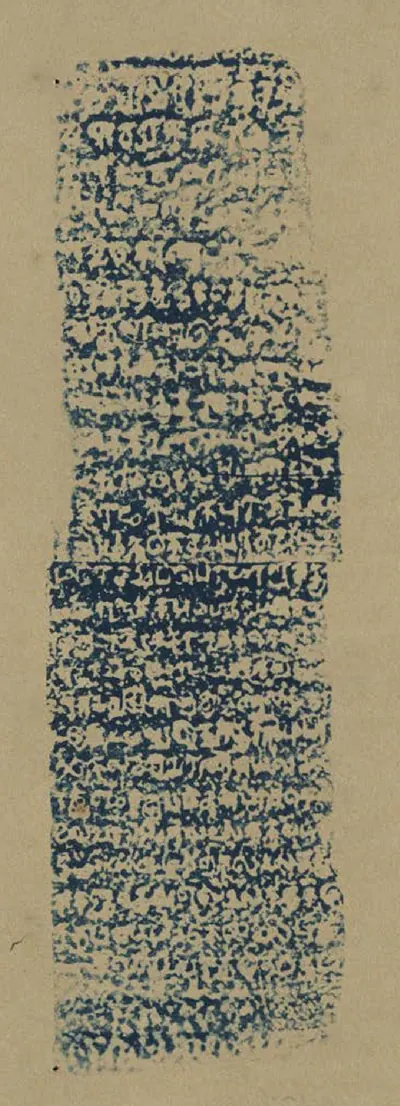 "Nellore No. 101": Tamil inscription of Madhurantaka Pottapi-Chola alias Tirukkalattideva over the shrine of the temple at Ramatirtham (Butterworth & Chetty 1905, Part II, to face p. 864 (PDF p. 403))Inscription rubbing · 1905
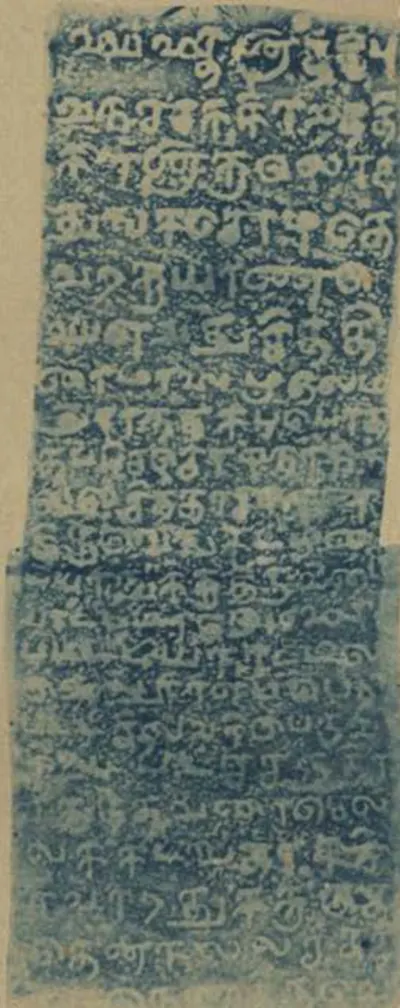 "Part of Gudur No. 34": the Gunupadu inscription of Nallasiddha, dated in the 27th year of a Chola Kulottunga (Butterworth and Venugopaul Chetty 1905, plate facing p. 406)Inscription rubbing · 1905
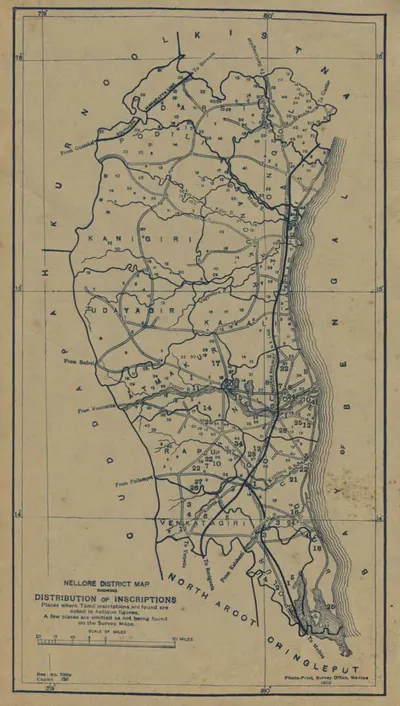 Nellore District map showing the distribution of inscriptions (Butterworth & Chetty 1905, PDF p. 7)Map · 1905
Related
People
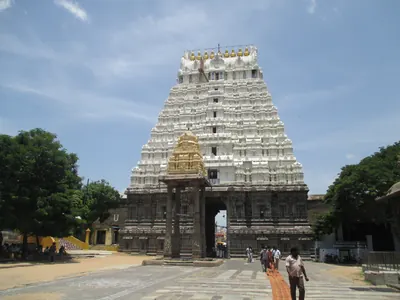
Tammusiddhi
c. 1205–1208 CE
Telugu Choda king of the Pottapi and Nellore family, and a vassal of the Chola king Kulottunga III. He was anointed at Nellore in 1205–06 and made grants at Kanchipuram, Tiruvalangadu, Tiruppasur, Tiruvorriyur, Nellore and Kavali. His inscriptions give the fullest early family tree of the family, but they disagree about who his brother or uncle Nallasiddhi was.
Tikka I (Telugu Choda of Nellore)
c. 1209–1248 CE
Telugu Choda king of Nellore, also called Tirukalatti and Ganda-Gopala, who ruled from about 1209 to 1248 or 1250. He was a loyal vassal of the Chola Rajaraja III, fought the Hoysalas and held Kanchi. In one modern account he owed his throne at Nellore to the Kakatiya Ganapatideva. He was the father of Manumasiddhi II.
Manumasiddhi II
c. 1248 CE
Telugu Choda king of Nellore from about 1248 or 1250, son of Tikka I and patron of the poet Tikkana Somayaji. He was driven out of Nellore early in his reign. The Kakatiya king Ganapatideva restored him after Tikkana went to the Kakatiya court as his envoy, and he later fought for Ganapati against Kalinga on the Godavari. Whether he was the same king as Vijaya-Gandagopala of Kanchi is disputed.
Tikkana Somayaji
Telugu poet of the 13th century at the court of the Telugu Choda king Manumasiddhi II of Nellore. He translated fifteen books of the Mahabharata into Telugu, completing the work Nannaya had begun two centuries earlier, and wrote the Nirvachanottara Ramayana. He went as his patron's envoy to the Kakatiya Ganapatideva, whose help restored Manumasiddhi to Nellore.
Inscriptions
Arulala-Perumal inscription of Tammusiddhi, 1205–06
1205 CE
A Sanskrit inscription in Grantha letters on the base of the platform called 'the mountain' in the Arulala-Perumal (Varadaraja) temple at Kanchipuram. It records that in Saka 1127 (1205–06) the Telugu Choda king Tammusiddhi, having been anointed at Nellore, gave the village of Muttiyampakka to the god. It names his father's surname, Ganda-Gopala, and the place of his anointment.
Kavali inscription of Tammusiddhi, 1207–08
1207 CE
Stone by the tank at Kavali in the Nellore district, in Sanskrit verse in Telugu letters, with the boundaries in Telugu. It records that in Saka 1129 (1207–08) the Telugu Choda king Tammusiddhi founded an agrahara (Brahmin village) named Sripura after his mother Sridevi and gave it to a hundred Brahmana shareholders. It calls his brother Nalla Siddha the eldest son and anointed king, by whose favour Tammusiddhi ruled.
References
Notes (0)
Sources (8)
Spotted an error on this page? Tell us
Last updated: