Jaggayyapeta inscriptions of Virapurushadatta
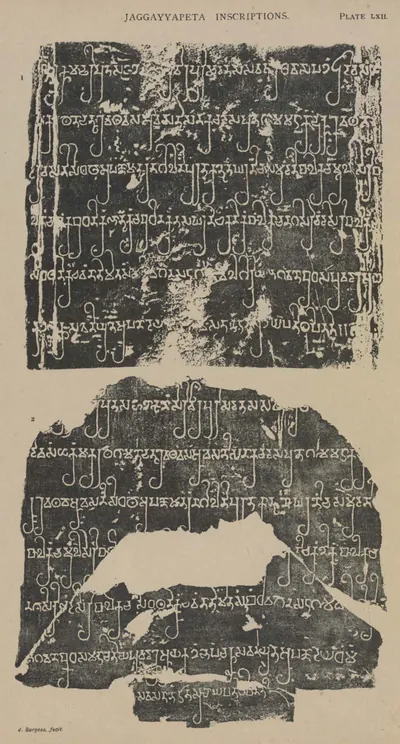
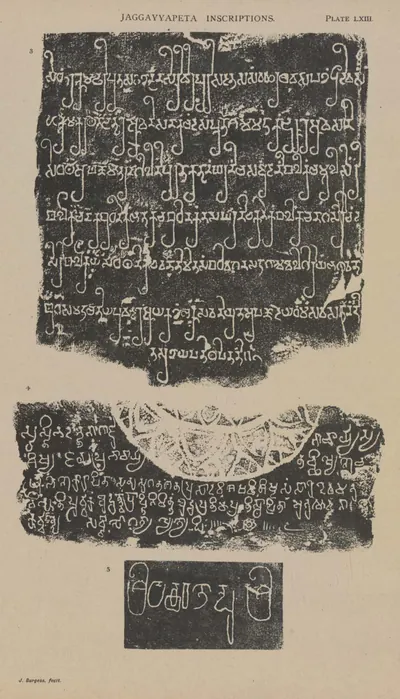
Three copies of a Prakrit inscription on the ayaka pillars of the Jaggayyapeta stupa. They record the gift of five pillars at the eastern gate of the Great Chaitya by the artisan Siddhartha, in the 20th year of the Ikshvaku king Virapurushadatta. James Burgess found them in 1882, and they were the first Ikshvaku records to be discovered.
These are the inscriptions through which the Ikshvakus of the Krishna valley first became known.1 They were cut on the pillars of the Jaggayyapeta stupa (relic mound), near the meeting of the Paleru and the Krishna.1
Discovery and description
James Burgess excavated the stupa in February 1882.2 Its base had projections facing the four cardinal points, and large pillars or stelae lay at three of them.2 At the east, one inscribed pillar lay where it had fallen.2 It was about 17 feet long even with its top broken off, square for the lower 7½ feet and octagonal above.2
The inscription is cut on the lower part of the octagonal shaft.2 Burgess found two more copies.2 One was on a broken pillar that villagers had carried off, which the local officer recovered.2 The other was in the roof of a small ruined temple at the foot of the hill.2
J. Ph. Vogel later observed that only one of the three copies is complete.13 The inscribed pillars belonged to the set of five on the east side.13 The pillars of the other sides seem to have been uninscribed.13
Content
Georg Bühler’s translation, revised for Burgess’s report, begins: “Success!”24 It dates the gift “On the 10th day of the 8th fortnight of the rainy season, in the 20th year of the king Purisadata (Purushadatta)”.24 It calls the king “the glorious hero (srivira) of the Ikhakus (Ikshvakus) and son of the Madhara (mother)”.24
The donor was “the artisan (avesani) Sidatha (Siddhartha) resident in the village of Mahakamdurura”.24 He was “the son of the artisan Nakachamda (Nagachandra) resident in the village of Nadatura in the province (rathe) of Kammaka”.24
He gave the pillars together with his mother Nagilani, his wife Samudani, his son and daughter, and his brother and the brother’s wife and children.24 Also with him was “the multitude of his blood-relations, friends and connexions”.24 The gift, made “in the village of Velagiri, near the eastern gate of the Great Chaitya of divine Buddha”, was of “five (5) Ayaka-pillars”.24 It was made “for the good and the welfare of all living beings”.24
Interpretation
Burgess put the script at “about the third or fourth century A.D., but possibly earlier”.24 He could not identify the king.24 He thought the king’s claim to Ikshvaku descent “most probably an idle boast” by a local dynasty.24 In his view this dynasty had succeeded the Andhras on the lower Krishna.24
Bühler, in his edition, placed King Purisadata in the 3rd century, before the Pallavas reached Vengi.1 The Nagarjunakonda finds showed that he was Madhariputa Siri-Virapurisadata, son of Chamtamula.35 Vogel accepted Bühler’s date as probably correct.35
Bühler took Purisadata as the name and siri-vira as an epithet (a title of praise).46 Sircar argued that such epithets were often part of a proper name.46 Vogel later took the inscription to mean that the stupa itself stood at Velagiri, the old name of Jaggayyapeta.7 He added it to his list of the dated foundations of Virapurushadatta’s reign.7
Sircar identified the donor’s home province, Kammaka-rattha, with the Karmarashtra of later inscriptions.8 This Karmarashtra is placed in northern Nellore and southern Guntur.8 He later explained the donor’s title avesani as a foreman of artisans.9 The term is known also from a Sanchi inscription of the Satavahana Satakarni.9
Footnotes
-
J. Ph. Vogel, Prakrit Inscriptions from a Buddhist Site at Nagarjunikonda, Epigraphia Indica XX (1933), p. 2 (archive.org (opens in a new tab)). ↩ ↩2 ↩3 ↩4 ↩5 ↩6
-
James Burgess, The Buddhist Stupas of Amaravati and Jaggayyapeta (1887), p. 110 (archive.org (opens in a new tab)). ↩ ↩2 ↩3 ↩4 ↩5 ↩6 ↩7 ↩8 ↩9 ↩10 ↩11 ↩12 ↩13 ↩14 ↩15 ↩16 ↩17 ↩18 ↩19 ↩20 ↩21
-
Vogel, Prakrit Inscriptions from Nagarjunikonda (1933), p. 3 (archive.org (opens in a new tab)). ↩ ↩2 ↩3 ↩4 ↩5
-
Burgess, Buddhist Stupas of Amaravati and Jaggayyapeta (1887), p. 111, translation by G. Bühler (archive.org (opens in a new tab)). ↩ ↩2 ↩3 ↩4 ↩5 ↩6 ↩7 ↩8 ↩9 ↩10 ↩11 ↩12 ↩13 ↩14 ↩15
-
Vogel, Prakrit Inscriptions from Nagarjunikonda (1933), p. 6 (archive.org (opens in a new tab)). ↩ ↩2
-
D. C. Sircar, The Successors of the Satavahanas in Lower Deccan (1939), p. 22, note 1 (archive.org (opens in a new tab)). ↩ ↩2
-
J. Ph. Vogel, “Additional Prakrit Inscriptions from Nagarjunikonda”, Epigraphia Indica XXI (1931–32), p. 65 (archive.org (opens in a new tab)). ↩ ↩2
-
Sircar, Successors of the Satavahanas (1939), p. 34 (archive.org (opens in a new tab)). ↩ ↩2
-
D. C. Sircar, “More Inscriptions from Nagarjunikonda”, Epigraphia Indica XXXV (1963–64), p. 16 (archive.org (opens in a new tab)). ↩ ↩2
Photos
References
Notes (0)
Sources (5)
Spotted an error on this page? Tell us
Last updated: