Jaggayyapeta stupa
Small early Buddhist stupa on Dhana Bodu hill near Jaggayyapeta. Its old limestone casing slabs and Mauryan-type letters point to the 2nd century BCE. Pillar inscriptions of the Ikshvaku king Virapurushadatta record a later dedication.
The Jaggayyapeta stupa stood on Dhana Bodu, a low hill about a mile east of the town of Jaggayyapeta, near the meeting of the Paleru and the Krishna.123 It is much smaller and far less complete than Amaravati.123 Its early carvings make it important.123 Burgess and Rea used them as a yardstick for the oldest phase of Buddhist art in the lower Krishna valley.123 Its inscriptions span several centuries.123
Discovery
Villagers had long dug into the brick mounds on the hill for building material.1 In 1881 they unearthed carved slabs, which the local official took into custody and reported to Madras.1 James Burgess examined the hill in February 1882.1 He found traces of a group of stupas, mostly small, and of other early buildings.1
All had been dug over for bricks and slabs.1 Only one stupa, at the south-west, kept clear remains.1 That stupa had lost its dome and railing, and its relic casket had been robbed.1 The stone burns into good lime.4 Burgess thought that this was why no slabs could be found reused in the town: they had probably gone into the lime-kiln.4
The building
When excavated, the base of the stupa measured 31½ feet across.1 (The Imperial Gazetteer of 1908 gives 66 feet, a figure this page does not follow.)5 Like Amaravati, it was faced with slabs of a pale limestone.1 Burgess believed this was quarried on the Krishna bank just south of the hill.1 He thought the Amaravati slabs came from the same place.1
The casing slabs stood about 3 ft 9 in above a paved procession path 10½ feet wide.1 Nothing was left of the railing beyond the path except traces of the brick-and-lime footings for its posts.1
Inside the casing, the stupa was built of layers of earth about two feet thick.46 A close floor of large, carefully fitted bricks covered each layer.46 Burgess explained this as a way of keeping rainwater from swelling the core and bursting the facing.46 He thought the great stupa at Amaravati had probably been built the same way.46
A fragment of the outer relic casket lay in the disturbed earth at the top.4 From this he concluded that the relic had been placed no lower than the base of the dome.4 At each cardinal point (north, south, east and west) the drum projected about two feet for a length of 12 to 15 feet.7 Only these projections carried carved slabs, apart from a pilaster on the edge of every slab.7
South-east of the stupa were the stumps of pillars set about 11 feet apart over an area of roughly 170 by 120 feet.14 They suggested a large hall.14 Burgess took it to be a place of assembly for visitors.14
Sculpture
The carving is in very low relief and old in style.4 On the casing slabs, a pilaster rises from a carefully carved base.4 Above the base stands a makara (sea-monster) or similar creature.4 On it stands a male or female figure, probably a yaksha (nature spirit).4 A heavy capital carries two winged animals.4 Burgess compared these with the sculptures at Bharhut and in the Pitalkhora cave, and with the earliest slabs from Amaravati.4
Two carved slabs attracted particular attention:
- One slab shows a pillared shrine with the footprints of the Buddha under a seat and an umbrella.48 Female worshippers on it wear head-dresses that Burgess likened to those painted in Cave X at Ajanta.48
- Another shows a tall man under an umbrella beside a wheel on a pillar.8 Square objects, perhaps coins, stream down from above.8 A woman, two young men, a horse and an elephant are shown at smaller scale.8 Burgess did not try to name the figure: “Who this represents we know not”.8
Burgess concluded that most of the early slabs at Amaravati had probably belonged to a similar casing on the first stupa there.2 Rea later compared the archaic carving at Bhattiprolu to this work.3
Inscriptions
- Early letters. A few letters on the upper edges of casing slabs are too broken to give a name.49 They are in characters of the Maurya type.49 Burgess put them as early as the beginning of the 2nd century BCE.49
- The ayaka pillar inscription. Tall pillars or stelae had stood in groups of five on each face.67 These are the ayaka pillars seen on carved images of stupas at Amaravati.67 One fallen pillar at the east was about 17 feet long even with its top broken off.7 The same Prakrit inscription appears on it and on two other pillar fragments.7 It is dated in the 20th year of King Madhariputa Siri-Virapurisadata of the Ikhakus (Ikshvakus).7910 It records that the artisan Siddhartha of Mahakandurura set up five ayaka pillars at the eastern gate of the Great Chaitya of the Buddha at the village of Velagiri.7910 Siddhartha was the son of Nagachandra of Nadatura in the province of Kammaka.7910 He made the gift together with his mother, his wife, his children and other relatives, for the welfare of all beings.7910 See Jaggayyapeta inscriptions of Virapurushadatta.
- The image inscription. A relief of the standing Buddha found on the path carries a Sanskrit inscription in letters of about 600 CE.92 It records that the image was made by Chandraprabha, a disciple of Jayaprabhacharya.92 Jayaprabhacharya in turn was a disciple of Nagarjunacharya.92
Dating the Ikshvaku inscription: an older view corrected
Burgess put the ayaka-pillar script at about the 3rd or 4th century CE, “but possibly earlier”.79 He thought King Purushadatta’s claim to Ikshvaku descent was “most probably an idle boast” by some unknown local dynasty.79
Bühler placed the king in the 3rd century.1112 Then came the excavations at Nagarjunakonda, whose inscriptions Vogel published in 1933.1112 They brought to light records of the same Ikhaku dynasty.1112 These name Madhariputa Siri-Virapurisadata, his father Vasithiputa Siri-Chamtamula and his son.1112 J. Ph. Vogel identified the Jaggayyapeta king with the Nagarjunakonda Virapurisadata (see Ikshvakus of Vijayapuri).1112
Vogel later added the Jaggayyapeta pillars to his list of the dated foundations of that king’s reign.13 He took Velagiri to be the old name of Jaggayyapeta.13 D. C. Sircar dated two Ikshvaku inscriptions by the cyclic year Vijaya to 273–74 and 333–34.14 In one of his reconstructions he placed Virapurushadatta’s reign about 255–75.14 The Archaeological Survey recorded small repairs to the remains in 1927–28.15
Footnotes
-
Burgess, Amaravati and Jaggayyapeta (1887), p. 107 (archive.org (opens in a new tab)). ↩ ↩2 ↩3 ↩4 ↩5 ↩6 ↩7 ↩8 ↩9 ↩10 ↩11 ↩12 ↩13 ↩14 ↩15 ↩16 ↩17 ↩18 ↩19 ↩20 ↩21
-
Burgess, Amaravati and Jaggayyapeta (1887), p. 112 (archive.org (opens in a new tab)). ↩ ↩2 ↩3 ↩4 ↩5 ↩6 ↩7 ↩8 ↩9
-
Alexander Rea, South Indian Buddhist Antiquities (1894), p. 15 (archive.org (opens in a new tab)). ↩ ↩2 ↩3 ↩4 ↩5 ↩6
-
Burgess, Amaravati and Jaggayyapeta (1887), p. 108 (archive.org (opens in a new tab)). ↩ ↩2 ↩3 ↩4 ↩5 ↩6 ↩7 ↩8 ↩9 ↩10 ↩11 ↩12 ↩13 ↩14 ↩15 ↩16 ↩17 ↩18 ↩19 ↩20 ↩21 ↩22
-
Imperial Gazetteer of India: Madras, Vol. I (1908), p. 323 (archive.org (opens in a new tab)). ↩
-
James Burgess, The Buddhist Stupas of Amaravati and Jaggayyapeta (1887), p. 21 (archive.org (opens in a new tab)). ↩ ↩2 ↩3 ↩4 ↩5 ↩6
-
Burgess, Amaravati and Jaggayyapeta (1887), p. 110 (archive.org (opens in a new tab)). ↩ ↩2 ↩3 ↩4 ↩5 ↩6 ↩7 ↩8 ↩9 ↩10 ↩11 ↩12
-
Burgess, Amaravati and Jaggayyapeta (1887), p. 109 (archive.org (opens in a new tab)). ↩ ↩2 ↩3 ↩4 ↩5 ↩6
-
Burgess, Amaravati and Jaggayyapeta (1887), p. 111 (archive.org (opens in a new tab)). ↩ ↩2 ↩3 ↩4 ↩5 ↩6 ↩7 ↩8 ↩9 ↩10 ↩11 ↩12
-
Gordon Mackenzie, A Manual of the Kistna District (1883), pp. 224–225 (archive.org (opens in a new tab)). ↩ ↩2 ↩3 ↩4
-
J. Ph. Vogel, “Prakrit Inscriptions from a Buddhist Site at Nagarjunikonda”, Epigraphia Indica XX (1933), p. 2 (archive.org (opens in a new tab)). ↩ ↩2 ↩3 ↩4 ↩5
-
Vogel, Epigraphia Indica XX (1933), p. 3 (archive.org (opens in a new tab)). ↩ ↩2 ↩3 ↩4 ↩5
-
J. Ph. Vogel, “Additional Prakrit Inscriptions from Nagarjunikonda”, Epigraphia Indica XXI (1931–32), p. 65 (archive.org (opens in a new tab)). ↩ ↩2
-
D. C. Sircar, “More Inscriptions from Nagarjunikonda”, Epigraphia Indica XXXV (1963–64), p. 6 (archive.org (opens in a new tab)). ↩ ↩2
-
H. Hargreaves (ed.), Annual Report of the Archaeological Survey of India, 1927–28 (1931), p. 4 (archive.org (opens in a new tab)). ↩
Photos
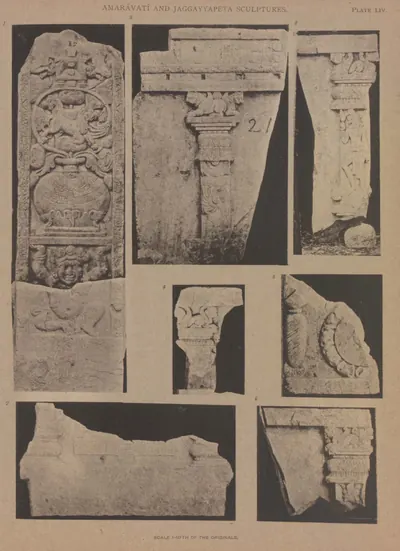 A pillar slab from Amaravati, and six fragments from Jaggayyapeta (Burgess 1887, Pl. LIV)Book plate · 1887
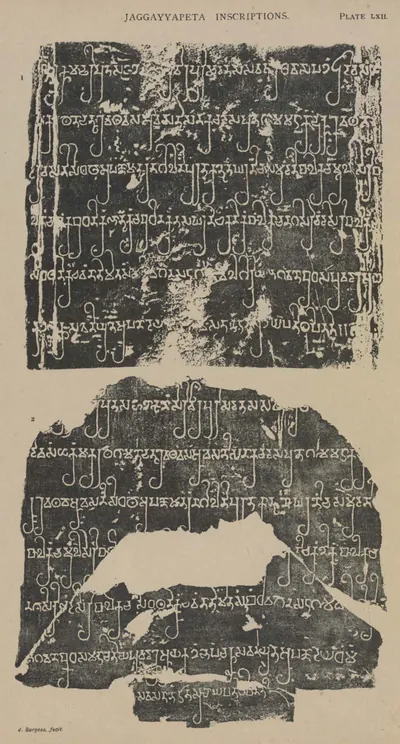 Jaggayyapeta inscriptions, Nos. 1 and 2 (Burgess 1887, Pl. LXII)Inscription rubbing · 1887
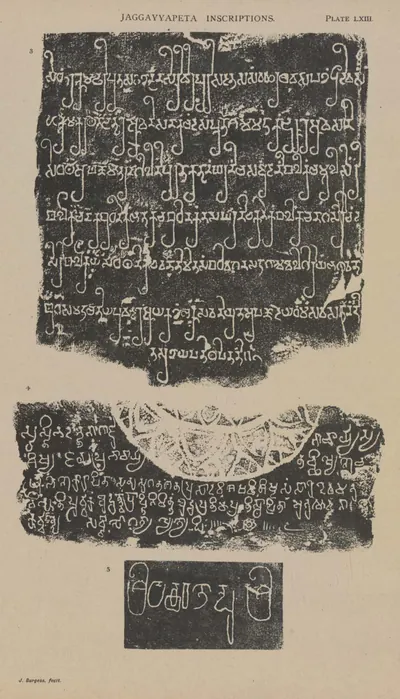 Jaggayyapeta inscriptions, Nos. 3-5 (Burgess 1887, Pl. LXIII)Inscription rubbing · 1887
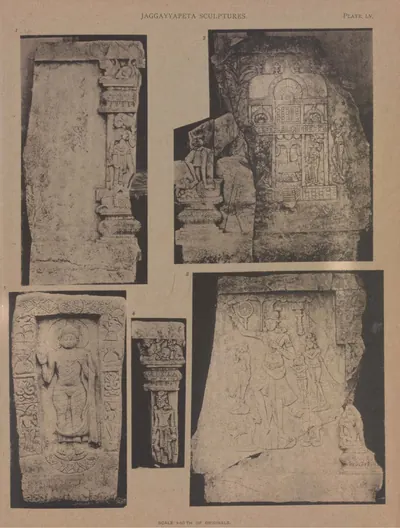 Jaggayyapeta: four slabs and a pilaster (Burgess 1887, Pl. LV)Book plate · 1887
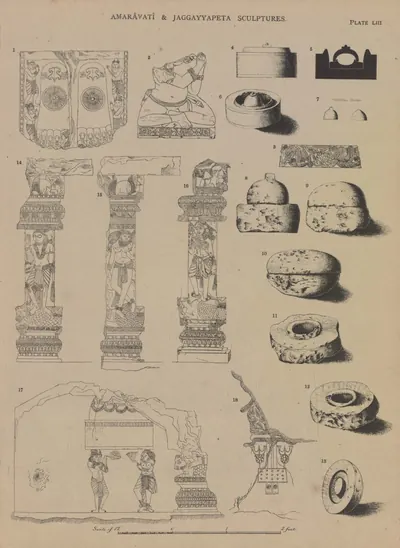 Sripada, salika, casket, &c., from Amaravati; caskets from other places in the Krishna District, three pilasters and two slabs from Jaggayyapeta (Burgess 1887, Pl. LIII)Drawing · 1887
References
Notes (0)
Sources (8)
Spotted an error on this page? Tell us
Last updated: