Jaggayyapeta
Market town on the Paleru near where it meets the Krishna, formerly called Betavolu. On a hill nearby, James Burgess excavated in 1882 the remains of an early Buddhist stupa with an inscription of the Ikshvaku period.
Jaggayyapeta is a town in what was Nandigama taluk of Krishna district. It stands on the Paleru river, a tributary of the Krishna, about four miles above the point where the two rivers meet.1 It is some thirty miles north-west of Amaravati.1 The Imperial Gazetteer gives its position as 16° 54′ N, 80° 7′ E and its population in 1901 as 8,432.2
The town
The town was formerly called Betavolu. Raja Vasireddi Venkatadri Nayudu rebuilt it, enclosed it with a wall and invited merchants to settle.13 He was the zamindar (landholder) whose workmen destroyed much of the Amaravati stupa (relic mound).13 He renamed the town after his father, Jaggayya.13
In the late 19th century the town was a depot for the trade between the coastal districts (the Northern Circars) and the Nizam’s Dominions.45 It also had a small silk-weaving industry, using thread brought from the Central Provinces.45
The Buddhist site
About a mile east of the town is a low hill called Dhana Bodu, “hill of wealth”.1 For many years villagers had dug into the brick mounds on its south-west side for building material.1 In 1881 they uncovered some carved slabs, and a local official reported the find to Madras.1
James Burgess examined the hill in February 1882.1 He found traces of a group of mostly small stupas and other early buildings.1 Only one stupa was well enough preserved to be studied.1 Its inscriptions run from letters of Mauryan type, perhaps of the 2nd century BCE, to an image inscription of about 600 CE.6 Among them is a dedication of pillars in the reign of an Ikshvaku king.6 See Jaggayyapeta stupa.
Burgess blamed Venkatadri Nayudu’s rebuilding of the town for much of the damage.1 He found part of an inscribed pillar from the stupa reused in the roof of a small temple at the foot of the hill.1 The 1883 district manual noted many stone circles in the taluk.4 It also recorded several other places nearby that Sewell had listed as possible Buddhist sites, Bidavada, Mulkapuram, Kokireni and Nelamarri among them.4
Footnotes
-
James Burgess, The Buddhist Stupas of Amaravati and Jaggayyapeta (1887), p. 107 (archive.org (opens in a new tab)). ↩ ↩2 ↩3 ↩4 ↩5 ↩6 ↩7 ↩8 ↩9 ↩10 ↩11 ↩12 ↩13
-
Imperial Gazetteer of India: Madras, Vol. I (1908), p. 322 (archive.org (opens in a new tab)). ↩
-
Gordon Mackenzie, A Manual of the Kistna District (1883), pp. 223–224 (archive.org (opens in a new tab)). ↩ ↩2 ↩3
-
Mackenzie, Kistna District Manual (1883), p. 224 (archive.org (opens in a new tab)). ↩ ↩2 ↩3 ↩4
-
Imperial Gazetteer of India: Madras, Vol. I (1908), p. 323 (archive.org (opens in a new tab)). ↩ ↩2
-
Burgess, Amaravati and Jaggayyapeta (1887), pp. 108–111 (archive.org (opens in a new tab)). ↩ ↩2
Photos
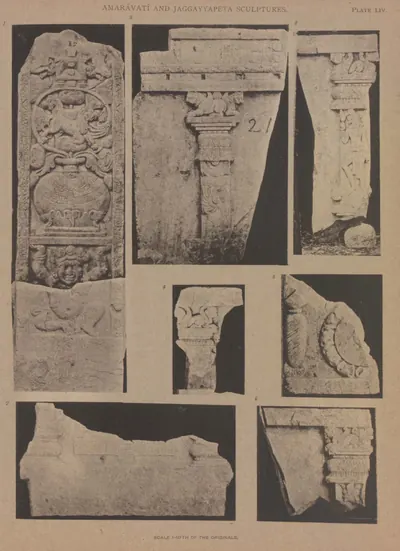 A pillar slab from Amaravati, and six fragments from Jaggayyapeta (Burgess 1887, Pl. LIV)Book plate · 1887
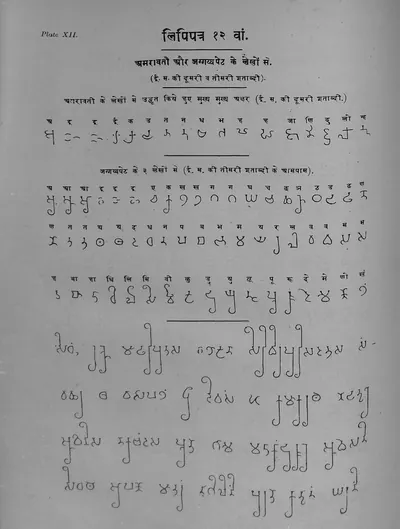 Alphabet table from the inscriptions of Amaravati and Jaggayyapeta, 2nd and 3rd centuries CE (Ojha, Bharatiya Prachin Lipimala, 1918, Plate 12)Book plate · 1918
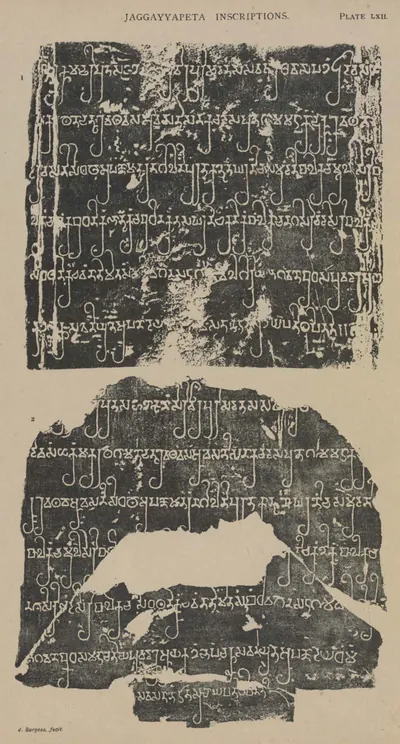 Jaggayyapeta inscriptions, Nos. 1 and 2 (Burgess 1887, Pl. LXII)Inscription rubbing · 1887
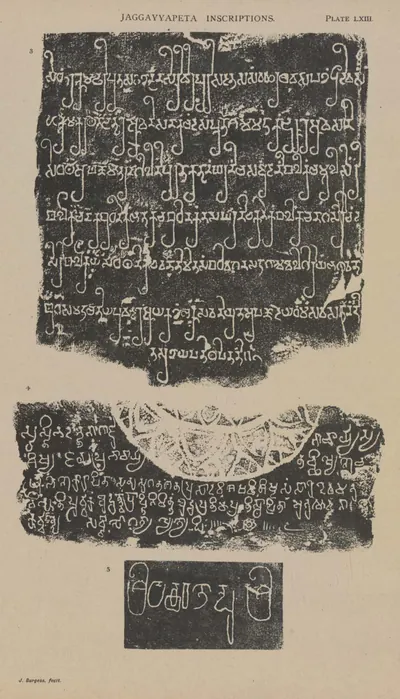 Jaggayyapeta inscriptions, Nos. 3-5 (Burgess 1887, Pl. LXIII)Inscription rubbing · 1887
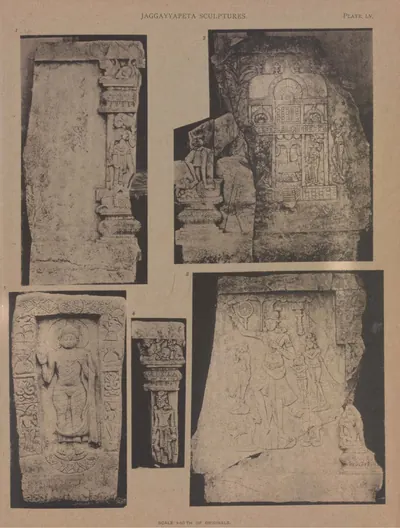 Jaggayyapeta: four slabs and a pilaster (Burgess 1887, Pl. LV)Book plate · 1887
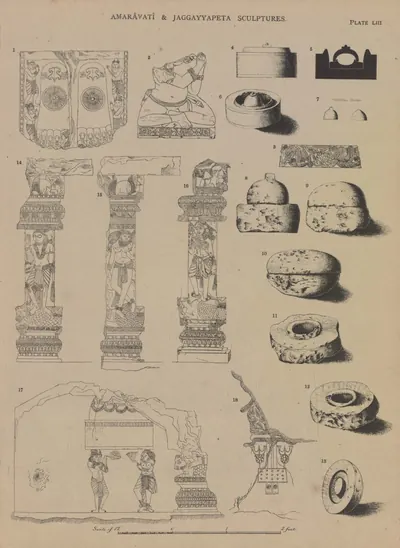 Sripada, salika, casket, &c., from Amaravati; caskets from other places in the Krishna District, three pilasters and two slabs from Jaggayyapeta (Burgess 1887, Pl. LIII)Drawing · 1887
References
Notes (0)
Sources (3)
Spotted an error on this page? Tell us
Last updated: