Jirjingi plates of Indravarman
A copper-plate grant of the Ganga king Indravarman, lord of Trikalinga, issued from Dantapura and dated in the year 39. It was found in an old temple site at Jirjingi near Tekkali in the Srikakulam country. When R. K. Ghoshal re-edited it in 1940, it was the oldest known record of the Eastern Gangas. It gives the village of Jijjika, the modern Jirjingi, to a Brahmin. On V. V. Mirashi's epoch (starting date) of the Ganga era, the year 39 falls in about 537.
Discovery
The plates were turned up, together with pieces of old pottery, when an old temple was dug out in the village of Jirjingi.1 The village is near Tekkali, then in the Ganjam district.1 Sir A. P. Patro secured the plates and passed them to R. Subba Rao of the Andhra Historical Research Society at Rajahmundry.1 Subba Rao published them first in the Society’s journal.1
R. K. Ghoshal re-edited the record in Epigraphia Indica XXV (1939–40), from ink impressions supplied by the Government Epigraphist.1 He did so because he thought the first edition inadequate for a record of such importance to the early history of the Gangas.1 See Jirjingi.
The plates
There are three plates, in a perfect state of preservation.2 The first and third are inscribed on one side only, with seven lines each.2 The second has six lines on each side, making twenty-six lines in all.2
Ghoshal found that the letters belong to the southern class of alphabets.2 They resemble those of the Godavari plates of Prithivimula, and of the Srungavarapukota and Siripuram plates of the Kalinga king Anantavarman.2 He also saw a resemblance to some early inscriptions of Cambodia.2 The language is Sanskrit, in prose except for two of the customary verses at the end.2
The grant
The grant is issued from the city of Dantapura by the Maharaja Indravarman, lord of Trikalinga, of the Ganga family.2 It records the gift of a village to a Brahmin of the Vishnuvriddha gotra (clan) and the Taittiriya school.2 Ghoshal accepted Subba Rao’s identification of the village, Jijjika, with the modern Jirjingi, where the plates were found.3
Ghoshal noted that Dantapura is known from Buddhist tradition as a capital of Kalinga.4 He added that this record is the first to name it.4
Date and significance
Ghoshal took the year 39 of the grant to refer, in all probability, to the Ganga era.2 He called the record the oldest of the Eastern Gangas then available.2 The next oldest, in his list, was a grant of Hastivarman of the year 79.2
V. V. Mirashi’s epoch of the era is 14 March 498, and on it the year 39 falls in about 537.56 Mirashi called this king Indravarman I.56 He distinguished him from a second Indravarman of the years 87 to 91 and a third of the years 128 to 154.56 The date on this page follows Mirashi. See the Eastern Gangas for the dispute over the era.
Ghoshal and Subba Rao were inclined to identify this Indravarman with the Adhiraja Indra.76 According to the Godavari plates of Prithivimula, that Adhiraja Indra overthrew a king Indrabhattaraka.76 Mirashi noted that some scholars made this identification because both kings boast of battles with four-tusked elephants.76 But he thought the boast a conventional phrase, and he preferred Indravarman II.76
Ghoshal suggested that Indravarman may have begun as a minor chief in the Godavari valley and won a kingdom in the Ganjam country.74 He added that this country remained the stronghold of the Eastern Gangas throughout their history.74 See the Vishnukundins and Indravarman (Vishnukundin).
Footnotes
-
R. K. Ghoshal, “Jirjingi Plates of Ganga Indravarman: the Year 39”, Epigraphia Indica XXV (1939–40), p. 281 (archive.org (opens in a new tab)). Paraphrased. ↩ ↩2 ↩3 ↩4 ↩5 ↩6
-
Ghoshal, “Jirjingi Plates of Ganga Indravarman” (1940), p. 282 (archive.org (opens in a new tab)). Paraphrased. ↩ ↩2 ↩3 ↩4 ↩5 ↩6 ↩7 ↩8 ↩9 ↩10 ↩11 ↩12
-
Ghoshal, “Jirjingi Plates of Ganga Indravarman” (1940), p. 286 (archive.org (opens in a new tab)). Paraphrased. ↩
-
Ghoshal, “Jirjingi Plates of Ganga Indravarman” (1940), p. 285 (archive.org (opens in a new tab)). Paraphrased. ↩ ↩2 ↩3 ↩4
-
V. V. Mirashi, “Epoch of the Ganga Era”, Epigraphia Indica XXVI (1941–42), p. 333 (archive.org (opens in a new tab)). Paraphrased. ↩ ↩2 ↩3
-
Mirashi, “Epoch of the Ganga Era” (1942), p. 334 and note 2 (archive.org (opens in a new tab)). Paraphrased. ↩ ↩2 ↩3 ↩4 ↩5 ↩6 ↩7
-
Ghoshal, “Jirjingi Plates of Ganga Indravarman” (1940), p. 283 (archive.org (opens in a new tab)). Paraphrased. ↩ ↩2 ↩3 ↩4 ↩5 ↩6
Photos
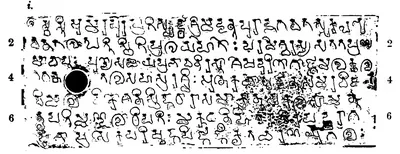 "Jirjingi Plates of Ganga Indravarman; the year 39", first plate (lines 1-7) (Epigraphia Indica XXV, plate following p. 286, PDF p. 342)Inscription rubbing · 1940
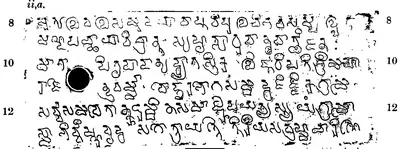 "Jirjingi Plates of Ganga Indravarman; the year 39", first side of the second plate (lines 8-13) (Epigraphia Indica XXV, plate following p. 286, PDF p. 342)Inscription rubbing · 1940
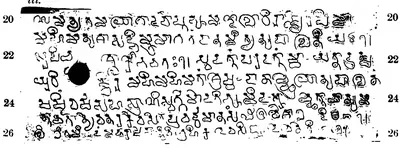 "Jirjingi Plates of Ganga Indravarman; the year 39", third plate (lines 20-26) (Epigraphia Indica XXV, plate following p. 286, PDF p. 342)Inscription rubbing · 1940
References
Notes (0)
Sources (2)
Spotted an error on this page? Tell us
Last updated: