Vilavatti grant of Simhavarman
Sanskrit copper-plate grant issued from Paddukkara in the tenth year of the Pallava king Simhavarman, son of the crown prince Vishnugopa. It gives the village of Vilavatti in Mundarashtra, with the taxes due from it, to the Brahman Vishnusarman. It was found about 1928 at Vavveru in the Kovur taluk of Nellore, and C. R. Krishnamacharlu edited it in 1938. It lists the dues of craftsmen and traders and bears the earliest clear Pallava bull on its seal.
The Vilavatti grant is a copper-plate grant of the Pallava king Simhavarman, son of the crown prince Vishnugopa.1 Its editor, C. R. Krishnamacharlu, compared it with the king’s grants already known from Mangalur, Pikira and Omgodu.23 He found its main interest in its list of the taxes that the king gave up in the village.1
Discovery and description
Satyavelu Rami Reddi found the plates about 1928 at Vavveru.4 He was digging old village earth about eight feet below the surface.4 Vavveru is a mile and a half west of Buchireddipalem in the Kovur taluk of the Nellore district.4 Some earthen pots found with the plates were broken and thrown away.4
The plates passed through the hands of B. Gopala Reddi and K. Ramakoteswara Rao to Krishnamacharlu.4 He examined them in 1933 and later bought them for the Madras Museum.4
There are five plates on a ring whose ends are soldered into a round seal.42 The seal shows a couchant (lying) bull with a large hump.42 Above the bull is something described as an anchor, or, as Krishnamacharlu had suggested, a boat.42 He compared a Pallava coin with a bull on one side and a two-masted ship on the other.42
P. B. Desai noted that this was the first Pallava seal on which the bull can be recognised beyond doubt.5 Unlike the king’s other grants, the plates are not numbered.2 The grant opens with svasti instead of jitam bhagavata.2
Language
The language is Sanskrit.2 Krishnamacharlu noted that the name Vilavatti is written with the Tamil letter l.2 He took this, with the word vatta for a group of villages, as a sign of Tamil influence on the writer.2 Yet the grant belonged to the Telugu country.2
Content
The grant was issued from Vijaya-Paddukkara by the Maharaja Simhavarman, son of the crown prince Vishnugopa.1 He was the grandson of Skandavarman and great-grandson of Viravarman, of the Bharadvaja gotra (clan) and the Pallava family.1
The grant gives the village of Vilavatti in Mundarashtra, with its hamlet and the taxes due from it to the king.1 The receiver was the Brahman Vishnusarman of the Gautama gotra, a Chhandoga (singer of the Sama Veda).1 It is dated on the fifth day of the bright fortnight of Sravana in the tenth year of the reign.1
The taxes given up
The king’s order lists the dues given up:1
- those payable by metal-workers and leather-workers1
- those of shop-keeping cloth-dealers, rope-dancers or jugglers, and shops1
- those of Ajivika ascetics, outcastes, mask-actors, water-diviners and weavers1
- the taxes on gambling, marriages and barbers1
- the dues of artisans1
Krishnamacharlu compared the eighteen kinds of exemptions mentioned but not listed in the Uruvupalli grant.1 His editor offered other readings of several of these terms.1 The king gave the order by word of mouth, and his private secretary (rahasyadhikrita) wrote it down.1
The places
Krishnamacharlu identified Mundarashtra with the Munda-nadu of later Nellore inscriptions.6 This lay in the Kovur taluk and the south of the Kandukur taluk.6 He thought Vilavatti might be Vavveru itself or, more probably, Vidavaluru, about 1½ miles east of it.6 He identified Paddukkara with Padugupadu, near Kovur, about nine miles south of Vavveru, north of the Penner.6
Date
Krishnamacharlu accepted 436 as the first year of Simhavarman, from the Jain work Lokavibhaga.6 So he dated the grant to 446.6 He also proposed a solution to the “Simhavarman problem” of the Uruvupalli grant.37 In his view the grant first made by Vishnugopa was formally issued by his son Simhavarman in his eleventh year.37 D. C. Sircar listed this grant with the other Sanskrit charters of the early Pallavas when he edited the Vunna Guravayapalem plates.8
Footnotes
-
Krishnamacharlu, “Vilavatti Grant” (1938), p. 298 (archive.org (opens in a new tab)). ↩ ↩2 ↩3 ↩4 ↩5 ↩6 ↩7 ↩8 ↩9 ↩10 ↩11 ↩12 ↩13 ↩14 ↩15 ↩16
-
Krishnamacharlu, “Vilavatti Grant” (1938), p. 297 (archive.org (opens in a new tab)). ↩ ↩2 ↩3 ↩4 ↩5 ↩6 ↩7 ↩8 ↩9 ↩10 ↩11
-
Krishnamacharlu, “Vilavatti Grant” (1938), p. 299 (archive.org (opens in a new tab)). ↩ ↩2 ↩3
-
C. R. Krishnamacharlu, “Vilavatti Grant of Pallava Simhavarman”, Epigraphia Indica XXIV (1937–38), p. 296 (archive.org (opens in a new tab)). ↩ ↩2 ↩3 ↩4 ↩5 ↩6 ↩7 ↩8 ↩9 ↩10
-
P. B. Desai, “Reyuru Grant of Pallava Narasimhavarman; Year 12”, Epigraphia Indica XXIX (1951–52), p. 90 (archive.org (opens in a new tab)). ↩
-
Krishnamacharlu, “Vilavatti Grant” (1938), p. 301 and note (archive.org (opens in a new tab)). ↩ ↩2 ↩3 ↩4 ↩5 ↩6
-
Krishnamacharlu, “Vilavatti Grant” (1938), p. 300 (archive.org (opens in a new tab)). ↩ ↩2
-
D. C. Sircar and P. Seshadri Sastri, “Vunna Guravayapalem Plates of Paramesvaravarman I, Year 19”, Epigraphia Indica XXXII (1957–58), p. 92, note (archive.org (opens in a new tab)). ↩
Photos
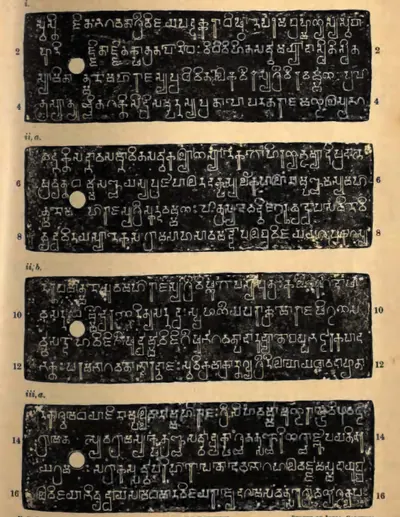 "Vilavatti Grant of Pallava Simhavarman", plates i, ii a, ii b and iii a (Epigraphia Indica XXIV, plate with No. 43 (PDF p. 382))Inscription rubbing · 1938
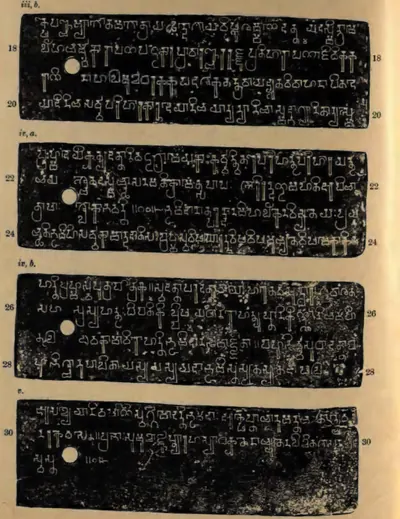 "Vilavatti Grant of Pallava Simhavarman", plates iii b, iv a, iv b and v (Epigraphia Indica XXIV, plate with No. 43 (PDF p. 383))Inscription rubbing · 1938
References
Notes (0)
Sources (3)
Spotted an error on this page? Tell us
Last updated: