Kalamalla inscription of Erikal Muturaju Dhananjaya
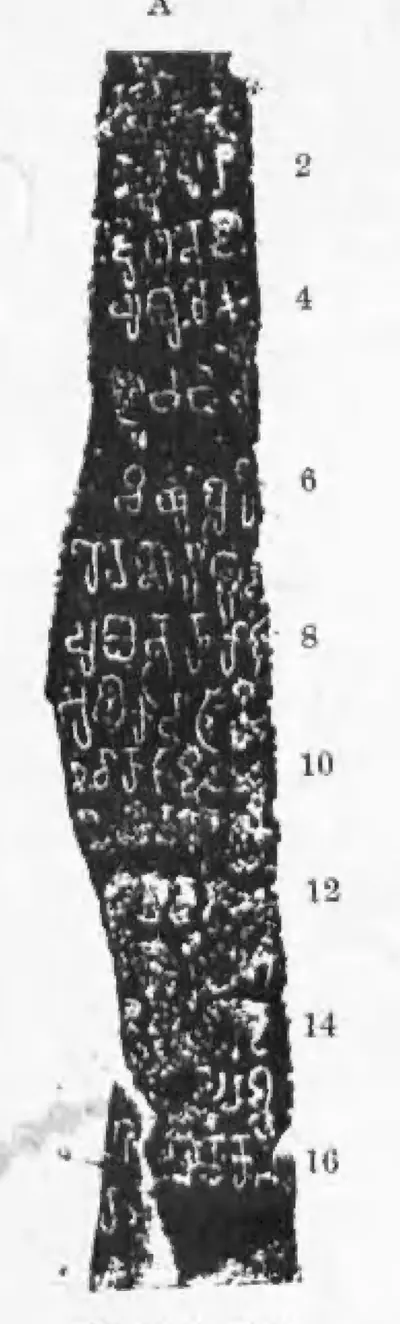
A damaged pillar inscription from Kalamalla in Kadapa district, dated from the shape of its letters to about 575 CE. Its editors called it one of the earliest records written entirely in Telugu.
Where it was found
The inscription is cut on two faces of a broken pillar in the courtyard of the Chennakesava temple at Kalamalla.1 Kalamalla was then in the Kamalapuram taluk of Kadapa (then Cuddapah) district.1 The inscription is badly damaged, and several lines are completely worn away and lost.1
The epigraphy office at Madras made a copy of it in 1904. H. Krishna Sastri first drew attention to it in 1912, in his edition of the Malepadu plates.2 He described it as a record of “a certain D[h]anaṁjeyuṇḍu who was ruling Rēnāṇḍu”.2
It was printed without translation as No. 607 in South Indian Inscriptions X (1948).3 The editors of that volume could make nothing of it beyond the names Dhananjaya and Renandu.3
K. A. Nilakanta Sastri and M. Venkataramayya produced the first full edition, with text and discussion.4 It was published in Epigraphia Indica XXVII (1956), from estampages (ink copies) supplied by the Government Epigraphist’s office.4
Script and language
The letters are bold, and the editors described them as the early Telugu-Kannada script.4 This was the form used by the Chalukyas of Badami, and the common ancestor of the Telugu and Kannada alphabets.4 They compared its letter forms with the Biragunda stone inscription of the Western Ganga king Avinita, of the last quarter of the 6th century.1 They assigned the Kalamalla inscription to the same period, about 575 CE.1
The language is Telugu throughout.1 The editors counted it among the earliest records then known to be written entirely in Telugu.1 Earlier Pallava inscriptions contain Telugu words, but in their view this was the first complete Telugu inscription yet found.1 They added that by this date Telugu had already started to grow apart from Kannada as a language, even though the two still shared one script.1
Content
The surviving text has 17 lines, and four of them (lines 11–14) are wholly lost.5 So far as it can be read, it seems to record a gift to (or by) a man called Revanakalu of Chirumburu, made while Erikal-Muturaju Dhananjaya was ruling Renandu.1 The editors identified Chirumburu with Chilamakuru, a few miles east-south-east of Kalamalla.5
Renandu was the core territory of the Telugu Cholas.5 It was roughly the country between two tributaries of the Penner, the Chitravati and the Cheyyeru.5 It covered most of Kadapa district and parts of Kolar and Chittoor.5
The king and his title
The editors identified the king with Dhananjaya, named in the Malepadu plates of Punyakumara as the father of Chola-Maharaja Mahendravikrama.16 In that family tree he is the third of three brothers.16
Krishna Sastri had already suggested in 1912 that the Kalamalla king was “not unlikely” to be this Dhananjayavarman.27 He judged from the letters that the record belonged roughly to the same period as the Malepadu plates.27 He placed those plates near the end of the 8th century.27
Erikal or Erigal, the editors argued, was a place name.8 They identified it with Nidugal in Tumkur district, which they thought an early seat of the Chola family.8
They took Muturaju to be a rank rather than a personal or dynastic name.6 In their reading it was a dignity held by a senior prince other than the reigning king and the heir-apparent (yuvaraja).6 Through such offices, they suggested, princes of the family governed separate parts of the kingdom.6
Date and its basis
The record bears no date. The figure of about 575 rests on two arguments:19
- the comparison of letter forms with Avinita’s inscription19
- a reconstruction of the family tree at about 25 years a generation, anchored on Telugu Chola princes who bear the names of their Pallava contemporaries19
The editors note that none of the Telugu Chola inscriptions they studied is dated in any era, so these dates are estimates.9
Significance
The Kalamalla pillar matters chiefly for the history of the language.1 It shows Telugu being used for the whole of a public record in the Rayalaseema country in the late 6th century.1 This was long before Telugu verse appears in Eastern Chalukya inscriptions such as the Addanki record of the 9th century.1
A companion inscription at Erragudipadu, also in Kamalapuram taluk, is written in almost identical letters.5 The same editors dated it to the last quarter of the 6th century or slightly later.5
Editions
- South Indian Inscriptions X (1948), No. 607 (text only)3
- K. A. Nilakanta Sastri and M. Venkataramayya, “Telugu Chola Records from Anantapur and Cuddapah”, Epigraphia Indica XXVII, No. 42 A, pp. 221–225 (text, discussion)1
Footnotes
-
K. A. Nilakanta Sastri and M. Venkataramayya, “Telugu Chola Records from Anantapur and Cuddapah”, Epigraphia Indica XXVII (1956), p. 221 (archive.org (opens in a new tab)). Paraphrased. ↩ ↩2 ↩3 ↩4 ↩5 ↩6 ↩7 ↩8 ↩9 ↩10 ↩11 ↩12 ↩13 ↩14 ↩15 ↩16 ↩17 ↩18 ↩19
-
H. Krishna Sastri, “Malepadu Plates of Punyakumara; the Fifth Year”, Epigraphia Indica XI (1912), p. 341 (archive.org (opens in a new tab)). ↩ ↩2 ↩3 ↩4 ↩5
-
J. Ramayya Pantulu (ed.), South Indian Inscriptions X (1948), No. 607, PDF p. 340 (archive.org (opens in a new tab)). ↩ ↩2 ↩3
-
Nilakanta Sastri and Venkataramayya, “Telugu Chola Records”, Epigraphia Indica XXVII (1956), p. 220 (archive.org (opens in a new tab)). Paraphrased. ↩ ↩2 ↩3 ↩4
-
Nilakanta Sastri and Venkataramayya, “Telugu Chola Records”, Epigraphia Indica XXVII (1956), p. 225 (archive.org (opens in a new tab)). Paraphrased. ↩ ↩2 ↩3 ↩4 ↩5 ↩6 ↩7
-
Nilakanta Sastri and Venkataramayya, “Telugu Chola Records”, Epigraphia Indica XXVII (1956), pp. 223–224 (archive.org (opens in a new tab)). Paraphrased. ↩ ↩2 ↩3 ↩4 ↩5
-
Krishna Sastri, “Malepadu Plates” (1912), p. 344 (archive.org (opens in a new tab)). ↩ ↩2 ↩3
-
Nilakanta Sastri and Venkataramayya, “Telugu Chola Records”, Epigraphia Indica XXVII (1956), p. 222 (archive.org (opens in a new tab)). Paraphrased. ↩ ↩2
-
Nilakanta Sastri and Venkataramayya, “Telugu Chola Records”, Epigraphia Indica XXVII (1956), pp. 250–251 (archive.org (opens in a new tab)). Paraphrased. ↩ ↩2 ↩3 ↩4
Photos
References
Notes (0)
Sources (3)
Spotted an error on this page? Tell us
Last updated: