Ekamranatha temple inscription of Ganapati
A Sanskrit inscription in Grantha script of June 1249 on a wall of the Ekamranatha temple at Kanchipuram. It records a village given by Ganapati's minister and general Samanta-Bhoja, governor of Kanchi. It is evidence that the Kakatiya kingdom then reached the Tamil country.
What it is
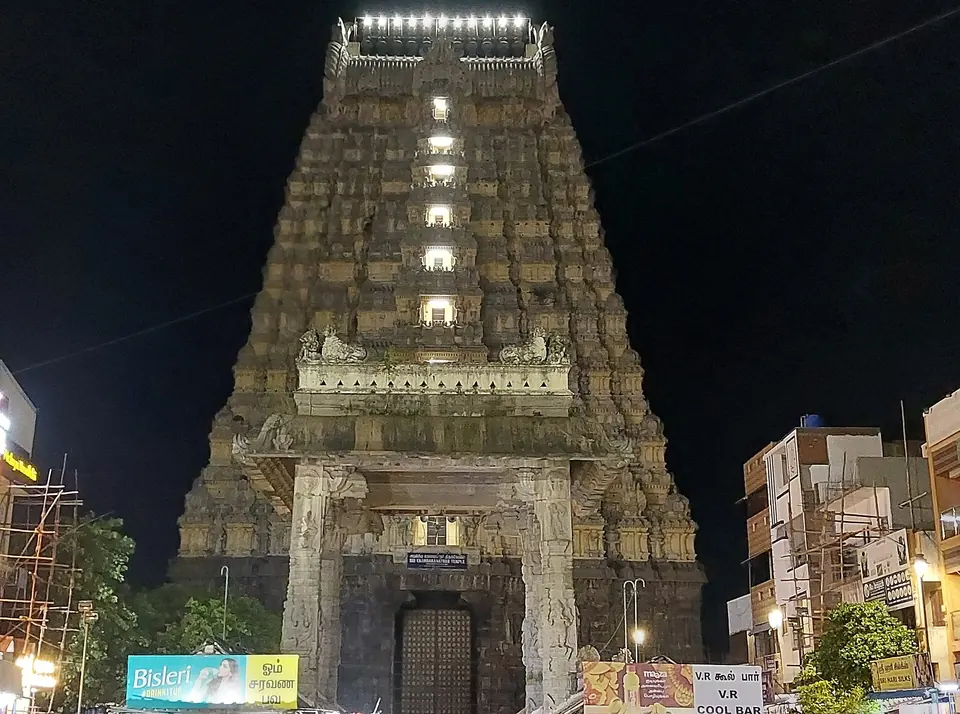
The inscription is cut on the north wall of the second enclosure (prakara) of the Ekamranatha temple.1 E. Hultzsch called this the largest of the many temples at Kanchipuram.1 The inscription has 17 Sanskrit verses in the Grantha script.1 The text calls itself an edict (sasana) of king Ganapati, who traced his descent from the race of the Sun.1
When Hultzsch published it in 1892, the inscription did not name the dynasty.1 He showed from the names of Ganapati’s predecessors that this Ganapati was the Kakatiya king of Warangal.1 He concluded that Kanchi then lay within the Kakatiya territories.1
Contents
The family line runs from the Sun through Manu, Sagara, Bhagiratha, Raghu and Rama to king Betmaraja. Hultzsch’s translation describes how people took him, mounted on his horse Garuda, for Vishnu on Garuda.2 Then came Prodaraja, who built a tank as large as the oceans and named it Jagatikesari after one of his own titles. Rudradeva followed him.23 Then came the eldest of his four younger brothers, Mahadeva, whose son was Ganapati.23
One verse asks “who can boast of the courage of king Ganapati”.3 At his rise Simhana lost heart, his soldiers overthrew the Kalinga king, and he was served by the kings of Lata and Gauda.3
The donor was Samanta-Bhoja of the Dochi family and the Kasyapa gotra, who was Ganapati’s minister and general (sainyapala).13 Hultzsch understood the verses to mean that he governed Kanchi for the king.13 By the king’s order he gave the Ekamra temple the village of Kalattur, so that the god could be worshipped with splendour.3
The grant was dated on a Tuesday, the eleventh tithi (lunar day) of the dark fortnight of Jyaishtha, Saka 1172 (Saka is an Indian way of counting years), the cyclic year Saumya.1 Using Robert Sewell’s tables, Hultzsch converted this to Tuesday, 8 June 1249.1
The Kakatiya genealogy
Hultzsch put this family line together with the Hanamkonda inscription of 1163, which calls Prola’s father Tribhuvanamalla.1 Here the same father is called Betmaraja.1 Hultzsch concluded that Betmaraja was his real name and Tribhuvanamalla a title.1 He drew up a short list of the kings: Betmaraja, Prola (surnamed Jagatikesarin), Rudradeva, Mahadeva and Ganapati.1 Local chronicles made Ganapati the son of Rudradeva. Hultzsch noted that an inscription quoted by Walter Elliot agreed with the Ekamranatha record in making him Mahadeva’s son.1
The Simhana verse and the Yadavas
Hultzsch took the Simhana who feared Ganapati to be the Yadava king Singhana II of Devagiri.4 Singhana, in turn, claimed to have uprooted the “head of the king of Telanga”.4 Hultzsch cited the Paithan grant of the Yadava Ramachandra. It says that Singhana’s predecessor Jaitugi I killed the king of Trikalinga and took his kingdom.4 Then Jaitugi fetched Ganapati “from the prison-house” and made him lord of his country.4
Hultzsch could not tell from these words whether the slain king was Ganapati’s father Mahadeva or his uncle Rudradeva.4 Nor could he tell by whom Ganapati had been imprisoned.4
The Kakatiyas in the south
Writing in 1960, D. C. Sircar listed about a hundred inscriptions from the Godavari, Krishna, Guntur, Kurnool, Kadapa (then Cuddapah) and Nellore districts. In his view they showed that the whole region north of the Chola kingdom belonged to Ganapati’s empire. He cited two of Ganapati’s own inscriptions at Kanchipuram, which he dated 1250, as proof that the Kakatiyas were pushing south.5
A later editor of a Srirangam record of Prataparudra likewise dated Kakatiya rule as far as Kanchipuram to about 1249.6 He named this inscription, another of Ganapati at Kanchipuram, and records of his ministers there.6 The two dates come from different conversions of the same Saka year, 1172. Hultzsch’s 8 June 1249 is the one worked out for this record.15
Editions
Hultzsch edited the text with a translation in the Indian Antiquary XXI (1892). His article also gathered what the Sanskrit treatise Prataparudriya says about the later Kakatiyas, including Rudramba (Rudramadevi) and her successor Prataparudra.47
Footnotes
-
E. Hultzsch, “Ekamranatha Inscription of Ganapati, dated Saka-Samvat 1172”, Indian Antiquary XXI (1892), p. 197 (archive.org (opens in a new tab)). ↩ ↩2 ↩3 ↩4 ↩5 ↩6 ↩7 ↩8 ↩9 ↩10 ↩11 ↩12 ↩13 ↩14 ↩15 ↩16 ↩17
-
Hultzsch, “Ekamranatha Inscription of Ganapati” (1892), p. 201, translation of verses 5–9 (archive.org (opens in a new tab)). ↩ ↩2 ↩3
-
Hultzsch, “Ekamranatha Inscription of Ganapati” (1892), p. 202, translation of verses 10–17 (archive.org (opens in a new tab)). ↩ ↩2 ↩3 ↩4 ↩5 ↩6 ↩7
-
Hultzsch, “Ekamranatha Inscription of Ganapati” (1892), p. 198 (archive.org (opens in a new tab)). ↩ ↩2 ↩3 ↩4 ↩5 ↩6 ↩7
-
D. C. Sircar, “Note on Two Eastern Ganga Inscriptions at Kanchipuram”, Epigraphia Indica XXXI (1960), p. 99 (archive.org (opens in a new tab)). Paraphrased. ↩ ↩2
-
V. Venkatasubba Ayyar, “Srirangam Inscription of Kakatiya Prataparudra; Saka 1239”, Epigraphia Indica XXVII (1956), p. 308 (archive.org (opens in a new tab)). Paraphrased. ↩ ↩2
-
Hultzsch, “Ekamranatha Inscription of Ganapati” (1892), p. 199 (archive.org (opens in a new tab)). ↩
Photos
References
Notes (0)
Sources (3)
Spotted an error on this page? Tell us
Last updated: