Kodavali rock inscription of Chandasati
A six-line Prakrit inscription cut into a rock-cut well beside a ruined Buddhist mound near Kodavali, north-west of Pithapuram in the Godavari district. It is dated in a regnal year of the Satavahana king Vasishthiputra Chandasati (Chandra Sati) and records a gift by a minister. Its year and wording have been read in three different ways.
The Kodavali inscription is the only stone record of the Satavahana king Vasishthiputra Chandasati.1 He was otherwise known from lead coins found in the Krishna (then Kistna) and Godavari districts.1 It is also the only Satavahana inscription known from the Godavari district in the sources used here.2 Robert Sewell took it as evidence of Andhra rule in that country early in the 3rd century CE.2 See Chandra Sri Satakarni.
The site
H. Krishna Sastri described the way to the site. From Pithapuram one goes about nine miles north-west along the Samalkot–Kattipudi road to the village of Kodavali.3 From there it is nearly two miles further to the foot of a range of low hills covered with thin forest.3 A gravel path, once apparently stepped with rubble, climbs to a mound on the top of a hillock called Dhanam-dibba, the “treasure mound”.1
There Krishna Sastri found what looked like the remains of a Buddhist stupa (relic mound) of large bricks and rough stone.1 It had a structure of dressed stone on its south side.1 Four rock-cut wells, 4 to 5 feet square and 6 to 7 feet deep, lie on the south and west sides of the mound.1 He thought they had stored water for a Buddhist monastery that excavation might reveal.1 Alexander Rea, who discovered the site, mentioned it in his report for 1907–08.1
The inscription
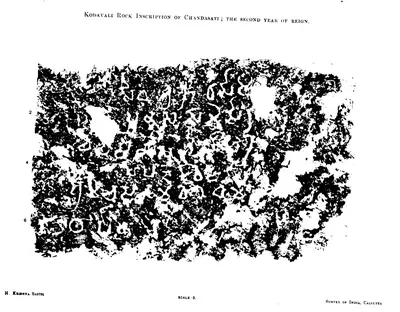
The inscription is cut in six lines on the north wall of one of the wells on the western side.1 That well measures about 5 ft 8 in by 5 ft 5 in.1 Krishna Sastri described the script as Brahmi of about the 3rd century CE.1 The words are separated by spaces.4 He compared this practice with the Hathigumpha inscription and the Myakadoni inscription of Pulumavi.4
Sten Konow first published the record in 1908.1 Krishna Sastri re-read it from the stone with C. R. Krishnama Acharlu, and their text differs much from Konow’s.1 In their translation it reads:
Success! In the reign of king Vasithiputa Sami-siri-Chamda-sati, in the year 2, month 1, the winter fortnight 2 (and) day 1, was established the charity (i.e., the gift) of a khamgu(?) by the minister Sasa (Sasa) of Khaddavali.5
Krishna Sastri took Khaddavali to be the old form of the village name Kodavali.1 He suggested that the doubtful word khamgu might mean the rock-cut well.1 He read the date as the first day of the second fortnight of the first month of winter.4 He equated it with a day in December 210 CE, in the second year of Chandasvati.4
Three readings
Scholars disagree about almost every detail:
- Sten Konow (1908) read the year, with doubt, as 13, and took the record to establish an earth-dwelling for an unnamed minister.14
- H. Krishna Sastri (1926) read the year as 2, with a month as well as a fortnight, and named the minister Sasa of Khaddavali.45
- Konow’s postscript (1926). Konow could not see the word raji or the month figure that Krishna Sastri read. He still thought the first figure was 10. He pointed out that no other southern inscription dated by seasonal fortnights also gives a month. He doubted the reading Khaddavali, though he admitted that the modern name supported it.5 He could not accept amachasasami as “by the minister Sasa”.5
- D. C. Sircar (1959) read the date as the second day of the second fortnight of winter in the eleventh regnal year. In his reading the amatya (minister or executive officer) Satyamitra set up a dharma, a religious object or institution, traces of which survive near the findspot.6
Date and significance
The record’s calendar date depends on where Chandasati is placed among the Satavahana kings. Sewell put the inscription about 208 CE.2 Smith’s table lists it as No. 1341 in Lüders’s list, under king No. 29, Chandasri, with an accession about 201 CE.7 E. J. Rapson’s coins point to an earlier king of the name, soon after Pulumavi.89
Sircar compared its letters with those of other late Satavahana records of the region.6 He found the Chinna inscription of Yajna Sri no earlier in script than this one and the Myakadoni record.6 Yet Yajna Sri is usually placed before both kings.6 In 1939 Sircar accepted Krishna Sastri’s equation of the second year with 210 CE as useful evidence for dating the late kings.10
About the sources. The year 210 CE that this site uses for the inscription is Krishna Sastri’s date.4 It is only one of the dates that the scholars above suggest.4278
Editions
- Sten Konow, Zeitschrift der Deutschen Morgenländischen Gesellschaft LXII (1908), p. 591 f., noticed as No. 1341 in Lüders’s List of Brahmi Inscriptions. Cited by Krishna Sastri; not consulted for this page.1
- H. Krishna Sastri, Epigraphia Indica XVIII (1925–26), pp. 316–319, with plate and Konow’s postscript.35
- D. C. Sircar’s revised reading, Epigraphia Indica XXXII (1957–58), p. 83, n. 7.6
Footnotes
-
Krishna Sastri, “The Kodavali Rock-Inscription of Chandasati” (1926), p. 317 and notes (archive.org (opens in a new tab)). ↩ ↩2 ↩3 ↩4 ↩5 ↩6 ↩7 ↩8 ↩9 ↩10 ↩11 ↩12 ↩13 ↩14 ↩15 ↩16 ↩17
-
Robert Sewell, The Historical Inscriptions of Southern India (1932), p. 324 (archive.org (opens in a new tab)). ↩ ↩2 ↩3 ↩4
-
H. Krishna Sastri, “The Kodavali Rock-Inscription of Chandasati”, Epigraphia Indica XVIII (1926), p. 316 (archive.org (opens in a new tab)). ↩ ↩2 ↩3
-
Krishna Sastri, “The Kodavali Rock-Inscription of Chandasati” (1926), p. 318 and notes (archive.org (opens in a new tab)). ↩ ↩2 ↩3 ↩4 ↩5 ↩6 ↩7 ↩8
-
Krishna Sastri, “The Kodavali Rock-Inscription of Chandasati” (1926), p. 319, translation and postscript by Sten Konow (archive.org (opens in a new tab)). ↩ ↩2 ↩3 ↩4 ↩5
-
D. C. Sircar, “Two Inscriptions from Guntur District”, Epigraphia Indica XXXII (1959), p. 83 and nn. 7, 9 (archive.org (opens in a new tab)). ↩ ↩2 ↩3 ↩4 ↩5
-
Vincent A. Smith, The Early History of India, 4th ed. (1924), table “The Later Andhra Kings and Connected Dynasties”, PDF p. 271 (archive.org (opens in a new tab)). ↩ ↩2
-
E. J. Rapson, Catalogue of the Coins of the Andhra Dynasty, the Western Ksatrapas, the Traikutaka Dynasty, and the “Bodhi” Dynasty (1908), p. xl (archive.org (opens in a new tab)). ↩ ↩2
-
Rapson, Catalogue of the Coins of the Andhra Dynasty (1908), catalogue p. 30, n. 1 (archive.org (opens in a new tab)). ↩
-
D. C. Sircar, The Successors of the Satavahanas in Lower Deccan (1939), p. 3 (archive.org (opens in a new tab)). ↩
Photos
References
Notes (0)
Sources (6)
Spotted an error on this page? Tell us
Last updated: