Chandra Sri Satakarni
Satavahana king, called Vasishthiputra Chandra Sati on his lead coins from the Krishna and Godavari districts. A rock inscription at Kodavali near Pithapuram calls him Chandasati. Scholars disagree whether he reigned soon after Pulumavi or near the end of the dynasty, and whether two kings of the name are involved.
Chandra Sri Satakarni is the name the Puranic lists give to one of the last kings of the Satavahana dynasty.12 Coins from the Telugu country name a Vasishthiputra Sri Chandra Sati.34 A rock inscription at Kodavali in the Godavari district names a Vasishthiputra Chandasati.34 Whether these are the same king, and where he stood in the dynasty, has been disputed since Rapson’s catalogue of 1908.
Names
Burgess gave the Puranic name as Chandrasri Satakarni, also read Vadasri.1 Sewell’s list has “Vada-Sri, or Chandravijna, or Vasishthiputra Chandra-Sri Satakarni”.2
On the coins Alexander Cunningham read the name as Vada-Sata, and Vincent Smith as Vada-Sataka[ni].5 Rapson showed that the first letter is cha, giving Cada or Canda, that is, Chandra.5
H. Krishna Sastri read the Kodavali inscription as Chamdasati.4 He suggested that sati might be a Prakrit form of svati, so that the name meant Chandasvati.4
Coins
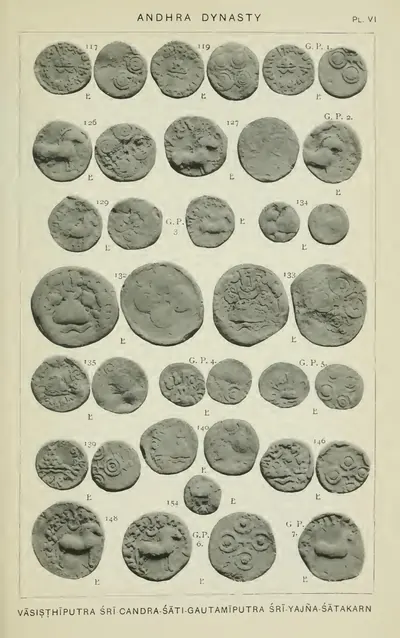
Rapson attributed to him lead coins of both Andhradesa fabrics (types of make).367 Those of Fabric A carry a three-arched stupa (relic mound) and the legend Rano Vasithiputasa Siri-Cada-Satisa, and those of Fabric B carry a horse.367
Robert Sewell found a lead coin at Gudivada that Cunningham read as a coin of “Sri Chanda”.8 Walter Elliot reported a coin of Cunningham’s with an elephant and the legend “Rajna Vasithiputasa Siri Chandasatasa”. He took the metronymic to show a third queen-mother of the name Vasishthi.9
Rapson thought the evidence pointed to two kings. Coins of the elephant type, very late in style, seem to read “Siri-Cada”, and he could not give them to the Chandra Sati whose Fabric B coins have a horse.1011 He gave them instead to a second Chandra, perhaps the Chandra Sri who stands next but one after Yajna Sri in the Puranas.1011
The Kodavali inscription
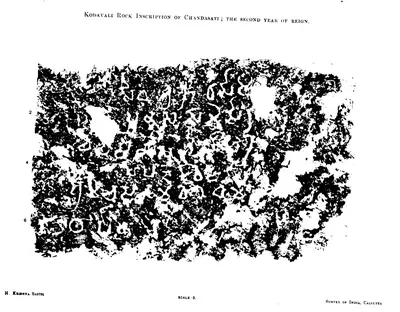
The only inscription of the king is cut into the wall of a well dug in the rock. The well is on a hillock beyond the village of Kodavali, about nine miles north-west of Pithapuram.124 Beside it are the remains of what looked like a Buddhist stupa, locally called Dhanam-dibba.124
Krishna Sastri read it as recording a gift in the second year of King Vasishthiputra Chamdasati.13 In his reading the giver was the minister (amacha) Sasa of Khaddavali, the old name of Kodavali.13 He interpreted the date as a day in December 210 CE.14
Sten Konow, who first published the record in 1908, doubted much of this reading in a postscript.13 D. C. Sircar later read the year as eleven, and the minister’s name as Satyamitra.15 In Sircar’s reading this minister had set up a religious foundation (dharma) there.15 See Kodavali inscription.
Place in the dynasty
Rapson placed Chandra Sati early. His coins share their design with those of Pulumavi and Siva Sri, and Rapson thought he might be a brother of Pulumavi.616 He identified him with the Skandhasvati to whom the Matsya Purana gives seven years.616 He thought the Puranic Siva-Skanda might be a corruption of his name.616
Rapson noted in his catalogue that Smith had dated the coins to about 219 CE, but that the coins themselves pointed to an earlier position.3 Smith reported D. R. Bhandarkar’s view that Pulumavi was succeeded by his brothers Siva Sri and Sri Chandra Sati.17
Others put Chandra Sri near the end of the line:
- James Burgess (1887): about 210–215 CE.1
- Sewell (1932): accession about 219 CE and a reign of ten years.2 Sewell says that his dates “are taken from Vincent Smith’s ‘Early History of India’, pp. 183 f.”, without naming the edition.18 Rapson notes that Smith had given the date 219 CE in a German journal in 1902.3 Sewell separately suggested that the earlier Sivaskanda might be the same as a Vasishthiputra Chandrasati whom L. D. Barnett found living in 165 CE.2 He took the Kodavali inscription to show Andhra rule near Pithapuram about 208 CE.18
- Smith (1924): king No. 29, accession about 201 CE and ten years. He gave the Kodavali record and the eastern coins to this king, while noting that Rapson preferred an earlier date for the coins.1917 He wrote that Chandra Sri’s “real existence” was attested by a few lead coins bearing his name.17
- D. C. Sircar (1939) treated Chandra Sati as a successor of Yajna Sri. He accepted Krishna Sastri’s suggestion that his second year corresponded to 210 CE, as useful for dating the late kings.20
Footnotes
-
James Burgess, The Buddhist Stupas of Amaravati and Jaggayyapeta (1887), p. 5 (archive.org (opens in a new tab)). ↩ ↩2 ↩3
-
Sewell, Historical Inscriptions (1932), p. 325 (archive.org (opens in a new tab)). ↩ ↩2 ↩3 ↩4
-
Rapson, Catalogue of the Coins of the Andhra Dynasty (1908), catalogue p. 30 and n. 1 (archive.org (opens in a new tab)). ↩ ↩2 ↩3 ↩4 ↩5 ↩6
-
Krishna Sastri, “The Kodavali Rock-Inscription of Chandasati” (1926), p. 317 (archive.org (opens in a new tab)). ↩ ↩2 ↩3 ↩4 ↩5 ↩6
-
Rapson, Catalogue of the Coins of the Andhra Dynasty (1908), p. lxxii (archive.org (opens in a new tab)). ↩ ↩2
-
E. J. Rapson, Catalogue of the Coins of the Andhra Dynasty, the Western Ksatrapas, the Traikutaka Dynasty, and the “Bodhi” Dynasty (1908), p. xl (archive.org (opens in a new tab)). ↩ ↩2 ↩3 ↩4 ↩5
-
Rapson, Catalogue of the Coins of the Andhra Dynasty (1908), p. lxxiv (archive.org (opens in a new tab)). ↩ ↩2
-
Alexander Rea, South Indian Buddhist Antiquities (1894), p. 20 (archive.org (opens in a new tab)). ↩
-
Walter Elliot, Coins of Southern India (1886), p. 20 (archive.org (opens in a new tab)). ↩
-
Rapson, Catalogue of the Coins of the Andhra Dynasty (1908), p. lxxvi (archive.org (opens in a new tab)). ↩ ↩2
-
Rapson, Catalogue of the Coins of the Andhra Dynasty (1908), pp. xlii–xliii (archive.org (opens in a new tab)). ↩ ↩2
-
H. Krishna Sastri, “The Kodavali Rock-Inscription of Chandasati”, Epigraphia Indica XVIII (1926), p. 316 (archive.org (opens in a new tab)). ↩ ↩2
-
Krishna Sastri, “The Kodavali Rock-Inscription of Chandasati” (1926), p. 319, translation and Sten Konow’s postscript (archive.org (opens in a new tab)). ↩ ↩2 ↩3
-
Krishna Sastri, “The Kodavali Rock-Inscription of Chandasati” (1926), p. 318 (archive.org (opens in a new tab)). ↩
-
D. C. Sircar, “Two Inscriptions from Guntur District”, Epigraphia Indica XXXII (1959), p. 83, n. 7 (archive.org (opens in a new tab)). ↩ ↩2
-
Rapson, Catalogue of the Coins of the Andhra Dynasty (1908), p. lxxiii (archive.org (opens in a new tab)). ↩ ↩2 ↩3
-
Vincent A. Smith, The Early History of India, 4th ed. (1924), pp. 223–224 and p. 224, n. 1 (archive.org (opens in a new tab)). ↩ ↩2 ↩3
-
Robert Sewell, The Historical Inscriptions of Southern India (1932), p. 324 (archive.org (opens in a new tab)). ↩ ↩2
-
Smith, Early History of India (1924), table “The Later Andhra Kings and Connected Dynasties”, PDF p. 271 (archive.org (opens in a new tab)). ↩
-
D. C. Sircar, The Successors of the Satavahanas in Lower Deccan (1939), p. 3 (archive.org (opens in a new tab)). ↩
Photos
Related
Dynasties
References
Notes (0)
Sources (9)
Spotted an error on this page? Tell us
Last updated: