Korumelli plates of Rajaraja I
Five copper plates of the Eastern Chalukya king Rajaraja I (Rajaraja Narendra). They grant the village of Korumelli in Guddavadi-vishaya to a Brahmin on the occasion of a lunar eclipse. Once in Sir Walter Elliot's collection and now in the British Museum, they were edited by J. F. Fleet in 1885. They give the date of the king's coronation in Saka 944 (August 1022), and tell of his father's marriage to the Chola princess Kundava.
These plates record a grant by Rajaraja Narendra, the Eastern Chalukya king remembered as the patron of the Telugu Mahabharata. With the later Nandamapundi grant, they are the main dated documents of his reign. They give the year of his coronation and set out his Chola ancestors on his mother’s side.1
Discovery and present location
The plates belonged to Sir Walter Elliot, who gave them to the British Museum.2 A transcript was printed in his collection of Telugu Sasanams.2 There they are entered as coming from the village of Korumelli in the Rajamahendri district.3 This is also the village granted in the inscription.3
V. Rangacharya’s list of 1919 lists “the Korumilli Plates of Rajaraja I” among the general copper plates of Godavari district, not under any taluk.4 In 1897 E. Hultzsch edited a Pithapuram pillar inscription that names Korumelli among the villages of the Guddavadi district.5 He identified it with “the modern Korumilli”, No. 120 on the Madras Survey map of the Ramachandrapuram taluk.5
Description
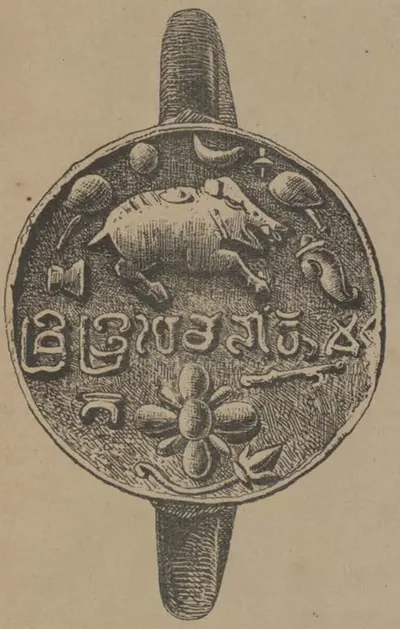
There are five plates, each a little under 10 inches long and over 5 inches broad.3 Their high rims have kept the writing almost perfectly preserved.3 The ring had already been cut when Fleet saw them.3 The round seal shows, in relief, the legend Sri-Tribhuvanankusa.3 Above it are a recumbent (lying) boar, the sun and moon, two fly-whisks, a double drum, a conch and perhaps a spear-head.3 Below it are a floral device, an elephant-goad, a closed lotus or sceptre, and a sign that Fleet took for a makara-torana (an arch with sea-monster ends).3
The first plate is a palimpsest (reused, with older writing beneath).3 Its outer side shows traces of twelve lines in an older and squarer form of the same alphabet, carefully beaten in.3 It also has a rim on both sides.3 Fleet concluded that it had been an inner plate of an older grant, reused for this one.3 The Nandamapundi grant of the same king also reused plates from an earlier charter.6
Script and language
Fleet described the characters as Old-Kanarese of the period.3 The language is Sanskrit throughout, except for one or two Kannada genitive forms in the description of the boundaries.3
Content
The inscription begins with a Pauranik (legendary) family line from Vishnu down to Udayana.3 It then tells of a king named Vijayaditya, of the line of the fifty-nine emperors of Ayodhya.3 He went south to conquer and was killed in battle with Trilochana-Pallava.3 His pregnant queen fled to the agrahara (Brahmin village) of Mudivemu.3 There she bore a son, Vishnuvardhana, who later conquered the Kadambas, the Gangas and other kings.3
Fleet dismissed this passage as “a mere farrago of vague tradition and Puranic myths, of no authority”.3
He thought the legend rested on two facts.3 The Chalukyas had come from the north and found the Pallavas holding lands they later took.3 And there was a Kadamba tradition of an ancestor named Trilochana.3 (See also the Ranastipundi grant, the earliest known record with this legend.)
The historical family line follows.31 Kubja-Vishnuvardhana, brother of Satyasraya (Pulakesin II), “ruled over the country of Vengi for eighteen years”.31 The usual list of kings then runs down to Amma II, with seven days for Indraraja.1 After Amma II came his half-brother Danarnava for three years.1 Then the kingdom was “without a lord” for twenty-seven years.1 Chalukya-Chandra, the son of Danarnava, reigned for twelve years, and after him his younger brother Vimaladitya.1
The plates then name the Chola king Rajaraja, “of the lineage of the Sun”, his son Rajendra-Choda, and Rajendra’s younger sister Kundavamahadevi.1 Vimaladitya married Kundava and reigned for seven years.1 Their son was Rajaraja, also called Vishnuvardhana.1
The grant itself records that Rajaraja gave the village of Korumelli, in the Guddavadi-vishaya, on the occasion of an eclipse of the moon.17 The donee was a Brahmin named Chidamarya of the Bharadvaja gotra (clan) and the Apastamba sutra.17 No other details are given of the day of the gift.1
The closing lines name the composer of the verses, Chetanabhatta, son of Rachiya-Pedderi-Bhima, and the writer, Gandacharya.8 Gandacharya also wrote the Nandamapundi grant.6 V. Venkayya took Chetanabhatta to be the son of Bhimanabhatta, who composed the Ranastipundi grant of Vimaladitya.9
Date
The plates give the date of Rajaraja’s coronation.1 It fell in Saka 944 (Saka is an Indian way of counting years), with the sun in Simha (the Lion), on a Thursday, the second day of the dark fortnight of Bhadrapada.1 The two editors who calculated it reached different results:
- Fleet, using the tables in Cunningham’s Indian Eras, equated it in 1885 with Thursday, 19 July 1022.1
- F. Kielhorn’s list of 1903 gives Thursday, 16 August 1022. Rangacharya repeated this date in 1919.104
The king’s number
Fleet first called the donor “Rajaraja II”, because his mother’s father, the Chola Rajaraja, had the same name. In 1890 he withdrew this and called him Rajaraja I, following E. Hultzsch.11 He did so because the donor was the first king of that name in the Chalukya family.11
Edition
J. F. Fleet, “Sanskrit and Old-Canarese Inscriptions, No. CLIII: Korumelli Plates of Rajaraja II.—after Saka 944”, Indian Antiquary XIV (1885), pp. 48–55, with text and plates.2
Footnotes
-
Fleet, “Korumelli Plates of Rajaraja” (1885), p. 50, with note 3 (archive.org (opens in a new tab)). ↩ ↩2 ↩3 ↩4 ↩5 ↩6 ↩7 ↩8 ↩9 ↩10 ↩11 ↩12 ↩13 ↩14 ↩15 ↩16
-
J. F. Fleet, “Sanskrit and Old-Canarese Inscriptions, No. CLIII: Korumelli Plates of Rajaraja”, Indian Antiquary XIV (1885), p. 48 (archive.org (opens in a new tab)). ↩ ↩2 ↩3
-
Fleet, “Korumelli Plates of Rajaraja” (1885), p. 49 (archive.org (opens in a new tab)). ↩ ↩2 ↩3 ↩4 ↩5 ↩6 ↩7 ↩8 ↩9 ↩10 ↩11 ↩12 ↩13 ↩14 ↩15 ↩16 ↩17 ↩18 ↩19 ↩20 ↩21 ↩22 ↩23 ↩24 ↩25
-
V. Rangacharya, A Topographical List of the Inscriptions of the Madras Presidency, Vol. II (1919), p. 711, Godavari district, No. 4-A (archive.org (opens in a new tab)). ↩ ↩2
-
E. Hultzsch, “Pithapuram Pillar Inscription of Mallideva and Manma-Satya II”, Epigraphia Indica IV (1896–97), pp. 83–84 and p. 84 note 2 (archive.org (opens in a new tab)). ↩ ↩2
-
F. Kielhorn, “Nandamapundi Grant of Rajaraja I”, Epigraphia Indica IV (1897), p. 301 (archive.org (opens in a new tab)). ↩ ↩2
-
Fleet, “Korumelli Plates of Rajaraja” (1885), p. 54, text lines 102–103 (archive.org (opens in a new tab)). ↩ ↩2
-
Fleet, “Korumelli Plates of Rajaraja” (1885), p. 55, text (archive.org (opens in a new tab)). ↩
-
V. Venkayya, “Ranastipundi Grant of Vimaladitya”, Epigraphia Indica VI (1900–01), p. 351 (archive.org (opens in a new tab)). ↩
-
F. Kielhorn, “A List of the Inscriptions of Southern India”, appendix to Epigraphia Indica VII (1902–03), p. 97, No. 569 (archive.org (opens in a new tab)). ↩
-
J. F. Fleet, “Sanskrit and Old-Canarese Inscriptions, No. 192: Chellur Copper-plate Grant of Vira-Chodadeva”, Indian Antiquary XIX (1890), p. 424, note (archive.org (opens in a new tab)). ↩ ↩2
Photos
References
Notes (0)
Sources (6)
Spotted an error on this page? Tell us
Last updated: