Kalidindi grant of Rajaraja I
A Sanskrit copper-plate grant of the Eastern Chalukya king Rajaraja I (Rajaraja Narendra). A farmer dug it up at Kalidindi near the Kolleru lake in 1938, and N. Venkataramanayya edited it in 1952. It records a battle in which three Chola generals sent into the Andhra country fell fighting the commanders of the Karnata (Western Chalukya) king. It also records the three Shiva temples Rajaraja built at Kalidindi in their memory. It says that the Chola emperor Rajendra gave Rajaraja his daughter Ammanga as chief queen.
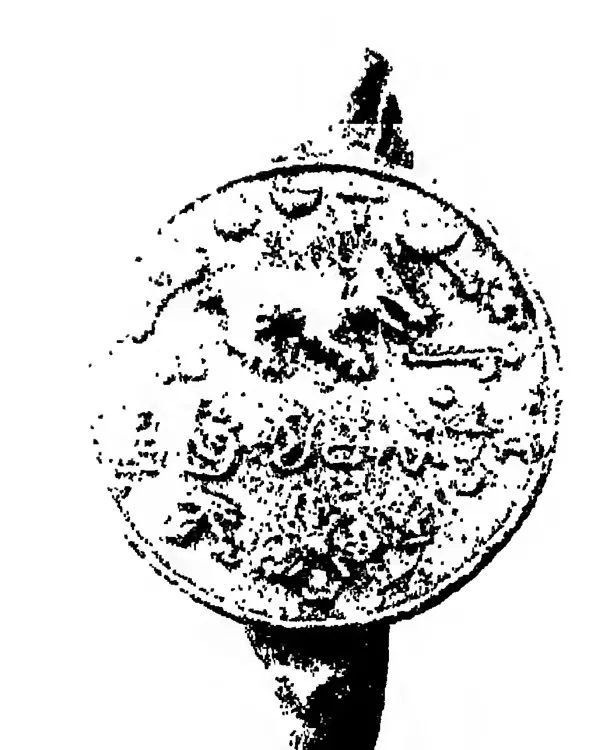
This grant of Rajaraja Narendra, the Eastern Chalukya king whom the editors call Rajaraja I, is the only record of his reign that describes a war.1 It tells of a battle between Chola generals and the army of the king of Karnata, in which the commanders on both sides were killed.1 In their memory the king built three Shiva temples at Kalidindi and endowed them with three villages.1 It is also the third known copper-plate charter of the king, after the Korumelli and Nandamapundi grants.2
Discovery
A farmer found the plates in 1938 while digging for earth at Kalidindi, a village in the Kaikalur taluk of Krishna district.3 He gave them to G. Ramabrahmam Chaudary, editor of the newspaper Prajamitra.3 Chaudary passed them to N. Venkataramanayya of the University of Madras for decipherment and publication.3 The Government Epigraphist examined them, and they were registered as copper plate No. 5 in the report for 1937–38.34 See Kalidindi.
Description
There are five plates, each about 5 inches by 10, of which the last is a broken fragment.32 They hang on a ring about 5 inches across, which had been cut before Venkataramanayya received them.32 Its ends are soldered into a round seal about 3 inches across with a raised rim.32 With the ring the set weighs 292 tolas, and the plates alone 200.32
Venkataramanayya called the seal a very fine specimen of the seals of the dynasty.2 Its base is moulded like a four-petalled flower.2 Across the middle runs the legend Sri-Tribhuvanankusah, with the running boar of the family above it, facing left.2
Around the boar are an elephant-goad, a double drum, a conch, two fly-whisks and a royal parasol, with the crescent moon and the sun at the top.2 Below the legend are a four-legged stool, a four-petalled flower and a lotus bud on its stalk.2
The first side of the first plate and the second side of the fifth are blank.2 From line 75 to the end the plates are palimpsests (plates written over earlier writing).2 Traces of the earlier writing, thoroughly beaten in, can be seen but not read.2
Venkataramanayya noted that all three known sets of copper plates of Rajaraja I were partly palimpsests.2 This was a practice of the king’s secretariat whose reasons he could not explain.2 He thought the first two plates might have been engraved by a different hand.2
Script and language
The alphabet is old Telugu, of the kind usual in inscriptions of the period.2 The language is Sanskrit throughout, in 41 verses in various metres and eight prose passages.2 A few Telugu words appear in the description of the village boundaries, such as the name of the lower Gudravara district.2 Venkataramanayya judged its style and diction superior to those of the Korumelli plates, especially in the passages on the Chola emperor and on the battle.5
The genealogy
The text has four parts:6
- the genealogy of the Eastern Chalukyas down to Rajaraja6
- the circumstances of the gift6
- the boundaries of the villages6
- the closing curses, perhaps with the names of the author and the scribe6
The genealogy begins with a legendary descent from Narayana, Brahma, Atri and the Moon down to Udayana.6 Fifty-nine unnamed kings at Ayodhya follow.6 In this legend, a sixtieth king, Vijayaditya, went south and died fighting Trilochana-Pallava.6 His posthumous son Vishnuvardhana restored the family’s fortunes.6
Venkataramanayya pointed out that no trace of this legend appears in the dynasty’s records before Vimaladitya’s accession.67 He thought it might reflect Chola influence after the main line was restored to power in 999–1000.67 He rejected the ancestor Vijayaditya as a historical person, noting that he had earlier accepted the belief himself.67
The historical part runs from Kubja-Vishnuvardhana to Rajaraja and agrees with other grants.7 Like the Korumelli plates, it has a slightly different wording for the seven-day reign of Indraraja.7
It adds two facts not known from Rajaraja’s other records.7 As a boy, he was invested with the necklace (kanthika) of the heir apparent.7 His maternal uncle was the Chola emperor Rajendra-Choda Madhurantaka.7 Hearing of Rajaraja’s qualities, Rajendra gave him his daughter Ammanga, who became his chief queen.7
A long passage praises the Chola emperor.7 Venkataramanayya took two of its verses to allude to Rajendra’s expedition to the Ganges and his conquests overseas.7 He thought the marriage was meant to bind Vengi permanently to the Chola kingdom.1
The coronation date
Like the Korumelli and Nandamapundi grants, this one gives Rajaraja’s coronation in Saka 944 (Saka is an Indian way of counting years).7 The day was a Thursday, the second day of the dark fortnight of Bhadrapada, with the sun in the sign of the Lion.7 Venkataramanayya equated it with 16 August 1022.7
That was nearly four years after the latest known date of his father Vimaladitya, in August 1018.781 Venkataramanayya argued that Rajaraja had begun to reign in 1019 or 1020, and that his coronation had been delayed by political troubles in Vengi.781 He based this on inscriptions that give both a regnal year and a Saka year, and on the Pamulavaka plates of Vijayaditya VII.781 He cited Chola inscriptions of about 1021 that refer to an expedition sent against Vengi by Rajendra I.781 See Rajaraja Narendra.
The battle and the temples
The grant says that the general Rajaraja Brahma-Maharaja had risen to eminence by the favour of Rajendra-Chola Madhurantaka and guarded his kingdom.1 On his sovereign’s orders, he marched into the Andhra country with a great army and two other generals.1 These were Uttama-Choda Chodakon and Uttama-Chola Miladudaiyan.1 The three Tamil commanders fought the commanders of the king of Karnata, and the commanders on both sides perished with their forces.1
The epigraphical report of 1937–38 put the start of the campaign differently.4 In its account, the Chola king had sent the generals at Rajaraja’s request.4 Venkataramanayya thought the battle had ended indecisively, or at least not in a Chola victory.1
Rajaraja then built at Kalidindi a temple of Shiva called Rajarajesvaram, in memory of Rajaraja Brahma-Maharaja.14 He built two other Shiva temples in memory of the other two generals.14 For worship in them, and for a feeding house for fifty students, he gave three villages.14 These were Kalidindi, renamed Madhurantakanallur, and the villages of Kadaparru and Avakuru.14 Venkataramanayya thought each temple probably received one village.9
Where and when was the battle fought?
The grant names neither the place nor the date of the battle.110 Venkataramanayya reasoned that memorial temples were sometimes built where the dead were buried or cremated.110 So he thought the battle had probably been fought near Kalidindi.110 The epigraphical report of 1937–38 had drawn the same conclusion.4
He dated the battle between 1022 and 1044, the last year of Rajendra-Chola.10 He suggested a link with a Western Chalukya record of 1037 from Hottur.10 That record gives a general of Jayasimha II, Chavanarasa, the title of destroyer of the pride of the fort of Bijavadi.10 If Bijavadi is Vijayawada (then Bezwada), less than fifty miles from Kalidindi, the battle may belong to the same campaign.10
He went on to suggest that the battle might be connected with Vijayaditya VII’s seizure of the throne from Rajaraja in 1031.10 He noted that Rajaraja had Chola support, and that his rival may have had Western Chalukya help.10 He identified the king of Karnata with the Western Chalukya Jayasimha II, as the report of 1937–38 had done.104 The report itself thought the grant was issued shortly after Rajaraja’s accession in 1022.24
The villages
All three villages lay in the lower (pallapu) Gudravara district.94 The report of 1937–38 took the district’s name from Gudivada.94
Kalidindi was bounded by Potumbarru on the north and north-east, Konneki on the east, Kadaparru on the west and Tadinadu on the north-west.9 Kadaparru lay west of Kalidindi, between it and Avakuru.9 The boundaries of Avakuru are mostly lost with the broken fifth plate.9
Venkataramanayya found that Kalidindi and Avakuru kept their names, on the eastern edge of the Kolleru lake in the Kaikalur taluk.9 He could not trace Kadaparru.9 Among the boundary villages, he identified Tadinadu with Tadinada, Potumbarru with Potumarru and Vevaka with Vaivaka.9
The officer, the poet and the engraver
The names of the executor, the composer and the scribe are lost.9 Venkataramanayya recognised the last surviving line as the beginning of a verse in the Korumelli plates.9 From it he concluded that the executor (ajnapti) was the Katakesa.9 He also concluded that the composer was Betana-bhatta, son of Rachiya-Pedderi-Bhima, and the scribe Gandacharya.9
He took Katakesa to be the title of an office, not a personal name.95 He held that Bhima, or Bhimana-bhatta, had composed the new form of the dynasty’s eulogy in the Ranastipundi grant of Vimaladitya.95 He held that Bhima’s son Betana-bhatta succeeded to his post.95
J. F. Fleet, editing the Korumelli plates in 1885, read the composer’s name in the same verse as Chetanabhattaka, and the scribe’s as Gandacharya.11 See the Korumelli plates.
Footnotes
-
Venkataramanayya, “Kalidindi Grant” (1952), p. 62 and note 1 (archive.org (opens in a new tab)). ↩ ↩2 ↩3 ↩4 ↩5 ↩6 ↩7 ↩8 ↩9 ↩10 ↩11 ↩12 ↩13 ↩14 ↩15 ↩16 ↩17 ↩18 ↩19 ↩20
-
Venkataramanayya, “Kalidindi Grant” (1952), p. 58 and notes (archive.org (opens in a new tab)). ↩ ↩2 ↩3 ↩4 ↩5 ↩6 ↩7 ↩8 ↩9 ↩10 ↩11 ↩12 ↩13 ↩14 ↩15 ↩16 ↩17 ↩18 ↩19 ↩20
-
N. Venkataramanayya, “Kalidindi Grant of Eastern Chalukya Rajaraja I”, Epigraphia Indica XXIX (1951–52), p. 57 and note 9 (archive.org (opens in a new tab)). ↩ ↩2 ↩3 ↩4 ↩5 ↩6 ↩7 ↩8
-
Annual Report on South Indian Epigraphy for the Year ending 31st March 1938 (1942), Part II, para. 14, p. 82 (archive.org (opens in a new tab)). ↩ ↩2 ↩3 ↩4 ↩5 ↩6 ↩7 ↩8 ↩9 ↩10 ↩11 ↩12
-
Venkataramanayya, “Kalidindi Grant” (1952), p. 65 (archive.org (opens in a new tab)). ↩ ↩2 ↩3 ↩4
-
Venkataramanayya, “Kalidindi Grant” (1952), p. 59 (archive.org (opens in a new tab)). ↩ ↩2 ↩3 ↩4 ↩5 ↩6 ↩7 ↩8 ↩9 ↩10 ↩11 ↩12
-
Venkataramanayya, “Kalidindi Grant” (1952), p. 60 (archive.org (opens in a new tab)). ↩ ↩2 ↩3 ↩4 ↩5 ↩6 ↩7 ↩8 ↩9 ↩10 ↩11 ↩12 ↩13 ↩14 ↩15 ↩16 ↩17 ↩18
-
Venkataramanayya, “Kalidindi Grant” (1952), p. 61 (archive.org (opens in a new tab)). ↩ ↩2 ↩3 ↩4
-
Venkataramanayya, “Kalidindi Grant” (1952), p. 64 (archive.org (opens in a new tab)). ↩ ↩2 ↩3 ↩4 ↩5 ↩6 ↩7 ↩8 ↩9 ↩10 ↩11 ↩12 ↩13 ↩14 ↩15 ↩16
-
Venkataramanayya, “Kalidindi Grant” (1952), p. 63 (archive.org (opens in a new tab)). ↩ ↩2 ↩3 ↩4 ↩5 ↩6 ↩7 ↩8 ↩9 ↩10
-
J. F. Fleet, “Sanskrit and Old-Canarese Inscriptions, No. CLIII: Korumelli plates of Rajaraja”, Indian Antiquary XIV (1885), p. 55, text (archive.org (opens in a new tab)). ↩
Photos
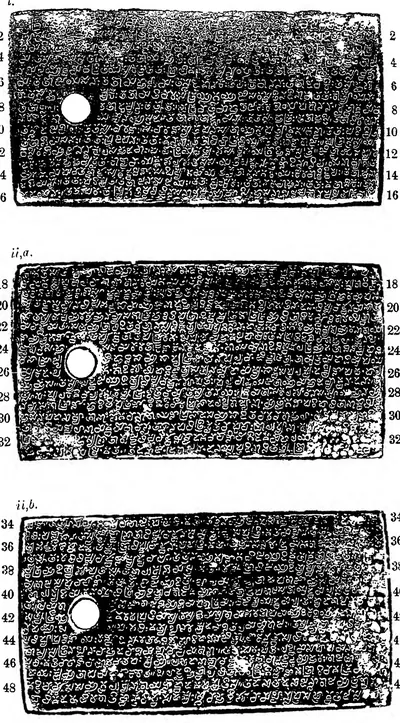 "Kalidindi Grant of Eastern Chalukya Rajaraja I", plates i, ii a and ii b (Epigraphia Indica XXIX, Plate I, between pp. 66 and 67 (PDF p. 140))Inscription rubbing · 1952
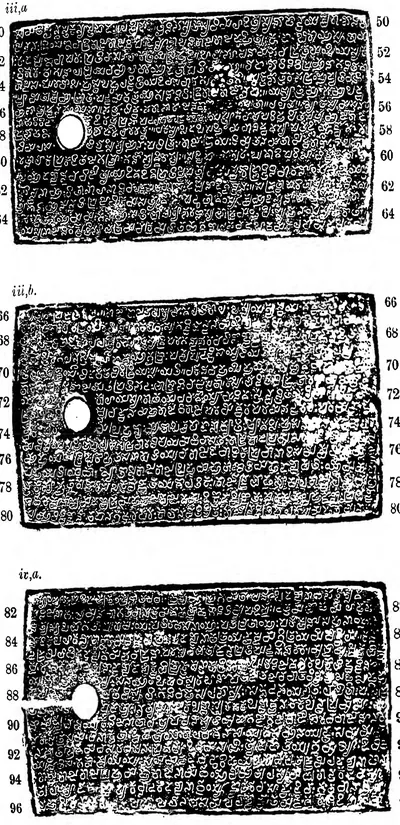 "Kalidindi Grant of Eastern Chalukya Rajaraja I", plates iii a, iii b and iv a (Epigraphia Indica XXIX, Plate I, between pp. 66 and 67 (PDF p. 141))Inscription rubbing · 1952
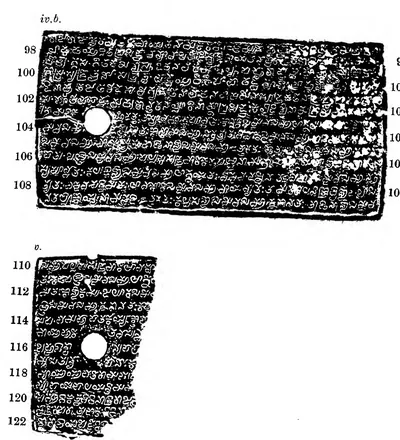 "Kalidindi Grant of Eastern Chalukya Rajaraja I", plates iv b and v (Epigraphia Indica XXIX, Plate II, between pp. 70 and 71 (PDF p. 146))Inscription rubbing · 1952
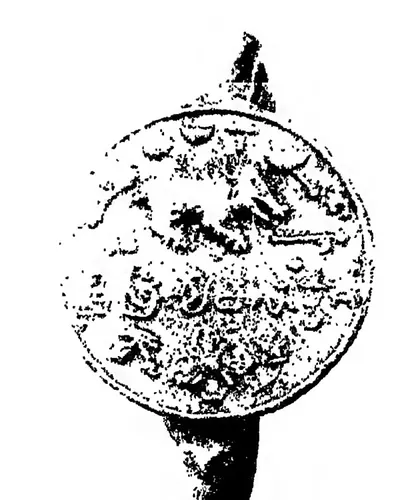 "Seal (From a photograph)", seal of the Kalidindi grant of Rajaraja I (Epigraphia Indica XXIX, Plate II, between pp. 70 and 71 (PDF p. 146))Historic photograph · 1952
References
Notes (0)
Sources (3)
Spotted an error on this page? Tell us
Last updated: