Pulakesin II
Chalukya king of Badami (609–642), the son of Kirtivarman I. His Aihole inscription of 634–35 says that he humbled the Kalingas and Kosalas, took the fortress of Pishtapura (Pithapuram), ravaged 'the water of Kunala' (taken to be the Kolleru lake) and drove the Pallava king behind the walls of Kanchi. He gave the conquered Vengi country to his younger brother Vishnuvardhana, the founder of the Eastern Chalukyas. His Kopparam plates of about 631 grant land in the Guntur country. He died when the Pallava Narasimhavarman I took Badami, probably in 642.
Pulakesin II was the most powerful of the Chalukya kings of Badami.12 For the Telugu country he matters as the conqueror who took Pishtapura (Pithapuram) and the Kolleru lake country.12 He placed his brother in Vengi, and so began the Eastern Chalukya line that ruled the coast for centuries.12
Family and names
Pulakesin II was a son of the Chalukya king Kirtivarman I, and a grandson of Pulakesin I.34 His father, Kirtivarman I, was the eldest son of Pulakesin I.5 Mangalesa, his uncle, was the younger brother of Kirtivarman I and, in Fleet’s view, probably his half-brother.6 Fleet held that Kirtivarman I left at least two sons, Pulakesin II and Vishnuvardhana, later called Kubja Vishnuvardhana.3
A grant from Nirpan in the Nasik district names a third son, Dharasraya-Jayasimhavarman.378 But Fleet accepted the third son only “if the Nirpan grant is to be trusted”.378 He thought the grant itself “extremely suspicious”.378
His name is written Polekesin, Pulikesin and Pulakesin.910 He was best known by the title Satyasraya, “the asylum of truth”.910 This title stands in place of his name in the later charters of his family and in the Eastern Chalukya records.910
Fleet wrote that he took the title Paramesvara, “supreme lord”, on defeating the northern king Harshavardhana.102 D. C. Sircar doubted this.11 In his view Pulakesin took the name after saving his homeland from its enemies, and the victory over Harsha later gave it an added meaning.11
The road to the throne
Mangalesa had a son for whom he tried to secure the throne. The Aihole inscription says that Pulakesin found his uncle jealous of him, and so he “had formed the resolution to wander abroad as an exile”.12 Mangalesa lost both his kingdom and his life.12
Fleet placed Mangalesa’s death about 608, in the civil war with his nephew.13 He suggested that the unnamed son might be Satyasraya-Dhruvaraja-Indravarman, a governor in the Konkan, though he did not think this son ever reigned.3 Sewell names the son Dhruvaraja alias Indravarman without hesitation.14
After a period of confusion, Pulakesin beat off two invaders, Appayika and Govinda.110 He retook the Kadamba capital Banavasi, and was crowned, probably in 609.110 A grant of his third year, 612, issued at Vatapi, came from Hyderabad in the Deccan.15
Conquests
The Aihole inscription was written in 634–35 by the poet Ravikirti.1617 It lists his wars:1617
- against the Gangas and Alupas1617
- against the Mauryas of the Konkan1617
- against the city of Puri, “the Fortune of the western sea”1617
- against the Latas, Malavas and Gurjaras1617
- against Harsha, whose “mirth (harsha) melted away by fear”1617
F. Kielhorn translated the part on the east.18 In his translation the Kalingas and the Kosalas were “made to evince signs of fear”.18 Pishtapura, “hard pressed” by him, “became a fortress not difficult of access”.18 He ravaged “the water of Kunala”, which was coloured with the blood of men and filled with armoured elephants.18 Then he drove the lord of the Pallavas behind the walls of Kanchipura.18 He crossed the Kaveri, and caused “great prosperity” to the Cholas, Keralas and Pandyas.18
Kielhorn identified Pishtapura with Pithapuram in the Godavari district.1920 He argued that “the water of Kunala” could only be the Kolleru lake, because the verses follow the march from north to south down the coast.1920 Fleet named the Pallava king as Mahendravarman I.1
Sewell has Pulakesin drive Mahendra I out of the northern Telugu country.14 He notes that the Pallava Kasakudi plates claim a Pallava victory over Pulakesin at Pullalura near Kanchi, and he thought the Chalukya army was beaten back from there.14 (See Mahendravarman I.)
Vengi and the Guntur country
Fleet thought that Vengi was probably taken during the campaign in which Pithapuram fell.2 Pulakesin made his younger brother Vishnuvardhana heir-apparent in 615.2 Later the kingdom proved “too extensive to be managed entirely from the western capital at Badami”.2 So Pulakesin sent his brother to govern Vengi.2 Before 632, by agreement or by rebellion, Vishnuvardhana became king there in his own right.2
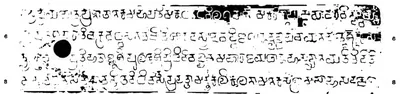
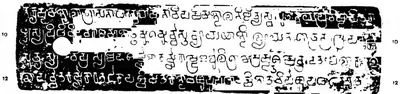
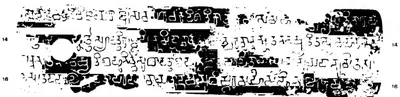
The Kopparam plates were found near Kopparam in the Narasaraopet taluk of the Guntur district.4 They are dated in Pulakesin’s 21st year.4 They grant a field of eight hundred nivartanas (a land measure) in the village of Irbuli in Karmarashtra to a Brahmana living at Mugamur.4
Robert Sewell’s postscript to the edition found that the date fits Thursday, 10 October 631.21 E. Hultzsch read the executor of the grant, “Prithividuvaraja”, as Vishnuvardhana.22 He concluded that Vishnuvardhana still depended on Pulakesin in that year.22
Fame abroad
Fleet cites an Arabic chronicle according to which letters and presents passed between Pulakesin and the Persian king Khosru II in 625–26.2 The Chinese pilgrim Hiuen Tsang travelled in India between 629 and 645.23 He described the king of Maharashtra, “Pu-lo-ki-she”.23 In Fleet’s quotation the pilgrim wrote that “his subjects obey him with perfect submission”, and that Harsha “has not yet conquered” his people.23
Defeat and death
According to Fleet, the reign “ended in disaster”.824 The Pallava Narasimhavarman I invaded the Chalukya kingdom and laid waste Badami.824 Fleet placed this between 634–35 and 655, probably in 642.824
Sewell says that Pulakesin is said to have been killed in the war, and that there is no record of him after 642.25 Sircar wrote that Narasimhavarman I “defeated and killed” him about 642.11 His son Vikramaditya I restored the kingdom about 655.26
Footnotes
-
Fleet, “Dynasties of the Kanarese Districts” (1896), p. 350 (archive.org (opens in a new tab)). ↩ ↩2 ↩3 ↩4 ↩5 ↩6
-
Fleet, “Dynasties of the Kanarese Districts” (1896), p. 352 (archive.org (opens in a new tab)). ↩ ↩2 ↩3 ↩4 ↩5 ↩6 ↩7 ↩8 ↩9 ↩10
-
Fleet, “Dynasties of the Kanarese Districts” (1896), p. 349 (archive.org (opens in a new tab)). ↩ ↩2 ↩3 ↩4 ↩5 ↩6
-
E. Hultzsch, “Kopparam Plates of Pulakesin II”, Epigraphia Indica XVIII (1926), p. 257 (archive.org (opens in a new tab)). ↩ ↩2 ↩3 ↩4
-
Fleet, “Dynasties of the Kanarese Districts” (1896), p. 344 (archive.org (opens in a new tab)). ↩
-
Fleet, “Dynasties of the Kanarese Districts” (1896), p. 346 (archive.org (opens in a new tab)). ↩
-
Fleet, “Dynasties of the Kanarese Districts” (1896), p. 357 (archive.org (opens in a new tab)). ↩ ↩2 ↩3
-
Fleet, “Dynasties of the Kanarese Districts” (1896), p. 358 (archive.org (opens in a new tab)). ↩ ↩2 ↩3 ↩4 ↩5 ↩6
-
J. F. Fleet, “Dynasties of the Kanarese Districts”, Gazetteer of the Bombay Presidency I, pt. II (1896), p. 343, translating the same title of Pulakesin I (archive.org (opens in a new tab)). ↩ ↩2 ↩3
-
Fleet, “Dynasties of the Kanarese Districts” (1896), p. 351 (archive.org (opens in a new tab)). ↩ ↩2 ↩3 ↩4 ↩5 ↩6
-
D. C. Sircar, “Amudalapadu Plates of Vikramaditya I, Year 5”, Epigraphia Indica XXXII (1959), p. 176 (archive.org (opens in a new tab)). Paraphrased, except for the short phrase quoted. ↩ ↩2 ↩3
-
Kielhorn, “Aihole Inscription” (1901), p. 9, verses 14–15 (archive.org (opens in a new tab)). ↩ ↩2
-
Fleet, “Dynasties of the Kanarese Districts” (1896), p. 348 (archive.org (opens in a new tab)). ↩
-
Robert Sewell, The Historical Inscriptions of Southern India (1932), p. 22 (archive.org (opens in a new tab)). Paraphrased. ↩ ↩2 ↩3
-
Fleet, “Dynasties of the Kanarese Districts” (1896), p. 356 (archive.org (opens in a new tab)). ↩
-
F. Kielhorn, “Aihole Inscription of Pulikesin II”, Epigraphia Indica VI (1901), p. 1 (archive.org (opens in a new tab)). ↩ ↩2 ↩3 ↩4 ↩5 ↩6 ↩7
-
Kielhorn, “Aihole Inscription” (1901), p. 10, verses 19–23 (archive.org (opens in a new tab)). ↩ ↩2 ↩3 ↩4 ↩5 ↩6 ↩7
-
Kielhorn, “Aihole Inscription” (1901), p. 11, verses 26–31 (archive.org (opens in a new tab)). ↩ ↩2 ↩3 ↩4 ↩5 ↩6
-
Kielhorn, “Aihole Inscription” (1901), p. 2 (archive.org (opens in a new tab)). ↩ ↩2
-
Kielhorn, “Aihole Inscription” (1901), p. 3 (archive.org (opens in a new tab)). ↩ ↩2
-
R. Sewell, postscript to Hultzsch, “Kopparam Plates”, Epigraphia Indica XVIII (1926), p. 261 (archive.org (opens in a new tab)). ↩
-
Hultzsch, “Kopparam Plates” (1926), p. 258 (archive.org (opens in a new tab)). ↩ ↩2
-
Fleet, “Dynasties of the Kanarese Districts” (1896), p. 353, quoting Hiuen Tsang in S. Beal’s translation (archive.org (opens in a new tab)). ↩ ↩2 ↩3
-
Fleet, “Dynasties of the Kanarese Districts” (1896), p. 359 (archive.org (opens in a new tab)). ↩ ↩2 ↩3
-
Sewell, Historical Inscriptions (1932), p. 24 (archive.org (opens in a new tab)). Paraphrased. ↩
-
Fleet, “Dynasties of the Kanarese Districts” (1896), p. 363 (archive.org (opens in a new tab)). ↩
Photos
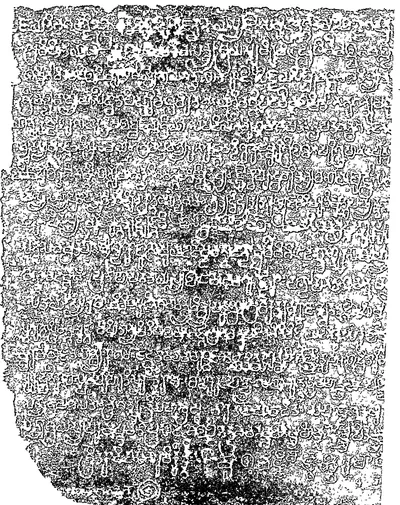 "Aihole Inscription of Pulikesin II.—A.D. 634-35", left part, lines 1-19 (Epigraphia Indica VI, plate between pp. 6 and 7, first page (PDF p. 18 of the archive.org scan in.ernet.dli.2015.56212))Inscription rubbing · 1901
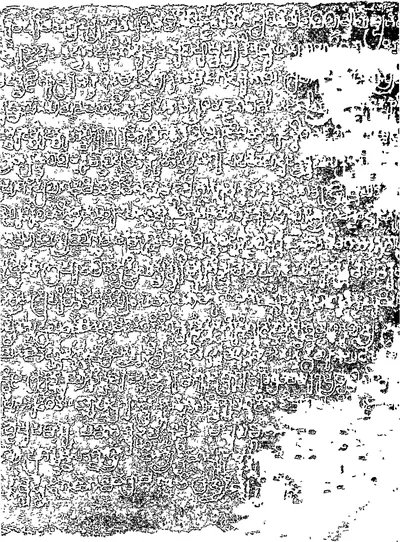 "Aihole Inscription of Pulikesin II.—A.D. 634-35", middle part (Epigraphia Indica VI, plate between pp. 6 and 7, second page (PDF p. 19 of scan in.ernet.dli.2015.56212))Inscription rubbing · 1901
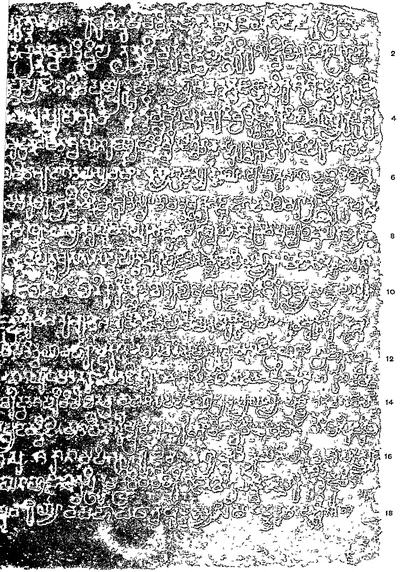 "Aihole Inscription of Pulikesin II.—A.D. 634-35", right part, lines 1-19 (Epigraphia Indica VI, plate between pp. 6 and 7, third page (PDF p. 20 of scan in.ernet.dli.2015.56212))Inscription rubbing · 1901
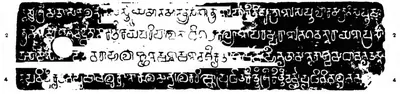 "Kopparam Plates of Pulakesin II", plate i (Epigraphia Indica XVIII, plate between pp. 258 and 259 (PDF p. 325))Inscription rubbing · 1926
 "Kopparam Plates of Pulakesin II", plate ii a (Epigraphia Indica XVIII, plate between pp. 258 and 259 (PDF p. 325))Inscription rubbing · 1926
 "Kopparam Plates of Pulakesin II", plate ii b (Epigraphia Indica XVIII, plate between pp. 258 and 259 (PDF p. 325))Inscription rubbing · 1926
 "Kopparam Plates of Pulakesin II", plate iii (Epigraphia Indica XVIII, plate between pp. 258 and 259 (PDF p. 325))Inscription rubbing · 1926
Related
Dynasties
References
Notes (0)
Sources (5)
Spotted an error on this page? Tell us
Last updated: