Rajaraja Narendra
Eastern Chalukya king of Vengi (crowned 1022, died about 1061–63), the son of a Chola princess and husband of another, who ruled from Rajahmundry. His reign was disturbed by Chola and Western Chalukya intervention and by a rising of his half-brother Vijayaditya VII. Telugu tradition remembers him as the patron of Nannaya, whose Mahabharata is the oldest surviving Telugu literary work.
Rajaraja Narendra ruled Vengi, the Eastern Chalukya kingdom between the Krishna and the Godavari, for about forty years in the middle of the 11th century.12 Telugu tradition remembers him for his capital, Rajahmundry, and for his patronage of the poet Nannaya.12
Family
Rajaraja Narendra was the son of the Eastern Chalukya king Vimaladitya and his queen Kundavadevi (Kundavvai), a daughter of the Chola emperor Rajaraja I.34 The Cholas had conquered Vengi about 999 and set up Vimaladitya’s elder brother Saktivarman as king.56 Rajaraja Chola then gave his daughter in marriage to Vimaladitya.7 Robert Sewell called this marriage very important, the first union of the Eastern Chalukya and Chola houses. He also recorded V. Venkayya’s view that Vimaladitya spent four years as a prisoner of the Chola king before ruling in his own right.7
J. F. Fleet thought that the prince was named Rajaraja after his Chola grandfather.8 Rajaraja Narendra married Ammangadevi, daughter of the Chola king Rajendra I, his mother’s brother.49 The Kalidindi grant, published by N. Venkataramanayya in 1952, adds a story about this marriage. His uncle, the Chola emperor Rajendra-Choda Madhurantaka, heard of his qualities and gave him his daughter Ammanga, who became his chief queen.1011 Venkataramanayya thought that the marriage was meant to bind Vengi permanently to the Chola kingdom.1011
Rajaraja Narendra had a half-brother, Vijayaditya VII, the son of Vimaladitya by another queen, who later became his rival.1213 His son by Ammangadevi was Rajendra-Choda, who became the Chola emperor Kulottunga I.14
Kundavvai was a daughter of Rajaraja Narendra.913 She appears in Sewell’s table, and as Kundavamba in the genealogy that Krishna Rao drew up in 1930.913 S. Krishnaswami Aiyangar also gave Rajaraja a son, Rajendra, and a daughter, Kundavvai.15
Coming to the throne, and titles
The Kalidindi grant says that Rajaraja was given, as a boy, the necklace (kanthika) that marked the heir-apparent.16 His coronation, recorded in his Korumelli and Nandamapundi grants, fell on a day that F. Kielhorn calculated as Thursday, 16 August 1022.32 Venkataramanayya argued that he had begun to rule some years before he was crowned.161711
He relied on inscriptions that give both his regnal year and the Saka year, which point to a reign beginning in 1019 or 1020. He also relied on the latest known date of Vimaladitya, in 1018. He noted that Chola inscriptions of about 1021 speak of an expedition sent by Rajendra Chola I against Vengi. One of them says that the king of Vengi ran away when he heard of it. He took these as signs of the disturbances that delayed the coronation.161711
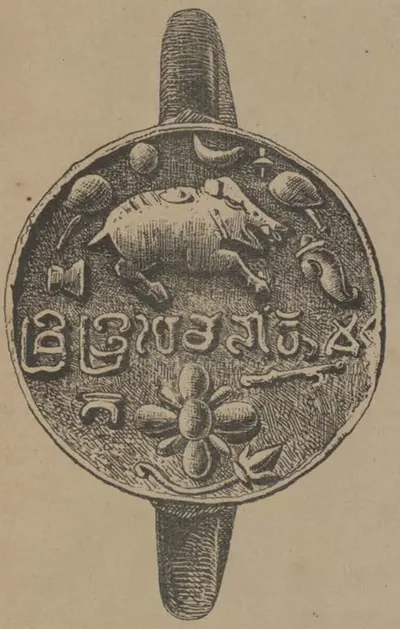
His grants call him by a second name, Vishnuvardhana, and give him the full imperial titles Maharajadhiraja, Paramesvara and Paramabhattaraka.4 The Nandamapundi grant describes him as “the devout worshipper of Maheshvara” (Shiva). Its seal shows the dynasty’s boar with the legend Sri-Tribhuvanankusa.318
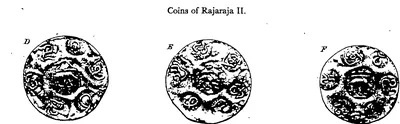
Gold coins stamped sri-Rajarajasya, “of the glorious Rajaraja”, like those of his uncle Saktivarman, were obtained in Arakan and Siam.194 Some came from the islands of Ramree and Cheduba off the Arakan coast.194 Fleet first called the king Rajaraja II, to tell him apart from his Chola grandfather.4 He later corrected this to Rajaraja I, since he was the first of the name in the Chalukya family.4
The grants of his reign
Rajaraja’s Korumelli grant was the only grant of the reign Fleet knew in 1891. It was then the earliest record to set out the dynasty’s complete genealogy: mythical, legendary and historical. It begins with the god Brahma and traces the family through the Moon. Fleet thought it “probably devised in rivalry of the Solar genealogy of the Cholas”, with whom the family was now closely connected.20
The grant gave the village of Korumelli, in the Guddavadi district, to a Brahman named Chidamarya on the occasion of a lunar eclipse.212223 Its first plate is a palimpsest, an inner plate of some older grant beaten flat and reused.212223 Venkataramanayya noted that all three of Rajaraja’s copper-plate grants known by 1952 were partly palimpsests.24
The best-documented act of his reign is the Nandamapundi grant, made in his 32nd year. Kielhorn dated it to the lunar eclipse of 28 November 1053. It was issued before the king’s councillors, chaplain, commander and heir-apparent.325 It gave the village of Nandamapundi to Narayana, a poet praised for writing in Sanskrit, Kannada, Prakrit, Paisachi and Telugu (Andhra).325
The grant names the author of its verses as Nanniyabhatta.25 In a note, E. Hultzsch suggested that he was “perhaps identical with Nannayabhatta, the first Telugu translator of the Mahabharata, whose patron was Rajaraja of Rajyamahendri”.25 Sewell’s entry for 1053 speaks of a grant to the poet Nannaya himself.26 In Kielhorn’s edition, however, the recipient is Narayana, and Nanniyabhatta is named only as the author of the verses.25
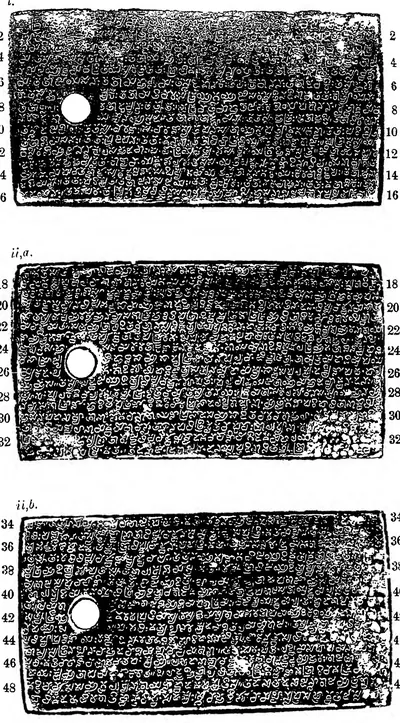
The Kalidindi grant records a war. Venkataramanayya’s summary says that a Chola general, Rajaraja Brahma-Maharaja, marched into the Andhra country with two other generals.1127 They fought the commanders of the king of Karnata, the Western Chalukya.1127 The three Chola generals and their forces perished.1127 In their memory Rajaraja built a Shiva temple called Rajarajesvaram, and two other Shiva temples, at Kalidindi near the Kolleru lake.1127 He endowed them with Kalidindi and two other villages.1127
The grant gives no date for the battle.28 Venkataramanayya suggested connecting it with a Western Chalukya general of about 1037, whose title claimed that he had humbled the fort of Bijavadi, perhaps Vijayawada (then Bezwada).28 He also suggested connecting it with the coup of Vijayaditya VII.28
Rajahmundry and Telugu
The Godavari district gazetteer says that Rajaraja fixed his capital at Rajahmundry, and that the Mahabharata was translated into Telugu in his reign. It adds that he was “well known to local tradition to this day under the name Rajaraja Narendra”.1 Sewell also places Nannaya Bhatta’s translation under his patronage.2 Fleet suggested a different origin for the city as a capital. He thought it might first have been occupied under Amma I, who bore the title Raja-Mahendra, and named after him.29 (See Rajahmundry.)
Rivals: the Cholas, the Western Chalukyas and Vijayaditya VII
Two grants found in the 20th century show that Rajaraja’s long reign was not undisturbed. In B. V. Krishna Rao’s summary, the Pamulavaka plates of Vijayaditya VII say that Rajaraja protected the earth for twelve years.30 Then his half-brother Vijayaditya expelled him by force and crowned himself king of Vengi.30 Krishna Rao calculated the coronation date in the plates as 9 July 1030.30
He thought that Vijayaditya’s rule was short and local, since Rajaraja’s descendants give him a full reign of 41 years.3013 Venkataramanayya recalculated the date as 27 June 1031, and spoke of Rajaraja being deprived of his throne in that year.1728 Krishna Rao noted that neither grant shows how long Vijayaditya reigned after he seized the throne.13
To the west, the Chalukyas of Kalyani used Vengi in their titles. A grant of December 1053 gives a son of Somesvara I the Eastern Chalukya title of lord of Vengi.26 Even so, a gift of 1055–56 at Draksharama by the daughter of a Western Chalukya minister led Sewell to think that the two branches were then on good terms.31
Krishna Rao believed, on the other hand, that Vijayaditya VII had become a vassal (subordinate ruler) of Somesvara I.32 In his view, about 1060, while Rajaraja was away, Vijayaditya invaded Vengi with Somesvara’s help.32 Inscriptions show Rajaraja ruling Vengi in 1047, and still recognised in the Guntur district in the late 1050s.3334
Length of reign
The records disagree on the length of his reign. One grant gives 41 years. Another, and the Pithapuram inscription of 1202, give 40, and add a year to his successor.435 Fleet thought this “looks somewhat as if there was a break”.435
The Pithapuram inscription says that he “ruled the Andhra-mandala for forty years”.36 It says the people thought him “a Vairochana (Bali) who did not undergo imprisonment by Vamana, (and) a Yudhishthira who was not addicted to the trouble of forest-life”.36 The Chellur plates give him 41 years.14
Sewell dates the reign 1022–1063, and the Godavari gazetteer 1022–62.91 Krishna Rao and Venkataramanayya put its end in 1061, when Vijayaditya VII’s son Saktivarman II was crowned king of Vengi.373817 The coronation fell on a day calculated as 18 October 1061.373817
Succession
The later Eastern Chalukya grants make his son Rajendra the next king. Sewell described him as mostly Chola by descent. He dated Rajendra’s rightful succession to the Vengi throne to 1063, while leaving open whether he actually took it then.39 The Godavari gazetteer says that Rajendra was pushed aside at his father’s death by his uncle Vijayaditya VII.1
Sewell set out two readings of what followed.40 In Fleet’s, Rajendra won the throne and afterwards let his uncle serve as viceroy. In Hultzsch’s, Vijayaditya VII actually ruled Vengi from 1063 to 1070 with Chola support.40 The grant of Saktivarman II, which Krishna Rao published in 1930, says that Vijayaditya placed his own son on the throne of Vengi after defeating all his enemies.32 In 1070 Rajendra seized the Chola throne and reigned as Kulottunga I.41
Memory
In 1922 the Andhra Historical Research Society at Rajahmundry celebrated the ninth centenary of his accession. It reckoned that he had come to the throne in the month of Bhadrapada nine hundred years before. The Society described him as “a great patron of Telugu literature”. It named Nannaya, Narayana Bhatta and Pavuluri Mallanna as poets of his court, and published a Telugu commemoration volume.42 The government gave the city’s schools and colleges a holiday for the day.43
Footnotes
-
Hemingway, Godavari (1907), p. 21 and note (archive.org (opens in a new tab)). ↩ ↩2 ↩3 ↩4 ↩5
-
Sewell and Aiyangar, Historical Inscriptions of Southern India (1932), p. 64 (archive.org (opens in a new tab)). ↩ ↩2 ↩3 ↩4
-
Kielhorn, “Nandamapundi Grant” (1897), p. 302 (archive.org (opens in a new tab)). ↩ ↩2 ↩3 ↩4 ↩5
-
Fleet, “Chronology of the Eastern Chalukya Kings” (1891), p. 273 and notes (archive.org (opens in a new tab)). ↩ ↩2 ↩3 ↩4 ↩5 ↩6 ↩7 ↩8 ↩9
-
Robert Sewell and S. Krishnaswami Aiyangar, The Historical Inscriptions of Southern India (1932), p. 56 (archive.org (opens in a new tab)). ↩
-
F. R. Hemingway, Madras District Gazetteers: Godavari (1907), p. 20 (archive.org (opens in a new tab)). ↩
-
Sewell and Aiyangar, Historical Inscriptions of Southern India (1932), p. 61 (archive.org (opens in a new tab)). ↩ ↩2
-
Fleet, “Chronology of the Eastern Chalukya Kings” (1891), p. 277 (archive.org (opens in a new tab)). ↩
-
Sewell and Aiyangar, Historical Inscriptions of Southern India (1932), p. 337 (archive.org (opens in a new tab)). ↩ ↩2 ↩3 ↩4
-
Venkataramanayya, “Kalidindi Grant” (1952), p. 59 (archive.org (opens in a new tab)). ↩ ↩2
-
Venkataramanayya, “Kalidindi Grant” (1952), p. 62 (archive.org (opens in a new tab)). ↩ ↩2 ↩3 ↩4 ↩5 ↩6 ↩7 ↩8 ↩9
-
Krishna Rao, “Telugu Academy Plates of Saktivarman II” (1930), p. 36 (archive.org (opens in a new tab)). ↩
-
Krishna Rao, “Telugu Academy Plates of Saktivarman II” (1930), p. 39 (archive.org (opens in a new tab)). ↩ ↩2 ↩3 ↩4 ↩5
-
E. Hultzsch, South-Indian Inscriptions, Vol. I (1890), p. 59, translation of the Chellur plates (archive.org (opens in a new tab)). ↩ ↩2
-
S. Krishnaswami Aiyangar, Ancient India (1911), p. 121 (archive.org (opens in a new tab)). ↩
-
Venkataramanayya, “Kalidindi Grant” (1952), p. 60 (archive.org (opens in a new tab)). ↩ ↩2 ↩3
-
Venkataramanayya, “Kalidindi Grant” (1952), p. 61 (archive.org (opens in a new tab)). ↩ ↩2 ↩3 ↩4 ↩5
-
F. Kielhorn, “Nandamapundi Grant of Rajaraja I”, Epigraphia Indica IV (1897), p. 301 (archive.org (opens in a new tab)). ↩
-
J. F. Fleet, “Some Gold Coins of the Eastern Chalukya Kings Saktivarman and Rajaraja II”, Indian Antiquary XIX (1890), p. 81 (archive.org (opens in a new tab)). ↩ ↩2
-
Fleet, “Chronology of the Eastern Chalukya Kings” (1891), p. 274 (archive.org (opens in a new tab)). ↩
-
J. F. Fleet, “Korumelli Plates of Rajaraja II [I]”, Indian Antiquary XIV (1885), p. 48 (archive.org (opens in a new tab)). ↩ ↩2
-
Fleet, “Korumelli Plates” (1885), p. 49 (archive.org (opens in a new tab)). ↩ ↩2
-
Fleet, “Korumelli Plates” (1885), p. 50 (archive.org (opens in a new tab)). ↩ ↩2
-
N. Venkataramanayya, “Kalidindi Grant of Eastern Chalukya Rajaraja I”, Epigraphia Indica XXIX (1951–52), p. 58 (archive.org (opens in a new tab)). ↩
-
Kielhorn, “Nandamapundi Grant” (1897), p. 303 and n. 3 (archive.org (opens in a new tab)). ↩ ↩2 ↩3 ↩4 ↩5
-
Sewell and Aiyangar, Historical Inscriptions of Southern India (1932), p. 74 (archive.org (opens in a new tab)). ↩ ↩2
-
Venkataramanayya, “Kalidindi Grant” (1952), p. 64 (archive.org (opens in a new tab)). ↩ ↩2 ↩3 ↩4 ↩5
-
Venkataramanayya, “Kalidindi Grant” (1952), p. 63 (archive.org (opens in a new tab)). ↩ ↩2 ↩3 ↩4
-
J. F. Fleet, “The Chronology of the Eastern Chalukya Kings”, Indian Antiquary XX (1891), p. 94 (archive.org (opens in a new tab)). ↩
-
Krishna Rao, “Telugu Academy Plates of Saktivarman II” (1930), p. 38 (archive.org (opens in a new tab)). ↩ ↩2 ↩3 ↩4
-
Sewell and Aiyangar, Historical Inscriptions of Southern India (1932), p. 75 (archive.org (opens in a new tab)). ↩
-
Krishna Rao, “Telugu Academy Plates of Saktivarman II” (1930), p. 37 (archive.org (opens in a new tab)). ↩ ↩2 ↩3
-
Sewell and Aiyangar, Historical Inscriptions of Southern India (1932), p. 71 (archive.org (opens in a new tab)). ↩
-
Sewell and Aiyangar, Historical Inscriptions of Southern India (1932), p. 76 (archive.org (opens in a new tab)). ↩
-
E. Hultzsch, “Pithapuram Pillar Inscription of Mallapadeva”, Epigraphia Indica IV (1897), pp. 227–228 (archive.org (opens in a new tab)). ↩ ↩2
-
Hultzsch, “Pithapuram Pillar Inscription” (1897), p. 240 (archive.org (opens in a new tab)). ↩ ↩2
-
B. V. Krishna Rao, “Telugu Academy Plates of Saktivarman II”, Journal of the Andhra Historical Research Society V, pt. 1 (1930), p. 34 (archive.org (opens in a new tab)). ↩ ↩2
-
Krishna Rao, “Telugu Academy Plates of Saktivarman II” (1930), p. 40 (archive.org (opens in a new tab)). ↩ ↩2
-
Sewell and Aiyangar, Historical Inscriptions of Southern India (1932), p. 77 (archive.org (opens in a new tab)). ↩
-
Sewell and Aiyangar, Historical Inscriptions of Southern India (1932), p. 78 (archive.org (opens in a new tab)). ↩ ↩2
-
Sewell and Aiyangar, Historical Inscriptions of Southern India (1932), p. 83 (archive.org (opens in a new tab)). ↩
-
Journal of the Andhra Historical Research Society, Vol. I (1926), “Brief history of the Society”, p. 4 (archive.org (opens in a new tab)). ↩
-
Journal of the Andhra Historical Research Society, Vol. I (1926), “Brief history of the Society”, PDF p. 16 (archive.org (opens in a new tab)). ↩
Photos
 "1. Seal of the copper-plate grant of Rajaraja. Dated Saka 944" (Indian Antiquary VII, plate at pp. 252-253 (PDF p. 323))Drawing · 1878
 "Coins of Rajaraja II." D, E and F, full size (Indian Antiquary XIX, plate facing p. 78 (PDF p. 85))Coin · 1890
 "Kalidindi Grant of Eastern Chalukya Rajaraja I", plates i, ii a and ii b (Epigraphia Indica XXIX, Plate I, between pp. 66 and 67 (PDF p. 140))Inscription rubbing · 1952
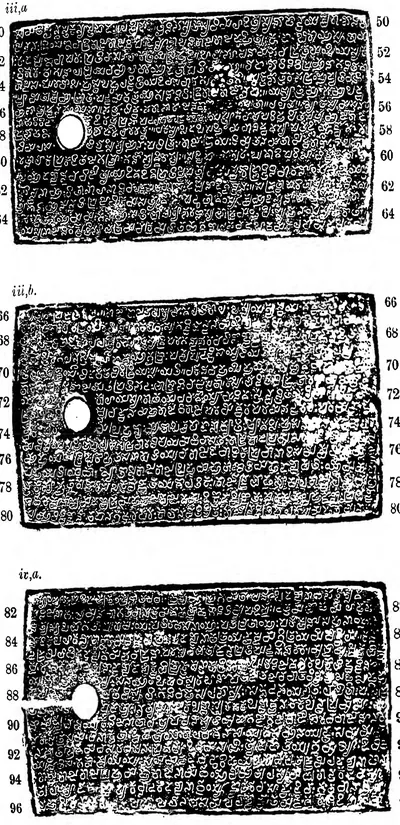 "Kalidindi Grant of Eastern Chalukya Rajaraja I", plates iii a, iii b and iv a (Epigraphia Indica XXIX, Plate I, between pp. 66 and 67 (PDF p. 141))Inscription rubbing · 1952
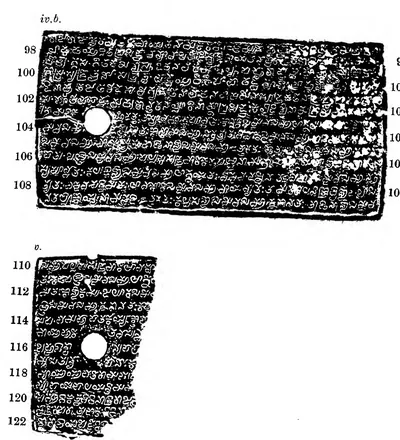 "Kalidindi Grant of Eastern Chalukya Rajaraja I", plates iv b and v (Epigraphia Indica XXIX, Plate II, between pp. 70 and 71 (PDF p. 146))Inscription rubbing · 1952
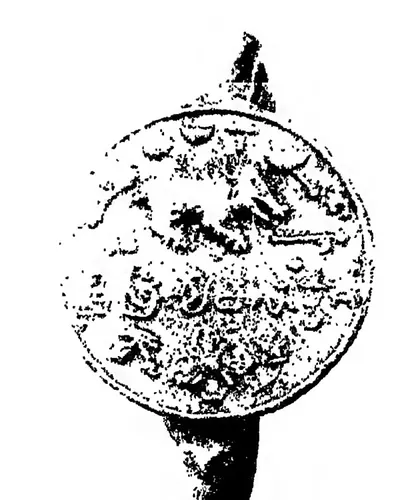 "Seal (From a photograph)", seal of the Kalidindi grant of Rajaraja I (Epigraphia Indica XXIX, Plate II, between pp. 70 and 71 (PDF p. 146))Historic photograph · 1952
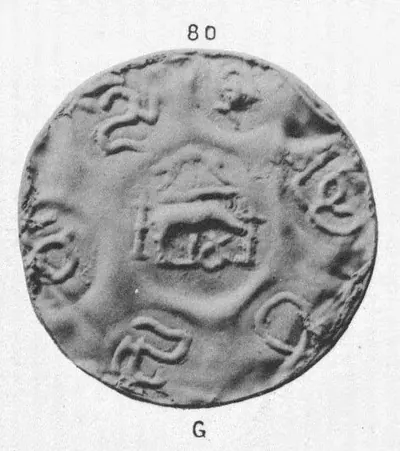 Gold coin No. 80, "South Indian Coins. Pl. III." (Elliot, Coins of Southern India, 1886, Plate III, No. 80 (PDF p. 191 of scan 00074712bsb))Coin · 1886
Related
Dynasties

Eastern Chalukyas of Vengi
c. 615–1077 CE
A branch of the Chalukyas of Badami that ruled Vengi, the coastal country between the lower Godavari and Krishna, from the early 7th century. Its founder, Kubja Vishnuvardhana, was a younger brother of Pulakesin II. The kings fought the Rashtrakutas for two centuries. After about 1000 they were bound to the Cholas by marriage, and in 1070 their heir became the Chola emperor Kulottunga I. Their copper-plate grants record the length of every reign. The first Telugu literary work, Nannaya's Mahabharata, was written at their court in Rajahmundry.
Cholas of Tanjore
c. 985–1268 CE
The imperial Chola dynasty of Tanjore (Thanjavur) and Gangaikondacholapuram in the Tamil country, overlords of much of the Telugu country from about 1000 to the 12th century. Rajaraja I restored the Eastern Chalukya Saktivarman I in Vengi about 999 and married his daughter to Saktivarman's brother Vimaladitya. Rajendra I waited on the Godavari while his general marched to the Ganges, and Virarajendra fought the Western Chalukyas at Bezwada. In 1070 the Eastern Chalukya heir became the Chola emperor Kulottunga I, whose sons governed Vengi until 1118. After a Western Chalukya occupation, Vikrama-Chola recovered the coast, but by the mid-12th century Chola rule north of the Krishna was nominal. In the south, the Telugu Choda chiefs of Nellore and Pottappi acknowledged the Chola king until the dynasty ended in the 1260s.
References
Notes (0)
Sources (11)
Spotted an error on this page? Tell us
Last updated: