Malepadu stone inscription of Satyaditya
A short Telugu stone record from Malepadu in the Cuddapah district. It records a gift of land at Chirumburu (Chilamakuru) by the Telugu Chola prince Satyaditya, ruler of the Siddhi thousand and the Renandu seven thousand. It was published in 1912 as a sample of the earliest Telugu records of the district, and it is written from the bottom upwards. Its two editors read the family tree in it differently.
Publication
The stone was one of the records from Malepadu brought to notice in 1904 by J. Ramayya Pantulu.12 He reported it together with the Malepadu plates of Punyakumara.12 It is No. 393 of the Madras epigraphical collection for that year.12
H. Krishna Sastri printed it in 1912, in a postscript to his edition of the plates, “as a specimen”.1 He did so because the family’s stone records were “the earliest Telugu records from the Cuddapah district”.1
Script
Krishna Sastri found its letters “quite similar” to those of the Alupa inscriptions of Udiyavara.2 E. Hultzsch had assigned those inscriptions to about 800.2 Krishna Sastri also noted that the record “is written from the bottom upwards”.2 The Amaravati pillar inscription of the Pallava Simhavarman is written the same way, and so is one side of the Bezwada pillar of the Eastern Chalukya Yuddhamalla.2
K. A. Nilakanta Sastri and M. Venkataramayya placed the record in the second quarter of the 8th century, alongside the Veludurti record of Uttamaditya.3
Contents
Krishna Sastri gave “only a tentative translation”.4 He noted that its spelling, grammar and idiom needed separate study.4 In his translation, the record names Satyaditya, “of the Kāśyapa-gōtra, son of Śaktikomara Vikramāditya (and grandson of) the great lord, the glorious Chōḷa-Mahārājādhirāja Vikramāditya”.4
Satyaditya made the gift “while ruling the Śiddhi one thousand and the Rēnāṇḍu seven thousand (districts)”.4 He “gave to Rēvaśarmma of the Kāśyapa-gōtra, (a resident) of Komaripāṛa, five marutru (of land) at Chirumbūru”.4 The boundaries follow.4
Then comes a blessing on those who keep up the gift, who will win “the merit of establishing a thousand temples, a thousand tanks (and) a thousand villages”.4 A curse falls on those who block it.4 Krishna Sastri identified Chirumburu with Chilamakuru, near the Kalamalla railway station.4 He explained marutru as a measure of land.4
Three generations or four?
Krishna Sastri’s “(and grandson of)” is his own addition.4 It makes three generations: Vikramaditya, Saktikomara Vikramaditya and Satyaditya.4
Nilakanta Sastri and Venkataramayya (1956) pointed out that the text states only one relationship, that of son.5 They read the names as four generations: Vikramaditya I, Saktikumara, Vikramaditya II and Satyaditya.5 In their reading, the supreme titles belong to Vikramaditya II, the reigning king.5 Satyaditya’s name lacks the honorific ending of a king, so he may have been only a prince.5
They added that the stone describes Satyaditya as ruling the Siddhi thousand and Renandu seven thousand.6 But it gives him no royal title, and it is not known whether he ever reigned.6 See Vikramaditya II.
Significance
The record is one of the few that name the Siddhi thousand, one of the three territories of Dhananjaya’s line.7 It was the basis of the later part of the editors’ family tree.7
Krishna Sastri suggested that the Siddhi thousand was perhaps the same as the Sidhout country.8 He noted that a 12th-century inscription from Peddamudiyam mentions a Renandu seventy, which must have been a subdivision of the Renandu seven thousand.8
Footnotes
-
H. Krishna Sastri, “Malepadu Plates of Punyakumara; the Fifth Year”, Epigraphia Indica XI (1912), p. 337 (archive.org (opens in a new tab)). ↩ ↩2 ↩3 ↩4 ↩5
-
Krishna Sastri, “Malepadu Plates” (1912), p. 345 and note 4 (archive.org (opens in a new tab)). ↩ ↩2 ↩3 ↩4 ↩5 ↩6 ↩7
-
Nilakanta Sastri and Venkataramayya, “Telugu Chola Records” (1956), p. 240 (archive.org (opens in a new tab)). Paraphrased. ↩
-
Krishna Sastri, “Malepadu Plates” (1912), p. 346 and notes (archive.org (opens in a new tab)). ↩ ↩2 ↩3 ↩4 ↩5 ↩6 ↩7 ↩8 ↩9 ↩10 ↩11 ↩12
-
K. A. Nilakanta Sastri and M. Venkataramayya, “Telugu Chola Records from Anantapur and Cuddapah”, Epigraphia Indica XXVII (1956), p. 237, note 1 (archive.org (opens in a new tab)). Paraphrased. ↩ ↩2 ↩3 ↩4
-
Nilakanta Sastri and Venkataramayya, “Telugu Chola Records” (1956), p. 241 (archive.org (opens in a new tab)). Paraphrased. ↩ ↩2
-
Nilakanta Sastri and Venkataramayya, “Telugu Chola Records” (1956), p. 249 (archive.org (opens in a new tab)). Paraphrased. ↩ ↩2
-
Krishna Sastri, “Malepadu Plates” (1912), p. 343 (archive.org (opens in a new tab)). ↩ ↩2
Photos
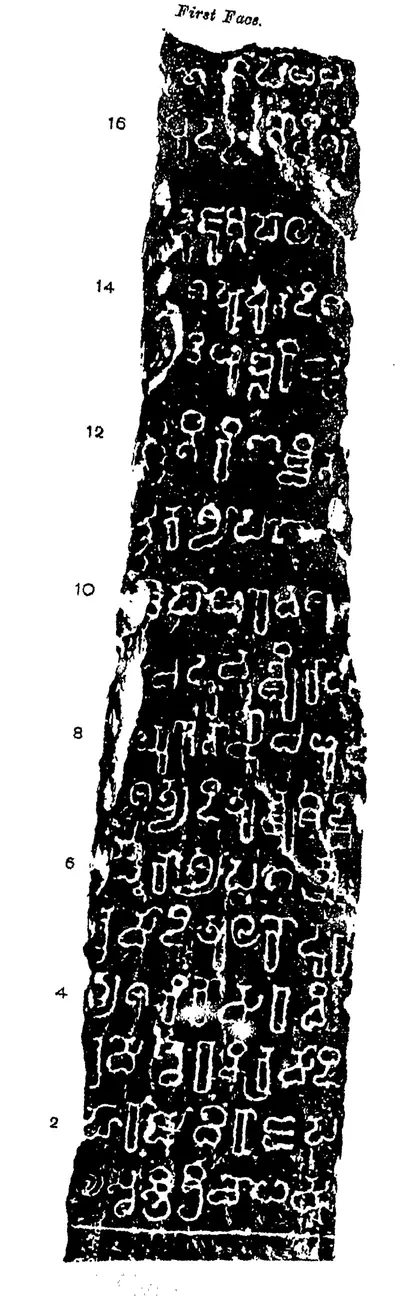 "Malepadu stone inscription of Satyaditya", First Face (Epigraphia Indica XI, plate to face p. 346, first face (PDF p. 412))Inscription rubbing · 1912
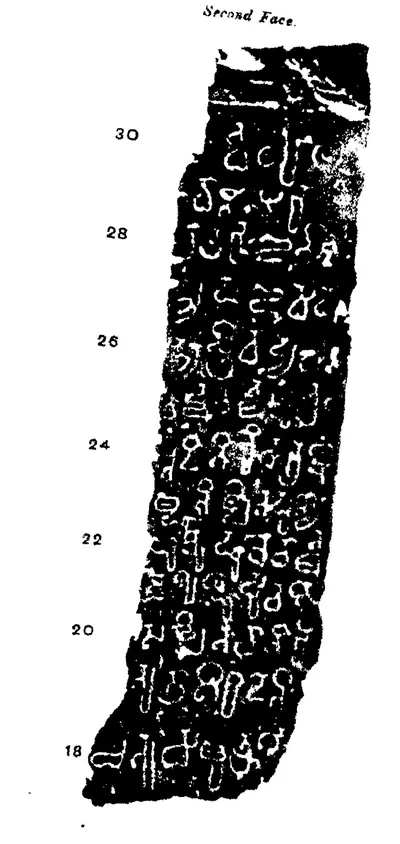 "Malepadu stone inscription of Satyaditya", Second Face (Epigraphia Indica XI, plate to face p. 346, second face (PDF p. 412))Inscription rubbing · 1912
References
Notes (0)
Sources (2)
Spotted an error on this page? Tell us
Last updated: