Reyuru grant of Narasimhavarman II
A Sanskrit copper-plate grant issued from Kanchipura in the 12th year of the Pallava king Narasimhavarman II, on a lunar eclipse in Vaisakha. It gives the village of Reyuru in Mel-Mundarashtra to the Brahman Kumaramandasarman of Kuravasri. It was kept in the archives of the Raja of Kalahasti and edited by P. B. Desai. It is the only dated record of this king. Desai placed the village at Revuru in the Atmakur taluk of Nellore.
The Reyuru grant is the only charter known of Narasimhavarman II, and his only dated record.1 It shows a Pallava king of about 700 giving a village in the Nellore country, after the Chalukyas had taken the neighbouring district of Karmarashtra.2
Discovery and description
The plates were kept in the archives of the Raja of Kalahasti, in the Chittoor district.3 Veturi Prabhakara Sastri found them and edited them in Telugu in the journal of the Sri Venkatesvara Oriental Institute, Tirupati.34 P. B. Desai re-edited them from the originals and impressions.34
There are five plates on a ring with a round seal.35 The seal shows a five-petalled lotus, a couchant (lying) humped bull facing front, a fly-whisk on either side and a crescent above, but no legend.5 The set weighs 80 tolas.5 Desai thought the bull on this seal the finest Pallava emblem then known.5
Script and language
The letters are Kannada-Telugu of the early 8th century.5 Desai compared them with the Uruvupalli grant for their elegance, though that grant is two centuries older.5 The language is Sanskrit, mostly prose.5
Desai noted that the grant is plain and short, unlike the Kuram plates of the king’s father.6 It borrows many of its phrases from the early Pallava Sanskrit charters, such as the Uruvupalli, Pikira and Vilavatti grants.6
Content
The grant was issued from Kanchipura. It names the king’s grandfather Mahendravikramavarman and his father Paramesvaravarman, and calls the king a devotee of Vishnu, of Siva and of the Brahmans.61
Narasimhavarman made the gift in the 12th year of his reign, on the full moon of Vaisakha, with a lunar eclipse.17 He gave the village of Reyuru, north of Asidharapura in Mel-Mundarashtra, as a Brahman’s grant.17 The donee was Kumaramandasarman of Kuravasri, a performer of the Soma sacrifice of the Rathitara gotra (clan).17 His father and grandfather were learned in two Vedas.17
The ministers, officers and courtiers were ordered to collect no dues from the village, especially while on tour.7 The grant credits the king’s father with the horse sacrifice.7 Desai concluded that the writer had borrowed the claim from older Pallava charters.7
The places
Desai took Mel-Mundarashtra, “western Mundarashtra”, to lie west of the Mundarashtra of the earlier grants, round Kovur.72 He took it to cover mainly the Atmakur taluk of Nellore.72 Following Prabhakara Sastri, he identified Reyuru with Revuru in that taluk.72
A village Reyuru is also granted in an Eastern Chalukya grant of 664, in Karmarashtra.2 Desai thought it might be the same village, and suggested that Narasimhavarman II or his father had won back this part of Karmarashtra from the Eastern Chalukyas.2 He admitted that there was no direct evidence for such a conquest.2
Desai identified Nandakurra, the seat of the executor, with Nandavaram in the Udayagiri taluk.24 He suggested that Kuravasri might be Krosuru in the Sattenapalle taluk.24
Date
Desai found lunar eclipses on the full moon of Vaisakha in 701, 702, 711 and 720.1 He preferred 711, so that the reign began about 700.1 D. C. Sircar first dated the Vunna Guravayapalem plates of the king’s father.8 After that, he thought Narasimhavarman II came to the throne about 690–691 or 700.8
Footnotes
-
Desai, “Reyuru Grant” (EI XXIX), p. 92 (archive.org (opens in a new tab)). ↩ ↩2 ↩3 ↩4 ↩5 ↩6 ↩7 ↩8
-
Desai, “Reyuru Grant” (EI XXIX), p. 94 (archive.org (opens in a new tab)). ↩ ↩2 ↩3 ↩4 ↩5 ↩6 ↩7 ↩8 ↩9
-
P. B. Desai, “Reyuru Grant of Pallava Narasimhavarman; Year 12”, Epigraphia Indica XXIX (1951–52), p. 89 (archive.org (opens in a new tab)). ↩ ↩2 ↩3 ↩4
-
Desai, “Reyuru Grant” (EI XXIX), p. 95 (archive.org (opens in a new tab)). ↩ ↩2 ↩3 ↩4
-
Desai, “Reyuru Grant” (EI XXIX), p. 90 (archive.org (opens in a new tab)). ↩ ↩2 ↩3 ↩4 ↩5 ↩6 ↩7
-
Desai, “Reyuru Grant” (EI XXIX), p. 91 (archive.org (opens in a new tab)). ↩ ↩2 ↩3
-
Desai, “Reyuru Grant” (EI XXIX), p. 93 (archive.org (opens in a new tab)). ↩ ↩2 ↩3 ↩4 ↩5 ↩6 ↩7 ↩8 ↩9 ↩10
-
D. C. Sircar and P. Seshadri Sastri, “Vunna Guravayapalem Plates of Paramesvaravarman I, Year 19”, Epigraphia Indica XXXII (1957–58), p. 96 (archive.org (opens in a new tab)). ↩ ↩2
Photos
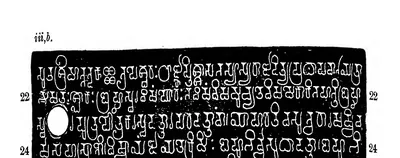 "Reyuru Grant of Pallava Narasimhavarman; Year 12", plate iii b (Epigraphia Indica XXIX, plate with No. 11 (PDF p. 199))Inscription rubbing · 1952
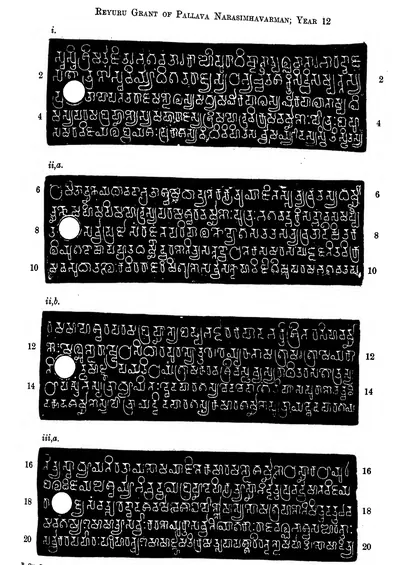 "Reyuru Grant of Pallava Narasimhavarman; Year 12", plates i, ii a, ii b and iii a (Epigraphia Indica XXIX, plate with No. 11 (PDF p. 198))Inscription rubbing · 1952
References
Notes (0)
Sources (2)
Spotted an error on this page? Tell us
Last updated: