Dommara-Nandyala plates of Punyakumara
Three Sanskrit copper plates with a lion seal, found in a sealed pot at Dommara-Nandyala in the Jammalamadugu taluk and edited in 1956. They record a grant by the Telugu Chola king Punyakumara, in his tenth year, to five Brahmanas. They repeat the family tree of the Malepadu plates and correct the name of their writer. Their editor said they contain the earliest inscriptional reference in south India to Siva as Lakutapani, and he dated them to the middle of the 8th century.
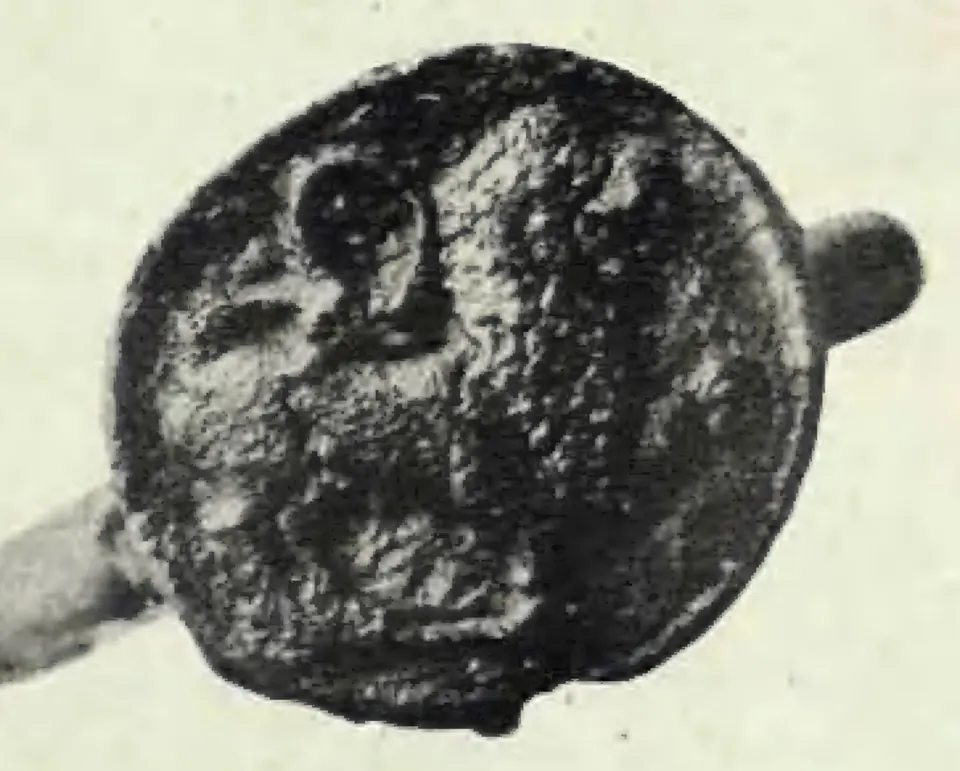
Discovery
H. K. Narasimhaswami was copying stone inscriptions at Dommara-Nandyala, in the Jammalamadugu taluk of the Kadapa (then Cuddapah) district, in 1940–41.1 There the villagers showed him the plates.1 Some years earlier a kinsman of theirs, ploughing a field, had struck a sealed earthen pot.1 The plates lay in it, packed in paddy husk.1 When the owner learnt that they recorded only a gift of land, he gave them to the Government Epigraphist’s office.1
The plates and the seal
The set has three rectangular plates strung on a copper ring, whose ends are soldered into a round seal.1 The seal shows in high relief a rampant lion (standing on its hind legs) with a prominent mane and raised left paw.1 Narasimhaswami noted how neatly the plates and seal are made compared with the Malepadu plates.1 The language is Sanskrit prose, apart from an opening verse and a closing imprecatory verse (curse).2
Contents
The text is almost the same as that of the Malepadu plates.2 It traces the family from Nandivarman and his sons Simhavishnu, Sundarananda and Dhananjayavarman.2 Then come Dhananjayavarman’s son Mahendravarman, who took the title Chola-Maharaja, and his sons Gunamudita and Punyakumara, lord of Hiranyarashtra.2
In his tenth year, while camping at Pudorur, Punyakumara granted land in the villages of Nandigama and Pasindikuru to five Brahmanas.23 The charter was written by Kottikuntaraja, the officer who appears in the Malepadu plates.23 Narasimhaswami showed that the name H. Krishna Sastri had read there as Kottikuldaraja should be read Kottikuntaraja.23
Siva as Lakutapani
The opening verse praises Siva as Lakutapani, a form linked with the Lakulisa (Pasupata) cult.2 Narasimhaswami thought this record and one other set of plates gave the earliest inscriptional reference to that form of Siva then known in south India.2
Date
Narasimhaswami compared the letters with the Kendur and Vakkaleri plates of the Chalukya Kirtivarman II.4 He placed both these plates and the Malepadu plates about the middle of the 8th century, with Punyakumara’s accession about 740.4 He noted that one letter, an open form of b, would by an older rule point to a date after 804.4 But he argued that the other letters are older.4
He worked back with 15 years for each brother who ruled in turn and 25 years for a generation.45 In this way he placed Nandivarman’s accession about 630, and drew up a table of Pallava and Chalukya contemporaries.45
H. Krishna Sastri had dated the Malepadu plates differently, to about the end of the 8th century.67 Narasimhaswami’s date of about 740 also differs from the date that Nilakanta Sastri and Venkataramayya gave for Punyakumara in the same volume, about 625.67
Narasimhaswami also suggested that Mahendravarman’s title Chola-Maharaja may have been conferred on him by the Pallava Paramesvaravarman I.8 See Punyakumara and the Telugu Cholas of Renadu.
Footnotes
-
H. K. Narasimhaswami, “Dommara-Nandyala Plates of Punyakumara; 10th Year”, Epigraphia Indica XXVII (1956), p. 268 (archive.org (opens in a new tab)). Paraphrased. ↩ ↩2 ↩3 ↩4 ↩5 ↩6 ↩7 ↩8
-
Narasimhaswami, “Dommara-Nandyala Plates” (1956), p. 269 and notes (archive.org (opens in a new tab)). Paraphrased. ↩ ↩2 ↩3 ↩4 ↩5 ↩6 ↩7 ↩8 ↩9
-
H. Krishna Sastri, “Malepadu Plates of Punyakumara; the Fifth Year”, Epigraphia Indica XI (1912), p. 339 (archive.org (opens in a new tab)). ↩ ↩2 ↩3
-
Narasimhaswami, “Dommara-Nandyala Plates” (1956), p. 270 (archive.org (opens in a new tab)). Paraphrased. ↩ ↩2 ↩3 ↩4 ↩5 ↩6
-
Narasimhaswami, “Dommara-Nandyala Plates” (1956), p. 271, synchronistic table (archive.org (opens in a new tab)). Paraphrased. ↩ ↩2
-
Krishna Sastri, “Malepadu Plates” (1912), p. 344 (archive.org (opens in a new tab)). ↩ ↩2
-
K. A. Nilakanta Sastri and M. Venkataramayya, “Telugu Chola Records from Anantapur and Cuddapah”, Epigraphia Indica XXVII (1956), p. 251 (archive.org (opens in a new tab)). Paraphrased. ↩ ↩2
-
Narasimhaswami, “Dommara-Nandyala Plates” (1956), p. 272 (archive.org (opens in a new tab)). Paraphrased. ↩
Photos
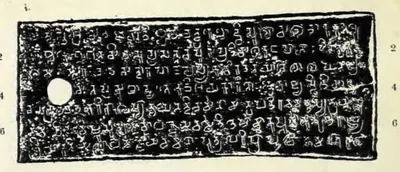 "Dommara-Nandyala Plates of Punyakumara, 10th Year", plate i (Epigraphia Indica XXVII, plate with No. 44 after p. 274, plate i (PDF p. 370))Inscription rubbing · 1956
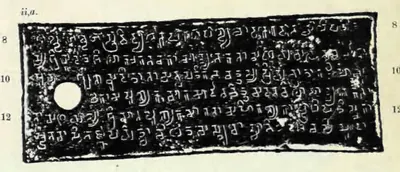 "Dommara-Nandyala Plates of Punyakumara, 10th Year", plate ii a (Epigraphia Indica XXVII, plate with No. 44 after p. 274, plate ii a (PDF p. 370))Inscription rubbing · 1956
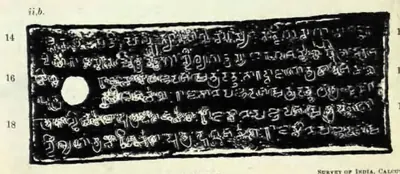 "Dommara-Nandyala Plates of Punyakumara, 10th Year", plate ii b (Epigraphia Indica XXVII, plate with No. 44 after p. 274, plate ii b (PDF p. 370))Inscription rubbing · 1956
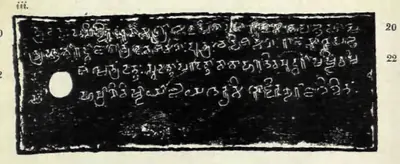 "Dommara-Nandyala Plates of Punyakumara, 10th Year", plate iii (Epigraphia Indica XXVII, plate with No. 44 after p. 274, plate iii (PDF p. 371))Inscription rubbing · 1956
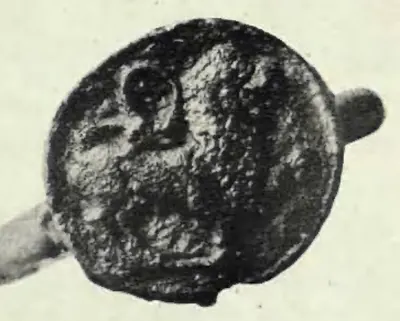 "Dommara-Nandyala Plates of Punyakumara, 10th Year": the seal ("From a photograph") (Epigraphia Indica XXVII, plate with No. 44 after p. 274, lower half (PDF p. 371))Historic photograph · 1956
References
Notes (0)
Sources (2)
Spotted an error on this page? Tell us
Last updated: