Motupalli pillar inscription of Ganapatideva
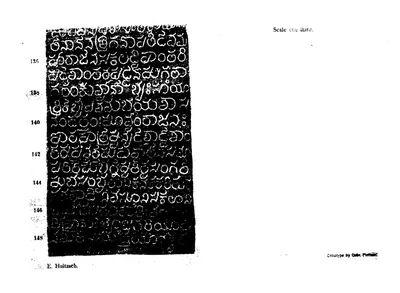
Edict of Saka 1166 (1244–45 CE) set up at the port of Motupalli. In it the Kakatiya king Ganapatideva promised sea traders safety for wrecked cargoes and fixed the customs duty on their goods.
What it is
The Motupalli inscription is a royal edict of the Kakatiya king Ganapatideva.12 It calls itself an abhaya-sasana, an “edict assuring safety”, addressed to merchants who traded by sea.12 Ganapatideva promised that the cargo of ships wrecked on his coast would no longer be seized.2 Only the usual duties would be taken.2 It is one of the few surviving documents of Kakatiya sea trade.3
The pillar
The text is engraved on the four sides of a pillar in the mandapa (pillared hall) in front of the Virabhadrasvamin temple at Motupalli.1 In 1914 the village lay in the Bapatla taluk of Guntur district.1 E. Hultzsch edited it from inked impressions supplied by H. Krishna Sastri.1 Krishna Sastri had noticed it in the Madras epigraphy report for 1909–10.1
It is well preserved apart from a few syllables at the edges of the pillar.1 The script is the Telugu of the period.1 Lines 1–152 and 166–173 are in Sanskrit, mostly verse, and lines 152–166 are in Telugu.1
Contents
The edict opens with an invocation of Svayambhudeva, the family god of the Kakatiyas.1 Verses to Ganesha, Sarasvati, Shiva’s crescent moon and Vishnu’s boar incarnation follow.1 Next comes a legendary family line that places the dynasty in the solar line of Ikshvaku and Rama, coming down to Durjaya.1
Six historical kings are then named:2
- Prolaraja I, who built a tank called Kesari-tataka2
- Tribhuvanamalladeva2
- Prolaraja II2
- Rudradeva2
- Mahadevaraja2
- Ganapatideva2
Hultzsch noted that Prola I is named in no other Kakatiya inscription.2 He also accepted Krishna Sastri’s view that the second king’s real name was Beta.2 In that view Tribhuvanamalla was a title taken from his Chalukya overlord, Vikramaditya VI.2
The promise to traders
In Hultzsch’s translation, the grant states: “Formerly kings used to take away by force the whole cargo, viz. gold, elephants, horses, gems, etc.”4 This cargo was “carried by ships and vessels which, after they had started from one country for another, were attacked by storms, wrecked, and thrown on shore.”4 The king, “out of mercy, for the sake of glory and merit”, now let traders keep everything except the fixed duty.4
The customs duties
The Telugu section sets the general duty at one in thirty on all exports and imports.5 It then gives special rates for these goods:5
- sandal5
- country camphor, Chinese camphor and pearls5
- rose-water, ivory, civet, camphor-oil, copper, zinc, lead, silk thread, corals and perfumes5
- pepper5
- silks, charged by the bale5
- areca nuts, charged by the lakh5
Two closing Sanskrit verses say that Ganapatideva set up this edict-pillar at the great Desiyakkondapattana, also called Motupalli.52 He did so in Saka 1166 (Saka is an Indian way of counting years), the year Krodhin, which Hultzsch equates with 1244–45 CE.52
Significance
Hultzsch linked the port to Marco Polo’s kingdom of “Mutfili”.6 He reasoned that Polo had named the whole kingdom after this town.6 He also pointed out that Ganapatideva chose it as the site of his edict to sailors.6 Hultzsch took both facts to mean that Motupalli was the kingdom’s chief port in the thirteenth century.6 Henry Yule had already identified Mutfili with Motupalli.7
P. V. Parabrahma Sastry read the duty list as evidence that horses, elephants, gems and metals passed through the port.8 He argued against the view, which he attributes to K. A. Nilakanta Sastri, that only foreigners carried on this trade.8 He saw the edict as a revival of sea trade after a period of neglect.89 He noted that customs ports of this kind were called karapattanas.89
Editions
The standard edition, with text, plates and a translation of the grant, is Hultzsch’s in Epigraphia Indica XII (1914), pp. 188–197.1 Parabrahma Sastry reprinted Hultzsch’s translation of the main part with a commentary on the rates.10
Footnotes
-
E. Hultzsch, Motupalli Pillar-Inscription of Ganapatideva, Epigraphia Indica XII (1914), p. 188 (archive.org (opens in a new tab)). ↩ ↩2 ↩3 ↩4 ↩5 ↩6 ↩7 ↩8 ↩9 ↩10 ↩11 ↩12 ↩13
-
Hultzsch, Motupalli Pillar-Inscription of Ganapatideva (1914), p. 189 (archive.org (opens in a new tab)). ↩ ↩2 ↩3 ↩4 ↩5 ↩6 ↩7 ↩8 ↩9 ↩10 ↩11 ↩12 ↩13 ↩14 ↩15 ↩16
-
P. V. Parabrahma Sastry, The Kakatiyas of Warangal (1978), p. 254. ↩
-
Hultzsch, Motupalli Pillar-Inscription of Ganapatideva (1914), p. 196 (archive.org (opens in a new tab)). ↩ ↩2 ↩3
-
Hultzsch, Motupalli Pillar-Inscription of Ganapatideva (1914), p. 197 (archive.org (opens in a new tab)). ↩ ↩2 ↩3 ↩4 ↩5 ↩6 ↩7 ↩8 ↩9 ↩10
-
Hultzsch, Motupalli Pillar-Inscription of Ganapatideva (1914), p. 190 (archive.org (opens in a new tab)). ↩ ↩2 ↩3 ↩4
-
Henry Yule and Henri Cordier, The Book of Ser Marco Polo, vol. II (1903), p. 362 (archive.org (opens in a new tab)). ↩
-
Parabrahma Sastry, The Kakatiyas of Warangal (1978), pp. 255–256. ↩ ↩2 ↩3 ↩4
-
Parabrahma Sastry, The Kakatiyas of Warangal (1978), p. 257. ↩ ↩2
-
Parabrahma Sastry, The Kakatiyas of Warangal (1978), pp. 254–255. ↩
Photos
References
Notes (0)
Sources (3)
Spotted an error on this page? Tell us
Last updated: