Pakhal lake inscription of Jagadala Mummadi
Undated Sanskrit pillar inscription on the bund of the Pakhal lake, from the reign of Ganapatideva. It records that Jagadala Mummadi, son of the king's chief minister Bayyana-nayaka, built the great tank and a town called Ganapapura beside it. It also gives a solar family line of the Kakatiyas.
What it is
This is the foundation record of the Pakhal lake, one of the largest Kakatiya irrigation tanks.12 It is a Sanskrit verse inscription on a stone pillar standing on the bund (dam) of the lake, east of Warangal.12
It records that Jagadala Mummadi, a son of Ganapatideva’s chief minister Bayyana-nayaka, built a great tank.3 The tank was at a sacred spot called the Maudgalya-tirtha, near a temple of Shiva-Ramanatha.3 Beside it he founded a town called Ganapapura.3 The record is not dated, but it belongs to the reign of Ganapatideva.34
The pillar
L. D. Barnett described the stone as an upright rectangular block inscribed on all four faces.1 At the top of the first face are two bands of roughly carved sculpture.1 The first shows a seated Ganesha with the moon and the sun on either side.1 The second shows a boar, the Kakatiya emblem, between two water jars.1
The script is Telugu of the period.14 Apart from a few lines of Telugu prose at the end, the whole text is in Sanskrit verse, in many different metres.14 The modern reprint of the Warangal district inscriptions describes the pillar as standing on the western bund.2 It puts the Telugu passage at lines 231–234.2
Discovery and editions
E. Hultzsch first noticed the inscription in his epigraphical report for 1902–03.1 In the 1915–16 season G. Yazdani, the Nizam’s Superintendent of Archaeology, reported that he had “carefully copied” the Kakatiya inscriptions of Pakhal, Ramappa and Uparpalli.5 He had sent their impressions to Barnett in London.5 The report also lists his photographs of the lake and of each side of the inscribed pillar.6
H. Krishna Sastri (1908) and Hultzsch (1914) referred to it as “unpublished” before Barnett’s edition appeared.78 Barnett’s edition was published in 1919 as No. 4 of the Hyderabad Archaeological Series.91 That monograph is not in the library used for this page. Barnett’s introduction and translation are cited here from their reprint in Epigraphia Telanganica (2023).1 P. Sreenivasachar printed the text again in 1956, with a short English note.13
Contents
The text opens with invocations to Ganesha, to Vishnu as the Boar and to the moon.4 Barnett noted that the Boar was chosen because the boar was the Kakatiya emblem.4 The text then calls itself a decree (sasana) of King Ganapati.4
A mythical family line follows.43 From Vishnu’s navel came the Sun, then Manu, and in Manu’s line Ikshvaku, Mandhatri, Sagara, Bhagiratha, Dasaratha and Rama.43 After them came the Chola king Karikala, here called Kalikala.43 In the same line came the Kakatiyas: Durjaya, Prola, Rudradeva, his brother Mahadeva, and Mahadeva’s son Ganapati.43 Of the historical kings, only Prola II, Rudradeva and Mahadeva are named before Ganapati, the reigning king.3
Ganapati and his minister’s family
Verses praising Ganapati follow.410 One verse lists the kings who paid him homage: the rulers of Kashi, Kalinga, the Shakas, the Malavas, Kerala, Tummana, the Hunas, the Kurus, Arimarda (Pagan), Magadha, Nepal and the Cholas.410 Barnett regarded the list as greatly exaggerated.410
Ganapati’s first minister was Bayyana-nayaka.43 By his wife Bachamamba he had three sons, Ganapati, Nalla-Ganapa and Jagadala Mummadi, the youngest a soldier and statesman.43
Mummadi built the tank at the Maudgalya-tirtha, with a shrine of Bhairava attached to the temple.43 Beside the tank he founded Ganapapura, which Barnett thought was named after Mummadi’s elder brother Nalla-Ganapa.43 Mummadi gave a house and five martus of land to the composer of the record.43 The composer is known only by his title Kavichakravarti, “emperor of poets”.43
Date and genealogy
Barnett placed the record in about 1245.410 His reasons were that it belongs to Ganapati’s reign and that one verse speaks of him as having ruled for a long time.410 The 1956 Corpus calls the record undated.3 The Warangal district reprint also gives no date.2
Verse 19 of the record repeats a stanza about the boar crest.4 The same stanza appears in Ganapati’s Kanchi inscription and in the Motupalli pillar of 1244–45.4 Hultzsch, editing the Motupalli record, said these verses refer to “the crest of the Kakatiyas, which … was the figure of a boar”.8
Krishna Sastri, writing in 1908, said that the Pakhal inscription, like Ganapati’s Chebrolu record, named a Durjaya in the Kakatiya ancestry.711 Here Durjaya appears as the father of Prola.711 He found its statement that Rudra was born in Prola’s family “quite against the testimony of other Kakatiya inscriptions”.711 Sreenivasachar instead noted that the record leaves out the earlier Kakatiya chiefs and starts its historical list with Prola II.3
Parabrahma Sastry’s use of the record
Parabrahma Sastry drew on the record for Ganapati’s title raja-gaja-kesari, a lion among royal elephants.1213 He also used it for the land measure marturu, which Barnett had already noted in it.121314 Parabrahma Sastry thought the poet Kavichakravarti was probably Ganapati’s poet laureate (court poet).15 In his view he was the same man named as the officer in charge of the 1213 Chebrolu inscription of Jaya.15
The lake
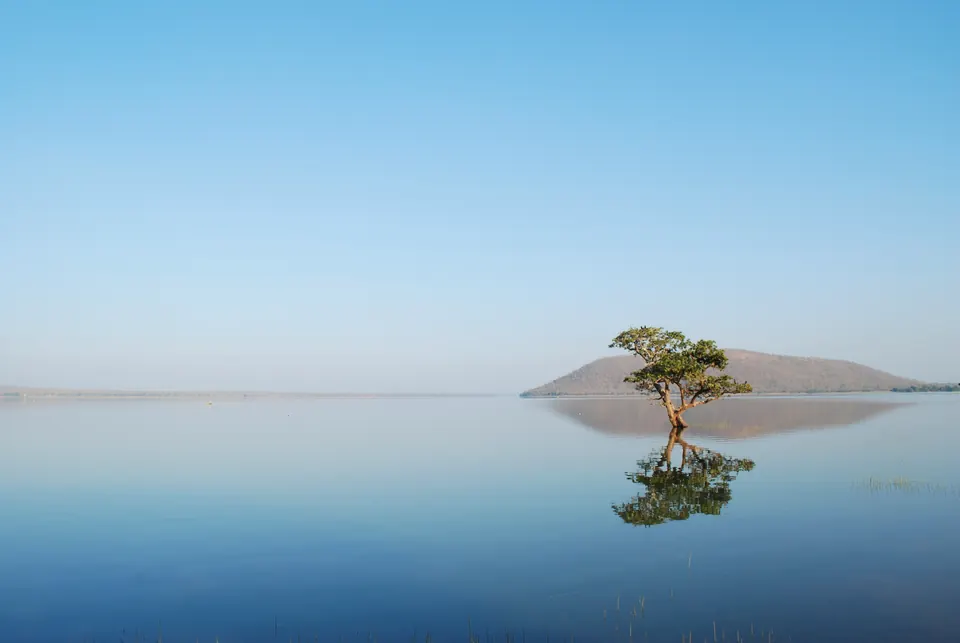
The Imperial Gazetteer of 1909 called the Pakhal lake the largest artificial sheet of water in Hyderabad State.1617 It measured about 8,000 by 6,000 yards, with an area of nearly 13 square miles.1617 A dam more than 2,000 yards long across the Pakhal river held it up.1617 At the centre of the dam the gazetteer noted the ruins of a small pavilion known as the chabutra of Shitab Khan.18
Parabrahma Sastry describes the dam as built of laterite gravel and red earth, about a mile long, with 40 channels.19 He gives the area now irrigated as about 9,000 acres.19 See also Pakhal.
Footnotes
-
L. D. Barnett, introduction to the Pakhal inscription (Hyderabad Archaeological Series No. 4, 1919), reprinted in Gajjala Vasanta Lakshmi (ed.), Epigraphia Telanganica, vol. 2 (2023), p. 234, No. 201. Paraphrased. ↩ ↩2 ↩3 ↩4 ↩5 ↩6 ↩7 ↩8 ↩9 ↩10 ↩11 ↩12
-
Epigraphia Telanganica, vol. 2 (2023), p. 332, No. 323, summarising Inscriptions of Warangal District (reprint 2016), pp. 202–211. Paraphrased. ↩ ↩2 ↩3 ↩4 ↩5
-
P. Sreenivasachar (ed.), A Corpus of Inscriptions in the Telingana Districts of Andhra Pradesh, Part III (1956), p. 150, No. Wg. 15 (archive.org (opens in a new tab)). Paraphrased. ↩ ↩2 ↩3 ↩4 ↩5 ↩6 ↩7 ↩8 ↩9 ↩10 ↩11 ↩12 ↩13 ↩14 ↩15 ↩16 ↩17 ↩18
-
Barnett (1919), reprinted in Epigraphia Telanganica, vol. 2 (2023), p. 235, No. 201. Paraphrased. ↩ ↩2 ↩3 ↩4 ↩5 ↩6 ↩7 ↩8 ↩9 ↩10 ↩11 ↩12 ↩13 ↩14 ↩15 ↩16 ↩17 ↩18 ↩19 ↩20 ↩21 ↩22 ↩23
-
Annual Report of the Archaeological Department of His Highness the Nizam’s Dominions, 1915-16 (1917), p. 10 (archive.org (opens in a new tab)). ↩ ↩2
-
Annual Report of the Archaeological Department … 1915-16 (1917), p. 26 (archive.org (opens in a new tab)). ↩
-
H. Krishna Sastri, “Anmakonda Inscription of Prola; the Chalukya-Vikrama Year Forty-Two”, Epigraphia Indica IX (1908), p. 259 (archive.org (opens in a new tab)). ↩ ↩2 ↩3 ↩4
-
E. Hultzsch, “Motupalli Pillar-Inscription of Ganapatideva”, Epigraphia Indica XII (1914), p. 189 (archive.org (opens in a new tab)). ↩ ↩2
-
Annual Report of the Archaeological Department of His Exalted Highness the Nizam’s Dominions, 1927-28 (1929), list of the Hyderabad Archaeological Series at the end of the volume (archive.org (opens in a new tab)). ↩
-
Barnett (1919), translation, reprinted in Epigraphia Telanganica, vol. 2 (2023), pp. 236–237, No. 201, verses 18 and 22. ↩ ↩2 ↩3 ↩4 ↩5
-
Krishna Sastri, “Anmakonda Inscription of Prola” (1908), p. 260, note 4 (archive.org (opens in a new tab)). ↩ ↩2 ↩3
-
Parabrahma Sastry, The Kakatiyas of Warangal (1978), p. 260. ↩ ↩2
-
Parabrahma Sastry, The Kakatiyas of Warangal (1978), p. 269. ↩ ↩2
-
L. D. Barnett (ed.), Inscriptions at Palampet and Uparpalli (1919), p. 17, note 1 (archive.org (opens in a new tab)). ↩
-
Parabrahma Sastry, The Kakatiyas of Warangal (1978), p. 293. ↩ ↩2
-
Imperial Gazetteer of India: Hyderabad State (1909), p. 90 (archive.org (opens in a new tab)). ↩ ↩2 ↩3
-
Imperial Gazetteer of India, Provincial Series: Hyderabad State (1909), p. 4 (archive.org (opens in a new tab)). ↩ ↩2 ↩3
-
Imperial Gazetteer of India: Hyderabad State (1909), p. 91 (archive.org (opens in a new tab)). ↩
-
P. V. Parabrahma Sastry, The Kakatiyas of Warangal (1978), p. 205. ↩ ↩2
Photos
References
Notes (0)
Sources (9)
Spotted an error on this page? Tell us
Last updated: