Motupalli
Coastal village, formerly in Guntur district, that was the main Kakatiya sea port. Ganapatideva set up his 1244 edict protecting sea traders here. Henry Yule identified it with a place Marco Polo called Mutfili.
A Kakatiya port
Motupalli is a village on the Andhra coast near Chinna Ganjam.12 Its formal name in the thirteenth century was Desiyakkondapattana. In the early twentieth century it was in the Bapatla taluk of Guntur district.12 P. V. Parabrahma Sastry places it in Prakasam district.3
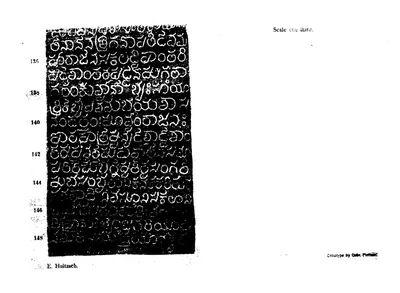
Here in Saka 1166 (1244–45 CE; Saka is an Indian way of counting years) the Kakatiya king Ganapatideva set up a pillar bearing an edict that promised sea traders protection.4 The edict ended the old practice of seizing the whole cargo of wrecked ships, and it fixed a customs duty of one in thirty on exports and imports.5 E. Hultzsch, who edited it, reasoned that Motupalli must have been the chief port of the Kakatiya kingdom.6
Mutfili
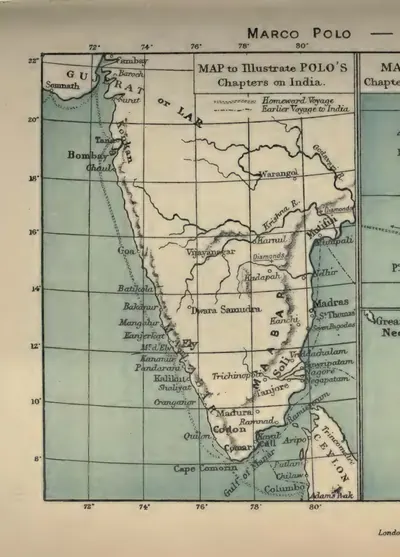
The Venetian traveller Marco Polo described a kingdom he called “Mutfili”, without naming its rulers.7 His editor Henry Yule identified this kingdom as the Kakatiya kingdom of Telingana.8 Yule thought that Polo seemed to name the kingdom after the place that he or his informants visited.8 He identified that place, Mutfili, with Motupalli, noting that Arabic usage turned p into f.8
Polo said that the kingdom was ruled by a queen.79 He described its diamonds and its fine cloth, buckrams (cotton cloth) that “look like tissue of spider’s web”.79 Parabrahma Sastry dates Polo’s visit to the closing years of Rudramadevi’s reign. He also counts Motupalli as one of several Kakatiya-period ports on the coast.1011 In his account it was linked by road to the interior through Tripurantakam.1011
Later centuries
By the nineteenth century Motupalli had declined. Gordon Mackenzie’s Kistna District Manual (1883) called it “an insignificant fishing village”.2 The manual noted its identification as Polo’s landing place.2 It recorded that French troops at Guntur had landed stores there about a hundred years earlier.2 The Imperial Gazetteer of 1908 likewise described it as “now an obscure fishing-village in the Bapatla taluk”.1
Footnotes
-
Imperial Gazetteer of India, Provincial Series: Madras, vol. I (1908), p. 302 (archive.org (opens in a new tab)). ↩ ↩2 ↩3
-
Gordon Mackenzie, A Manual of the Kistna District (1883), p. 206 (archive.org (opens in a new tab)). ↩ ↩2 ↩3 ↩4 ↩5
-
P. V. Parabrahma Sastry, The Kakatiyas of Warangal (1978), p. 257. ↩
-
E. Hultzsch, Motupalli Pillar-Inscription of Ganapatideva, Epigraphia Indica XII (1914), p. 189 (archive.org (opens in a new tab)). ↩
-
Hultzsch, Motupalli Pillar-Inscription of Ganapatideva (1914), p. 197 (archive.org (opens in a new tab)). ↩
-
Hultzsch, Motupalli Pillar-Inscription of Ganapatideva (1914), p. 190 (archive.org (opens in a new tab)). ↩
-
Yule and Cordier, The Book of Ser Marco Polo, vol. II (1903), pp. 359–360 (archive.org (opens in a new tab)). ↩ ↩2 ↩3
-
Henry Yule and Henri Cordier, The Book of Ser Marco Polo, vol. II (1903), p. 362 (archive.org (opens in a new tab)). ↩ ↩2 ↩3
-
Yule and Cordier, The Book of Ser Marco Polo, vol. II (1903), p. 361 (archive.org (opens in a new tab)). ↩ ↩2
-
Parabrahma Sastry, The Kakatiyas of Warangal (1978), p. 256. ↩ ↩2
-
Parabrahma Sastry, The Kakatiyas of Warangal (1978), p. 250. ↩ ↩2
Photos
References
Notes (0)
Sources (5)
Spotted an error on this page? Tell us
Last updated: