Myakadoni inscription of Pulumavi
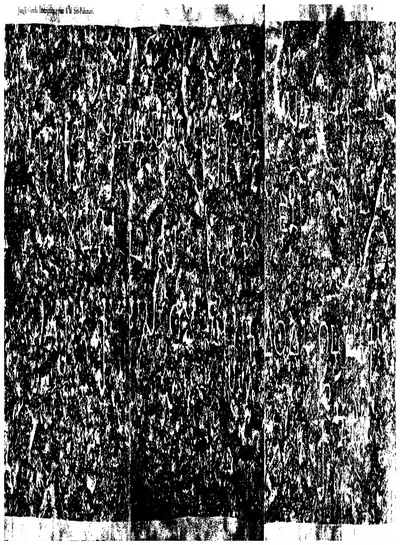
A four-line Prakrit inscription on a granite boulder called Jangli Gundu near Myakadoni, Adoni taluk, Bellary district. It is dated in the eighth year of 'Siri-Pulumavi, King of the Satavahanas'. It records a reservoir dug by a householder and names a district, Satavahani-hara, held by a great general. It is the only Satavahana inscription from Rayalaseema in these sources.
The Myakadoni inscription is a short private record of the reign of a Satavahana king Pulumavi.1 It was found in the Adoni taluk (sub-district) of what was then Bellary district.1 Its editor, V. S. Sukthankar, called the site “an important landmark, fixing definitely a point south of the Krishna to which the sway of the Satavahanas extended”.2 It also names a district and two of the officers who held land in it.2 See Vasishthiputra Pulumavi and Satavahanas.
Discovery and the stone
T. Rajarao found the inscription while touring the Adoni taluk.1 He was the Kanarese assistant in the office of the Assistant Archaeological Superintendent for Epigraphy, Southern Circle.1 Estampages (ink copies on paper) were made under the supervision of H. Krishna Sastri.1
The inscription is cut on the eastern face of a large natural boulder of reddish granite.1 The boulder is known to the villagers as Jangli Gundu, “jungle stone”.1 It is firmly buried in the soil midway between the villages of Myakadoni and Chinnakadaburu, about eight miles due north of Adoni.1
The surface has peeled in places, sometimes down to the depth of the letters.1 The four lines cover an area of about 8 feet by 3 feet.1 The letters are about 2½ inches high, cut boldly but not deeply.1
The words are separated by small gaps, which made the record easier to read.1 H. Krishna Sastri later compared this spacing of words with the Kodavali inscription of Chandasati and the Hathigumpha inscription.3
Text
Sukthankar edited the record from the stone and from impressions. In his translation it reads:
Success! On the first day of the first (fortnight of) the second month of Winter in the eighth year (of the reign) of Siri-Pulumavi, King of the Satavahana (family), the reservoir was sunk by the householder (gahapatika) … resident in the village (of) Vepuraka, belonging to the Captain (gumika) Kumaradatta, in the country (janapada) of Satavahani-hara, belonging to the Great General (mahasenapati) Khamdanaka (Skandanaga).2
The householder’s own name and description are uncertain.2 Sukthankar thought the damaged words were probably a tribal name and a personal name.2
Sukthankar could find no reservoir near the rock.4 He noted, though, that the soil around it was alluvial (laid down by water) and might once have been the bed of a tank.4
The king
The king is called only “Siri-Pulumavi” and “King of the Satavahanas”.4 He is named without the metronymic (a name taken from the mother) usual for Satavahana kings.4 Sukthankar noted that the family name Satavahana is rare in inscriptions.4
At least four kings named Pulumavi were then known.4 Sukthankar relied on Vincent Smith’s list of these kings.4 That list gave the two later Pulumavis only about seven years each, too few for a record of the eighth year.4
Sukthankar therefore identified the king with Vasishthiputra Pulumavi, the “Siro Polemaios” of Ptolemy.4 He admitted, though, that the identification was precarious (uncertain).4 On the script, he found the letters close to those of the Jaggayyapeta inscription of Purisadata (Purushadatta).1 He saw no reason why they could not be earlier than the 3rd century.1 Sukthankar does not name Purisadata’s dynasty.1 D. C. Sircar (1939) places this king, Virapurisadata, on the Ikshvaku throne and lists his inscriptions at Jaggayyapeta.5
Robert Sewell accepted the identification with Pulumavi II and dated the record 145–46 CE.6 He took it to prove Andhra rule in that tract at that time.6
D. C. Sircar listed it among the “Later Satavahana” inscriptions of the region.7 He also noted that the king named in it is generally placed after Yajna Sri, which would make him a later Pulumavi.8
Satavahani-hara
Sukthankar took hara here to mean a district or kingdom.2 He identified Satavahani-hara with the Satahani-rattha named in the Hira-Hadagalli copper plates of the Pallava king Sivaskandavarman.4 Those plates were also found in Bellary district.4 If the two were the same, he argued, the district must have covered much of the modern Bellary district.42
He suggested that the great general and the captain named in the record held their lands somewhat like jagirs (land grants).2
Before this find, the Bellary gazetteer of 1904 could cite only an inscription and a coin from neighbouring parts of Mysore as evidence for Andhra rule in the district.9
Editions
- V. S. Sukthankar, “A New Andhra Inscription of Siri-Pulumavi”, Epigraphia Indica XIV (1917–18), pp. 153–155, with plate.1
Footnotes
-
V. S. Sukthankar, “A New Andhra Inscription of Siri-Pulumavi”, Epigraphia Indica XIV (1918), p. 153 (archive.org (opens in a new tab)). ↩ ↩2 ↩3 ↩4 ↩5 ↩6 ↩7 ↩8 ↩9 ↩10 ↩11 ↩12 ↩13 ↩14 ↩15 ↩16
-
Sukthankar, “A New Andhra Inscription of Siri-Pulumavi” (1918), p. 155, text, translation and notes (archive.org (opens in a new tab)). ↩ ↩2 ↩3 ↩4 ↩5 ↩6 ↩7 ↩8
-
H. Krishna Sastri, “The Kodavali Rock-Inscription of Chandasati”, Epigraphia Indica XVIII (1926), p. 318, n. 4 (archive.org (opens in a new tab)). ↩
-
Sukthankar, “A New Andhra Inscription of Siri-Pulumavi” (1918), p. 154 (archive.org (opens in a new tab)). ↩ ↩2 ↩3 ↩4 ↩5 ↩6 ↩7 ↩8 ↩9 ↩10 ↩11 ↩12 ↩13
-
D. C. Sircar, The Successors of the Satavahanas in Lower Deccan (1939), p. 22 (archive.org (opens in a new tab)). Cite-only; paraphrased. ↩
-
Robert Sewell, The Historical Inscriptions of Southern India (1932), p. 14 (archive.org (opens in a new tab)). ↩ ↩2
-
Sircar, “Two Inscriptions from Guntur District” (1959), p. 86 (archive.org (opens in a new tab)). ↩
-
D. C. Sircar, “Two Inscriptions from Guntur District”, Epigraphia Indica XXXII (1959), p. 83 and n. 9 (archive.org (opens in a new tab)). ↩
-
W. Francis, Madras District Gazetteers: Bellary (1904), p. 27 (archive.org (opens in a new tab)). ↩
Photos
References
Notes (0)
Sources (6)
Spotted an error on this page? Tell us
Last updated: