Amaravati inscription of King Sri Sivamaka Sada
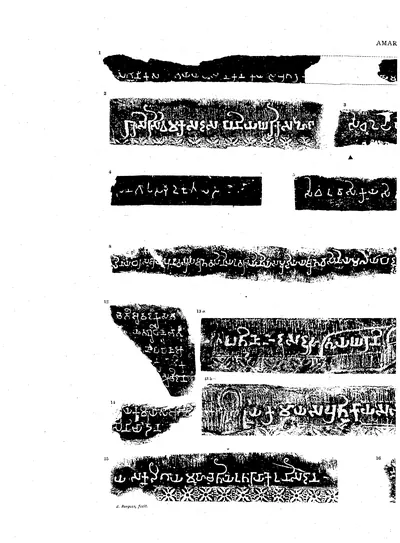
Fragment of a one-line Prakrit inscription on a carved coping stone of the Amaravati stupa, recording a gift by the 'superintendent of the water establishment' of a king Sri Sivamaka Sada. The king has been taken for the founder Simuka, for Siva Sri Satakarni, or for a ruler of another family altogether.
This short fragment from the Amaravati stupa (relic mound) names a king, “possibly one of the Andhras of the first or second century A.D.” in James Burgess’s words.1 Burgess counted it, with the inscription dated in the reign of Vasishthiputra Pulumavi, among the most important of the Amaravati inscriptions.23 Its king, Sri Sivamaka Sada, is otherwise unknown, and his identity bears on the question of who ruled the lower Krishna in the 2nd century CE.4
The stone
The inscription is on a carved coping stone that James Burgess published in his account of the stupa’s railing. The sculpture shows a monk laid out on a bier with mourners, several houses with arched roofs, a procession of horsemen, and other figures. Burgess found it “difficult to explain”.1 The inscription runs along the rounded top of the coping above one of the houses. Only its beginning survives.1 Burgess reproduced it as Plate LVI, No. 2.13
Text
Burgess printed the surviving words as Rano Siri-Sivamaka-Sadasa paniyagharikasa ha … and translated, after E. Hultzsch:
The gift of … the superintendent of the water establishment (paniyaghara) of king Sri Sivamaka Sada.1
Hultzsch proposed this reading “with diffidence”. He took paniyaghara as a place where water was given out free. He allowed that the word might instead be an epithet of the king.1 E. J. Rapson also called the inscription fragmentary and its purport uncertain.5
Who was Sivamaka Sada?
Four views appear in the sources:
- Simuka. Burgess wondered whether Sivamaka might be Simuka, the founder named at Nanaghat, and whether Sada might stand for the Sata of Satakarni and Satavahana.1 See Simuka.
- Siva Sri Satakarni. Rapson thought the king might be the Vasishthiputra Siva Sri Satakarni whose lead coins are found in the same region. He added that the letters showed the inscription to be late.56 See Siva Sri Satakarni.
- Another Satavahana. Vincent Smith’s table placed the inscription against the Puranic king Sivasvati. He noted that it might belong instead to either of the two kings after Pulumavi.7
- Not a Satavahana. D. C. Sircar edited an inscription from Velpuru in Guntur district of a Maharaja of the Aira family whose name also seems to end in sada. On grounds of script he assigned the Sivamaka Sada inscription to the same age as the Velpuru record, which he dated to about the time of Pulumavi.84 In his view a sada-ending name in this region need not be Satavahana. Whether Sivamaka Sada himself was an Aira could not be decided without further evidence.4
Significance
If Sivamaka Sada was a Satavahana, the inscription adds a king to those attested at Amaravati. If Sircar was right, it may be a record of the Aira rulers whom he believed the Satavahanas displaced in the Krishna–Guntur region under Pulumavi.49 See Satavahanas.
Footnotes
-
James Burgess, The Buddhist Stupas of Amaravati and Jaggayyapeta (1887), p. 61 and n. 2 (archive.org (opens in a new tab)). ↩ ↩2 ↩3 ↩4 ↩5 ↩6 ↩7
-
Burgess, Amaravati and Jaggayyapeta (1887), p. 100 (archive.org (opens in a new tab)). ↩
-
Burgess, Amaravati and Jaggayyapeta (1887), p. 101, n. 2 (archive.org (opens in a new tab)). ↩ ↩2
-
Sircar, “Two Inscriptions from Guntur District” (1959), pp. 84–85 (archive.org (opens in a new tab)). ↩ ↩2 ↩3 ↩4
-
Rapson, Catalogue of the Coins of the Andhra Dynasty (1908), p. lii, No. 19 (archive.org (opens in a new tab)). ↩ ↩2
-
E. J. Rapson, Catalogue of the Coins of the Andhra Dynasty, the Western Ksatrapas, the Traikutaka Dynasty, and the “Bodhi” Dynasty (1908), p. xl, n. 2 (archive.org (opens in a new tab)). ↩
-
Vincent A. Smith, The Early History of India, 4th ed. (1924), table “The Later Andhra Kings and Connected Dynasties”, PDF p. 271 (archive.org (opens in a new tab)). ↩
-
D. C. Sircar, “Two Inscriptions from Guntur District”, Epigraphia Indica XXXII (1959), p. 83 (archive.org (opens in a new tab)). ↩
-
Sircar, “Two Inscriptions from Guntur District” (1959), p. 86 (archive.org (opens in a new tab)). ↩
Photos
References
Notes (0)
Sources (4)
Spotted an error on this page? Tell us
Last updated: