Vasishthiputra Pulumavi
Son and successor of Gautamiputra Satakarni, and the earliest Satavahana king named in an inscription from the lower Krishna valley. He lost much of the western Deccan to the Saka satrap Rudradaman, who was probably his father-in-law. A King Pulumavi is also named in a rock inscription at Myakadoni in Bellary district.
Vasishthiputra Pulumavi was a king of the Satavahana dynasty in the 2nd century CE. He was the son of Gautamiputra Satakarni.12 His name is spelled in several ways, among them Pulumavi, Pulumayi and Pulumai.12
He matters for the Telugu country because an inscription of his reign survives at Amaravati.34 D. C. Sircar found no earlier Satavahana record in the lower Krishna valley.34
Reign and dates
E. J. Rapson listed his inscriptions as follows:
- at Nasik, from his 2nd, 6th, 19th and 22nd years
- at Karle, from his 7th and 24th years
- at Amaravati, one without a date
So he reigned for at least 24 years.156 Like his father’s, his records are dated only in regnal years, and his exact dates are disputed:
- Rapson (1908): accession about 131 CE, a few years before 150 CE, when Rudradaman’s inscription records the defeat of a Satakarni (see below).7
- James Burgess (1887): about 135–163 CE.8
- Vincent Smith (1924): from about 128 CE, after a period as his father’s colleague, to about 156 CE.910
- Robert Sewell (1932), after Vincent Smith: accession about 138 CE and a reign of 32 years. Sewell also gives L. D. Barnett’s accession date of 131 CE.11
- D. C. Sircar (1959): about 130–159 CE.12
The Greek geographer Ptolemy named Baithana, Paithan on the upper Godavari, as the royal seat of “Siri Polemaios”.135 Burgess and Rapson took this to be Sri Pulumavi.135 Rapson noted that Ptolemy was alive after 161 CE and so lived at the same time as Pulumavi.135
J. W. McCrindle, who translated Ptolemy, equated the name with “the Pulumayi of the Nasik Cave and Amaravati Stupa inscriptions”.14 Writing in 1939, Sircar used Ptolemy’s notice and the king’s link with Rudradaman to fix him about the middle of the 2nd century.15
The Nasik grants
In Pulumavi’s 19th year his grandmother, Gautami Balasri, gave a cave at Nasik to Buddhist monks of the Bhadavaniya school.162 Pulumavi granted the village of Pisajipadaka for its upkeep.162
Her inscription lists the many kingdoms conquered by his father.7 Pulumavi himself is called only lord of Dakshinapatha, the Deccan. From this Rapson inferred that the western conquests had been lost by the time it was carved.7
É. Senart read a word in the record as showing that Pulumavi passed the merit of the gift to his father. He took this to mean that Gautamiputra was by then dead.17
Three years later Pulumavi, styled “lord of Navanara”, gave an order to his officer at Govardhana.186 The officer was to give the monks of the “Queen’s Cave” another village, Samalipada, in exchange for the one granted earlier.186
Rudradaman
The Saka satrap Rudradaman set up his Junagadh (Girnar) rock inscription in Saka year 72 (150 CE).7 In it he recorded that he twice defeated “Satakarni, Lord of the Deccan”.7 In the translation Rapson quotes, Rudradaman “twice in fair fight completely defeated, but did not destroy on account of the nearness of their connection” this Satakarni.7
Rapson identified the Satakarni as Pulumavi.76 He explained the “connection” by an inscription at Kanheri of a queen of “Vasishthiputra Sri Satakarni”, of the Kardamaka family.76 She was almost certainly described in it as the daughter of the Mahakshatrapa Rudra, that is, Rudradaman.76 On this reading Pulumavi was Rudradaman’s son-in-law.76
Sewell accepted the marriage and gave the queen’s name as Dakshamitra.11 He wrote that Pulumavi lost Kathiawar, Kutch, Malwa and the Konkan to Rudradaman, but kept Poona and Nasik.11 Smith also accepted the marriage, and dated Rudradaman’s victories before 130 CE.9
Pulumavi and the Andhra country
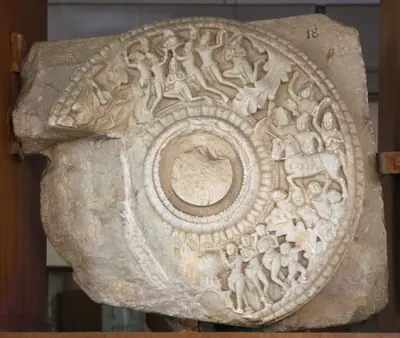
Pulumavi’s name dates an inscription on a coping stone from the Amaravati stupa (relic mound).3 It records a Dharmachakra (wheel of the law) set up at the western gate of the great chaitya (Buddhist shrine) by two donors and members of their families. The king’s name gives only the date, and the gift was not his. Burgess took the record as evidence that the stupa was being enlarged in his reign.3
Walter Elliot, writing in 1886, counted the Amaravati stupa among the Buddhist monuments of Andhra rule.19 He described it as the stupa “on which the name of Pudumayi has recently been read”.19 (See Amaravati inscription of the time of Vasishthiputra Pulumavi.)
D. R. Bhandarkar, as reported by Smith, held that father and son reigned jointly for a time.9 During that time, in his view, Pulumavi governed Maharashtra while Gautamiputra held Andhradesa.9
Sircar gave Pulumavi himself a larger place in Andhra history.204 He edited an inscription from Guntur district of a Maharaja of the Aira family.204 From it he argued that the Airas ruled the Krishna–Guntur region in the 2nd century CE.204 In his view Pulumavi conquered it from them in the second quarter of that century.204 No Satavahana inscription earlier than Pulumavi’s had been found there.204
In 1939 Sircar described local families, among them the Ikshvakus, as still loyal to the Satavahanas in the time of Pulumavi and Yajna Sri.15
Coins point the same way. Rapson attributed to Pulumavi coins of one of the two Andhradesa types. They have a stupa (chaitya) on one side and the “Ujjain symbol” on the other. Robert Sewell and Alexander Rea found examples at Gudivada.2122
Rapson also tentatively assigned to him some lead coins of the other Andhra fabric, with a lion.2324 Their worn legend can be restored as “Siri[…]samisa”, and Pulumavi bore a title ending in -svami.2324
He also attributed to Pulumavi a lead coin with a two-masted ship.252627 It belongs to a group found along the Coromandel coast between Madras and Cuddalore.252627 Rapson read its legend, not with full confidence, as Siri-Pu[lumu]vi.252627
Rapson took these coins to show a brief extension of Satavahana rule into Pallava territory.252627 He added that the ship design, like the many Roman coins found on that coast, bore witness to sea trade.252627 The Bellary gazetteer of 1904 cited a lead coin bearing the name Pulumayi as evidence of Andhra rule there.28 The coin had been found in Mysore near the Bellary border.28
The Myakadoni inscription
A rock inscription of a King Pulumavi, dated in his 8th year, lies between the villages of Myakadoni and Chinnakadaburu.29 The place is about eight miles north of Adoni in Bellary district, and the villagers called the boulder Jangli Gundu.29
It records that a householder of the village of Vepuraka sank a reservoir.30 The village belonged to a captain called Kumaradatta, in the district of Satavahani-hara.30 That district belonged to the great general Skandanaga.30
V. S. Sukthankar, who edited it, identified the king with Vasishthiputra Pulumavi. In Smith’s list the two later Pulumavis reigned only seven years each, too short for a record of the 8th year.31 Sewell accepted this and dated the record 145–46 CE.32 Sircar noted that the Pulumavi of this record was generally placed after Yajna Sri, which would make him a later king of the same name.12 See Myakadoni inscription.
Footnotes
-
Rapson, Catalogue of the Coins of the Andhra Dynasty (1908), p. xxxvii (archive.org (opens in a new tab)). ↩ ↩2 ↩3
-
Rapson, Catalogue of the Coins of the Andhra Dynasty (1908), p. l (archive.org (opens in a new tab)). ↩ ↩2 ↩3 ↩4
-
James Burgess, The Buddhist Stupas of Amaravati and Jaggayyapeta (1887), p. 100 (archive.org (opens in a new tab)). ↩ ↩2 ↩3 ↩4
-
D. C. Sircar, “Two Inscriptions from Guntur District”, Epigraphia Indica XXXII (1959), p. 86 (archive.org (opens in a new tab)). ↩ ↩2 ↩3 ↩4 ↩5 ↩6 ↩7
-
Rapson, Catalogue of the Coins of the Andhra Dynasty (1908), p. xxxix (archive.org (opens in a new tab)). ↩ ↩2 ↩3 ↩4
-
Rapson, Catalogue of the Coins of the Andhra Dynasty (1908), p. li (archive.org (opens in a new tab)). ↩ ↩2 ↩3 ↩4 ↩5 ↩6 ↩7
-
Rapson, Catalogue of the Coins of the Andhra Dynasty (1908), p. xxxviii (archive.org (opens in a new tab)). ↩ ↩2 ↩3 ↩4 ↩5 ↩6 ↩7 ↩8 ↩9 ↩10
-
James Burgess, The Buddhist Stupas of Amaravati and Jaggayyapeta (1887), p. 5 (archive.org (opens in a new tab)). ↩
-
Vincent A. Smith, The Early History of India, 4th ed. (1924), p. 222 and n. 1 (archive.org (opens in a new tab)). ↩ ↩2 ↩3 ↩4
-
Smith, Early History of India (1924), p. 223 (archive.org (opens in a new tab)). ↩
-
Robert Sewell, The Historical Inscriptions of Southern India (1932), p. 325 (archive.org (opens in a new tab)). ↩ ↩2 ↩3
-
D. C. Sircar, “Two Inscriptions from Guntur District”, Epigraphia Indica XXXII (1959), p. 83 (archive.org (opens in a new tab)). ↩ ↩2
-
James Burgess, The Buddhist Stupas of Amaravati and Jaggayyapeta (1887), p. 4 (archive.org (opens in a new tab)). ↩ ↩2 ↩3
-
J. W. McCrindle (tr.), Ancient India as Described by Ptolemy (1885), p. 177 (archive.org (opens in a new tab)). ↩
-
D. C. Sircar, The Successors of the Satavahanas in Lower Deccan (1939), p. 3 (archive.org (opens in a new tab)). ↩ ↩2
-
É. Senart, “The Inscriptions in the Caves at Nasik”, Epigraphia Indica VIII (1906), p. 62 (archive.org (opens in a new tab)). ↩ ↩2
-
Senart, “The Inscriptions in the Caves at Nasik” (1906), p. 64 (archive.org (opens in a new tab)). ↩
-
Senart, “The Inscriptions in the Caves at Nasik” (1906), pp. 65–67 (archive.org (opens in a new tab)). ↩ ↩2
-
Walter Elliot, Coins of Southern India (1886), p. 22 (archive.org (opens in a new tab)). ↩ ↩2
-
D. C. Sircar, “Two Inscriptions from Guntur District”, Epigraphia Indica XXXII (1959), pp. 84–85 (archive.org (opens in a new tab)). ↩ ↩2 ↩3 ↩4 ↩5
-
Rapson, Catalogue of the Coins of the Andhra Dynasty (1908), p. lxxii (archive.org (opens in a new tab)). ↩
-
Rapson, Catalogue of the Coins of the Andhra Dynasty (1908), catalogue p. 20 (archive.org (opens in a new tab)). ↩
-
Rapson, Catalogue of the Coins of the Andhra Dynasty (1908), p. lxxv (archive.org (opens in a new tab)). ↩ ↩2
-
Rapson, Catalogue of the Coins of the Andhra Dynasty (1908), p. lxxvi (archive.org (opens in a new tab)). ↩ ↩2
-
E. J. Rapson, Catalogue of the Coins of the Andhra Dynasty, the Western Ksatrapas, the Traikutaka Dynasty, and the “Bodhi” Dynasty (1908), catalogue p. 22 (archive.org (opens in a new tab)). ↩ ↩2 ↩3 ↩4 ↩5
-
Rapson, Catalogue of the Coins of the Andhra Dynasty (1908), p. lxxxi (archive.org (opens in a new tab)). ↩ ↩2 ↩3 ↩4 ↩5
-
Rapson, Catalogue of the Coins of the Andhra Dynasty (1908), p. lxxxii (archive.org (opens in a new tab)). ↩ ↩2 ↩3 ↩4 ↩5
-
W. Francis, Madras District Gazetteers: Bellary (1904), p. 27 (archive.org (opens in a new tab)). ↩ ↩2
-
V. S. Sukthankar, “A New Andhra Inscription of Siri-Pulumavi”, Epigraphia Indica XIV (1918), p. 153 (archive.org (opens in a new tab)). ↩ ↩2
-
Sukthankar, “A New Andhra Inscription of Siri-Pulumavi” (1918), p. 155 (archive.org (opens in a new tab)). ↩ ↩2 ↩3
-
Sukthankar, “A New Andhra Inscription of Siri-Pulumavi” (1918), p. 154 (archive.org (opens in a new tab)). ↩
-
Robert Sewell, The Historical Inscriptions of Southern India (1932), p. 14 (archive.org (opens in a new tab)). ↩
Photos
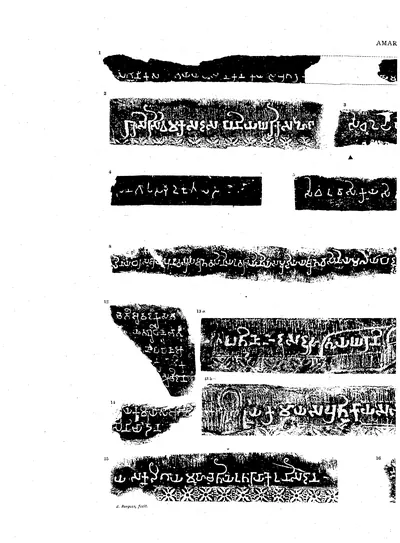 "Amaravati Inscriptions", Nos. 1-16 (left half of the folding plate), including No. 1, dated in the reign of Vasishthiputra Sri Pulumavi, and No. 2, naming "king Sri Sivamaka Sada" (Burgess 1887, Pl. LVI)Inscription rubbing · 1887
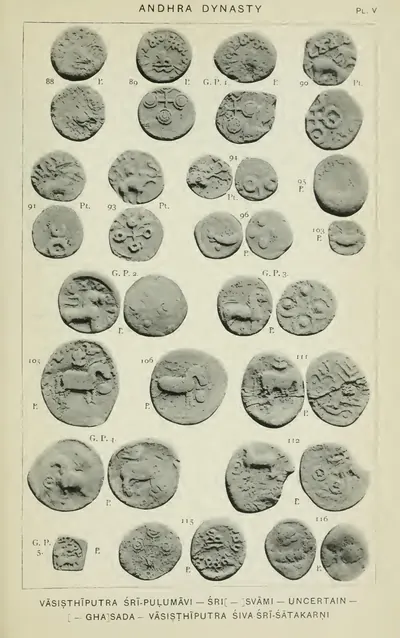 Coins of "Vasisthiputra Sri-Pulumavi - Sri[ ]svami - uncertain - [ ]ghasada - Vasisthiputra Siva Sri-Satakarni", including two-masted ship coins (Rapson 1908, Pl. V)Coin · 1908
Related
Dynasties
References
Notes (0)
Sources (11)
Spotted an error on this page? Tell us
Last updated: