Amaravati inscription of the time of Vasishthiputra Pulumavi
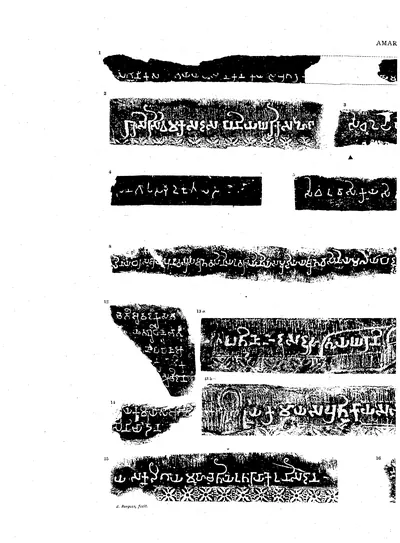
A two-line Prakrit inscription on a broken coping stone from the Amaravati stupa. It records a Dharmachakra (wheel of the law) set up at the western gate of the Great Chaitya, in a regnal year of the Satavahana king Vasishthiputra Sri Pulumavi. The year itself is lost.
This short gift inscription is one of the very few records from the Amaravati stupa (relic mound) dated in the reign of a named Satavahana king. Burgess used it, with an Amaravati inscription of Sri Yajna, to place the stupa’s royal-era records in the 2nd century CE.1 It has therefore been central to attempts to date the monument.23 It is also central to working out when the Satavahanas ruled the lower Krishna valley.23
Discovery and physical description
The stone had been broken across.2 James Burgess found one half near the western gateway of the stupa during his survey of the site.2 The other half had been dug up earlier.2 Joined, the pieces formed a slab about 6 feet 7 inches long, 2 feet broad and 8½ inches thick.2 Two steps were cut along one end and one side.2
The inscription runs along the outer edge of the most projecting step.2 Burgess thought the stone had been part of a coping, possibly the cornice of a large pedestal carrying a Dharmachakra.2 Part of the inscription was lost at the break.2 Gordon Mackenzie’s Kistna district manual of 1883 also notes an inscription “on some fragments” recording a gift in Pulumavi’s reign.4
Language and script
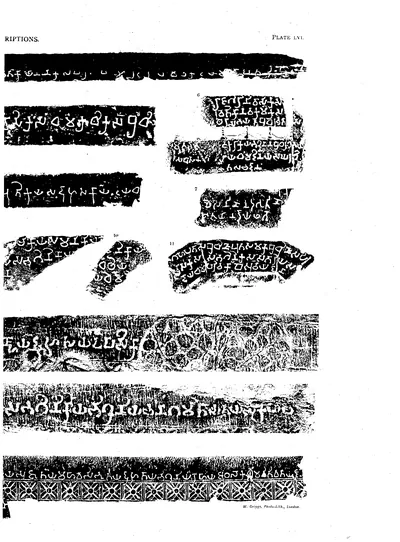
The text is in Prakrit, a spoken language related to Sanskrit. It is written in two lines of Brahmi, the script used in India from Asoka’s time onward. Burgess published a facsimile of his own impression as Plate LVI, No. 1.2 His translations of the Amaravati inscriptions draw on the German versions that E. Hultzsch made from these facsimiles.2 For this record he noted that Bhagwanlal Indraji had earlier published a translation that was much the same.2
Content
The inscription opens with Siddham (“success”).2 It dates itself in a year of “the king, the son of the queen of the Vasishtha family, the Lord Sri Pulumavi”, that is, Vasishthiputra Pulumavi.2 The number of the year falls in the damaged part and cannot be read.2 The gift is described as made “at the western gate,—a Dharmachakra was established, a meritorious gift to the great Chaitya [of the Exalted one] (and) in possession of the school of the Chaitikiyas”.2
The donors were two people described as Pimdasutariyas, a word left unexplained in the translation.2 They were the householder Kahutara, and Isila, son of the householder Puri.2 Isila gave together with his brothers, his sisters, his wife Nakanika and his sons.2 The word “mother” is restored in a gap.2
A Dharmachakra is the wheel that stands for the Buddha’s teaching.2 Burgess noted that at the entrances of early Buddhist shrines a wheel was often raised on a pillar.5
The Chaitika school
The phrase “in possession of the school of the Chaitikiyas” recurs in many Amaravati inscriptions. Burgess took the Chaitikas to be the school also called the Purvasailas, one of the branches of the Mahasanghikas.67 On that basis he identified the Amaravati stupa with the Purvasaila monastery described by the Chinese pilgrim Hiuen Tsang.67
Significance and dating
For Burgess the inscription showed that the stupa was being enlarged or decorated in Pulumavi’s reign.12 He dated that reign to about 135–163 CE, from links between Satavahana and western satrap records.12 He concluded that the outer rail of the stupa was begun in the 2nd century.8
Sewell’s list, following Vincent Smith, put Pulumavi’s accession in 138 CE (Barnett, 131 CE).910 It identified him with the “Siro Polemaios” of Ptolemy.910 D. C. Sircar dated Pulumavi to about 130–159 CE.11 He used this inscription as a fixed point for comparing the letter-forms of other early inscriptions from the Krishna–Guntur region.11
The record also bears on a wider question. Sircar counted it among a handful of “Later Satavahana” inscriptions in the region.3 No earlier Satavahana record had been found there.3 So he argued that Pulumavi was the king who brought the Krishna–Guntur country under Satavahana rule, in the second quarter of the 2nd century CE.3 The calendar date of the inscription therefore depends on Satavahana chronology, which is still debated. The site’s start year of 130 CE is only approximate.
Editions
- James Burgess, The Buddhist Stupas of Amaravati and Jaggayyapeta (1887), p. 100, Plate LVI, No. 1: text, translation and description.2
- E. Hultzsch’s German translations of the Amaravati inscriptions, in the Zeitschrift der Deutschen Morgenländischen Gesellschaft, vols. 37 and 40, and Bhagwanlal Indraji’s translation of this record in Burgess’s Notes on the Amaravati Stupa (Madras, 1882), p. 27. Both are cited by Burgess; neither has been consulted for this page.2
Footnotes
-
James Burgess, The Buddhist Stupas of Amaravati and Jaggayyapeta (1887), p. 5 (archive.org (opens in a new tab)). ↩ ↩2 ↩3
-
James Burgess, The Buddhist Stupas of Amaravati and Jaggayyapeta (1887), p. 100 (archive.org (opens in a new tab)). ↩ ↩2 ↩3 ↩4 ↩5 ↩6 ↩7 ↩8 ↩9 ↩10 ↩11 ↩12 ↩13 ↩14 ↩15 ↩16 ↩17 ↩18 ↩19 ↩20 ↩21 ↩22 ↩23 ↩24 ↩25 ↩26
-
D. C. Sircar, “Two Inscriptions from Guntur District”, Epigraphia Indica XXXII (1959), p. 86 (archive.org (opens in a new tab)). ↩ ↩2 ↩3 ↩4 ↩5
-
Gordon Mackenzie, A Manual of the Kistna District (1883), p. 167 (archive.org (opens in a new tab)). ↩
-
James Burgess, The Buddhist Stupas of Amaravati and Jaggayyapeta (1887), p. 61 (archive.org (opens in a new tab)). ↩
-
James Burgess, The Buddhist Stupas of Amaravati and Jaggayyapeta (1887), p. 101 (archive.org (opens in a new tab)). ↩ ↩2
-
James Burgess, The Buddhist Stupas of Amaravati and Jaggayyapeta (1887), p. 24 (archive.org (opens in a new tab)). ↩ ↩2
-
James Burgess, The Buddhist Stupas of Amaravati and Jaggayyapeta (1887), p. 112 (archive.org (opens in a new tab)). ↩
-
Robert Sewell, The Historical Inscriptions of Southern India (1932), p. 14 (archive.org (opens in a new tab)). ↩ ↩2
-
Robert Sewell, The Historical Inscriptions of Southern India (1932), p. 325 (archive.org (opens in a new tab)). ↩ ↩2
-
D. C. Sircar, “Two Inscriptions from Guntur District”, Epigraphia Indica XXXII (1959), p. 83 (archive.org (opens in a new tab)). ↩ ↩2
Photos
 "Amaravati Inscriptions", Nos. 1-16 (left half of the folding plate), including No. 1, dated in the reign of Vasishthiputra Sri Pulumavi, and No. 2, naming "king Sri Sivamaka Sada" (Burgess 1887, Pl. LVI)Inscription rubbing · 1887
 "Amaravati Inscriptions", Nos. 1-16 (right half of the folding plate) (Burgess 1887, Pl. LVI)Inscription rubbing · 1887
References
Notes (0)
Sources (4)
Spotted an error on this page? Tell us
Last updated: