Nadagam plates of Vajrahasta
Five copper plates with a bull seal, found by a cultivator at Nadagam in the Narasannapeta taluk (Srikakulam district). They record a grant made from Kalinganagara in Saka 979 (1058) by the Ganga king Vajrahasta, lord of the Three Kalingas, to his son-in-law Samaya. They give the exact moment of Vajrahasta's coronation in 1038 and a list of the kings before him. Their editor, G. V. Ramamurti, used them to argue that Kalinganagara was Mukhalingam.
By these copper plates, the Ganga king Vajrahasta, lord of the Three Kalingas, made a grant to Pangu-Samaya in Saka 979 (Saka is an Indian way of counting years).12 They give the time of Vajrahasta’s anointing (coronation) in Saka 960, which Ramamurti calculated as 3 May 1038.1 Ramamurti also used them to argue that Kalinganagara, the Ganga residence, was at Mukhalingam.345
Discovery
G. V. Ramamurti edited the plates in Epigraphia Indica IV (1896–97).6 He reported that a cultivator, Sanku Appanna, had found them about two years earlier while working in his field.6 The place was Nadagam, a village in the Narasannapeta taluk (sub-district) of the Ganjam district.6
The villagers believed that the plates had belonged to some Jangams, a Saiva sect.6 The Jangams had lived in the area until fifty years before.6 Ramamurti sent the plates through the Collector to E. Hultzsch.6 The owner was reported to be willing to have them kept in the Madras Museum.6 See Nadagam.
The plates and the seal
There are five plates.67 The first is written on the inner side only, and the next three on both faces.67 The last is blank, and it protects the writing on the back of the fourth.67
The ring had not been cut.67 It is soldered into “a thick circular seal, on which is fixed an image of a bull couchant” (lying down).67 On one side of the bull are a conch-shell and a chauri (fly-whisk), and on the other a sword and an elephant-goad.67 There is a crescent in front, and what looks like a drum at the back.67 Ramamurti noted that almost all these figures appear on the seals of other grants of the Ganga kings, “who were worshippers of Siva”.67
Script and language
The alphabet “belongs to the old Nagari type without any admixture of other kinds of characters”.7 Ramamurti thought that this type was in use in Kalinga at the time.7 He had found stone inscriptions at Mukhalingam in almost the same characters.7 But he added that “the Eastern Chalukya type of the eleventh century is however more extensively in evidence here, as everywhere else in the Telugu country”.7
The engraver was careless.7 Three lines at the end had been partly rubbed out and engraved over.7 The language is Sanskrit throughout, and nearly half of it is in verse.7
The grant
The record is issued from Kalinganagara by Vajrahasta, a prince of the Ganga family.12 He is styled Paramamahesvara, Paramabhattaraka, Maharajadhiraja and Trikalingadhipati, lord of the Three Kalingas.12 The grant forms twelve villages of the district of Erada into a separate district.12 The new district is named after its chief village, Velpura.12 It is granted to Pangu-Samaya, son of Srikantha-Nayaka and Vedavi.12
The half-erased lines show how the donee was related to the king.1 There Samaya is called “my son-in-law, the Dandanayaka S[a]maya”.1 The sentence engraved in their place adds a village in the district of Keluvartani.1
The grant is dated Saka 979, on Sunday, the twelfth tithi (lunar day) of the bright fortnight of Phalguna.1 Ramamurti equated this with 4 March 1058.1 He noted that the day, called Govinda-dvadasi, was an occasion for gifts of land and money.1 Robert Sewell gave the date as 8 February 1058 instead.8
The coronation date and the genealogy
The plates also give the time of Vajrahasta’s anointing, in Saka 960.1 Ramamurti calculated this as 3 May 1038.1 He called it “a certain, reliable land-mark in the chronology of the Gangas” and “the earliest known date of this dynasty”.1
Their list of kings gives the length of each reign.92 It begins with an earlier Vajrahasta, who reigned forty-four years.92 He did so after uniting “that whole earth which had been formerly divided into five (parts) and enjoyed by five kings”.92 The list runs through his sons and descendants to the donor.92
Ramamurti compared it with the much longer list in a grant of Anantavarman Chodaganga of Saka 1040.3 He found differences “which render the authenticity of the second list suspicious”.3 V. Rangacharya noted that the donor is Vajrahasta III in one numbering and Vajrahasta V in the other.10 See Vajrahasta III.
Kalinganagara and Mukhalingam
Ramamurti used the occasion to argue about Kalinganagara, the residence named in all the Ganga copper plates.345 He argued that it was not the seaport Kalingapatnam, where he found no remains of the kind expected of a capital.345 In his view, it was the site of the villages of Mukhalingam and Nagarakatakam on the Vamsadhara.345
He reported that Sanskrit and Telugu inscriptions there describe the god Madhukesvara as the god of Nagara, the “Nagara of the Kalinga (country)”.345 The temples of Madhukesvara and Aniyankabhimesvara bear names that match the grant of Saka 1040.345 They also match the second name of the king, Vajrahasta Aniyankabhima.345
He concluded that the site and the ruins between the two villages “represents the ancient capital of Kalinga”.345 See Mukhalingam and the temples of Mukhalingam.
Footnotes
-
Ramamurti, “Nadagam Plates of Vajrahasta” (1897), p. 185 (archive.org (opens in a new tab)). ↩ ↩2 ↩3 ↩4 ↩5 ↩6 ↩7 ↩8 ↩9 ↩10 ↩11 ↩12 ↩13 ↩14 ↩15 ↩16
-
Ramamurti, “Nadagam Plates of Vajrahasta” (1897), p. 193, translation, lines 30–57 (archive.org (opens in a new tab)). ↩ ↩2 ↩3 ↩4 ↩5 ↩6 ↩7 ↩8 ↩9 ↩10
-
Ramamurti, “Nadagam Plates of Vajrahasta” (1897), p. 187 (archive.org (opens in a new tab)). ↩ ↩2 ↩3 ↩4 ↩5 ↩6 ↩7 ↩8 ↩9 ↩10
-
Ramamurti, “Nadagam Plates of Vajrahasta” (1897), p. 188 (archive.org (opens in a new tab)). ↩ ↩2 ↩3 ↩4 ↩5 ↩6 ↩7 ↩8
-
Ramamurti, “Nadagam Plates of Vajrahasta” (1897), p. 189 (archive.org (opens in a new tab)). ↩ ↩2 ↩3 ↩4 ↩5 ↩6 ↩7 ↩8
-
G. V. Ramamurti, “Nadagam Plates of Vajrahasta; Saka-Samvat 979”, Epigraphia Indica IV (1896–97), p. 183 (archive.org (opens in a new tab)). ↩ ↩2 ↩3 ↩4 ↩5 ↩6 ↩7 ↩8 ↩9 ↩10 ↩11 ↩12 ↩13 ↩14 ↩15
-
Ramamurti, “Nadagam Plates of Vajrahasta” (1897), p. 184 (archive.org (opens in a new tab)). ↩ ↩2 ↩3 ↩4 ↩5 ↩6 ↩7 ↩8 ↩9 ↩10 ↩11 ↩12 ↩13 ↩14 ↩15
-
Robert Sewell, The Historical Inscriptions of Southern India (1932), p. 75 (archive.org (opens in a new tab)). Paraphrased. ↩
-
Ramamurti, “Nadagam Plates of Vajrahasta” (1897), p. 192, translation, verse 1 (archive.org (opens in a new tab)). ↩ ↩2 ↩3 ↩4
-
V. Rangacharya, A Topographical List of the Inscriptions of the Madras Presidency, Vol. I (1919), p. 684, Ganjam No. 143-A (archive.org (opens in a new tab)). ↩
Photos
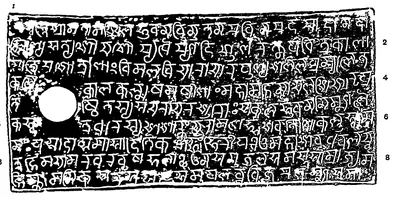 "Nadagam Plates of Vajrahasta.—Saka-Samvat 979", first plate (lines 1-9) (Epigraphia Indica IV, plates between pp. 190 and 191, PDF p. 233)Inscription rubbing · 1897
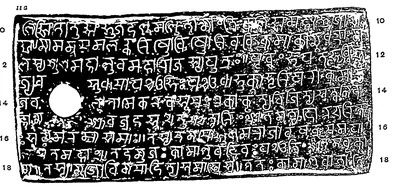 "Nadagam Plates of Vajrahasta.—Saka-Samvat 979", first side of the second plate (lines 10-18) (Epigraphia Indica IV, plates between pp. 190 and 191, PDF p. 233)Inscription rubbing · 1897
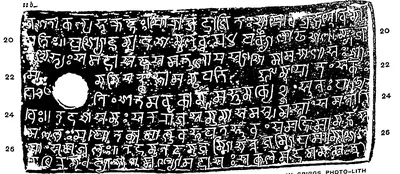 "Nadagam Plates of Vajrahasta.—Saka-Samvat 979", second side of the second plate (lines 19-27) (Epigraphia Indica IV, plates between pp. 190 and 191, PDF p. 233)Inscription rubbing · 1897
References
Notes (0)
Sources (3)
Spotted an error on this page? Tell us
Last updated: