Temples of Mukhalingam
Three Siva temples at Mukhalingam on the Vamsadhara: the Madhukesvara (Mukhalingesvara), Bhimesvara (Aniyankabhimesvara) and Somesvara. They are in the Orissan style and stand among the ruins of Kalinganagara, the capital of the Eastern Ganga kings. A grant of Anantavarman Chodaganga credits the Madhukesvara temple to an early king Kamarnava, and the Bhimesvara is thought to be named after the king Vajrahasta Aniyankabhima. Their walls and pillars carry scores of Telugu and Sanskrit inscriptions of the Gangas.
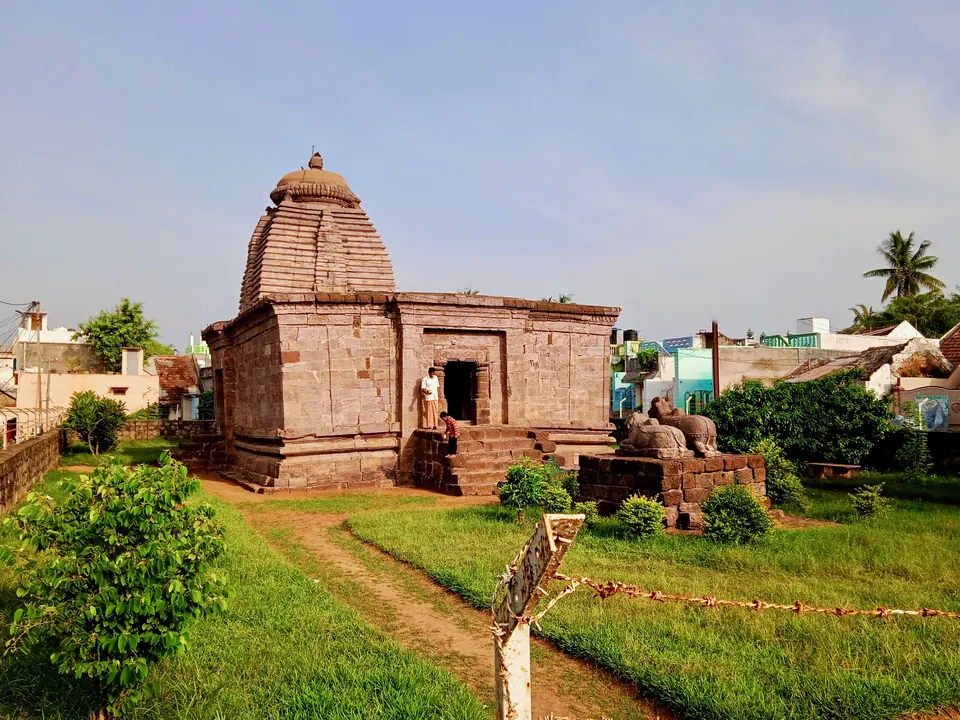
The three temples
G. V. Ramamurti examined the antiquities of Mukhalingam in the 1890s.1 He found there “three temples dedicated to Siva under the names Madhukesvara, Bhimesvara and Somesvara”.1 The first had “numerous inscriptions on its walls and pillars”, many of them covered with a thick coat of lime.1 The second had a few.1 Ruins of temples and other buildings stretched for about two miles south of the village, to Nagarakatakam.1 Large slabs with inscriptions and “well-sculptured figures” were being dug out.1
Ramamurti wrote that “of the many monumental works with which the devotion of several powerful Ganga kings embellished their capital, these three temples alone remain”.2 See Mukhalingam.
The Imperial Gazetteer (1908) describes the Siva temple as “held in great veneration”.3 The Raja of Parlakimedi maintained it, and thousands of pilgrims came to its festival and fair at Sivaratri.3
The gazetteer calls it and the two other temples “excellent examples of the Orissan or Indo-Aryan style of architecture, which differs widely from the Dravidian style of the southern Districts”.3 It adds that “the sculpture on them is remarkable for its elegance and precision”.3 “One of them was built in the beginning of the ninth century”.3 It does not say which. The Ganjam district manual (1882) notes simply that “at Mukhalingam Siva is worshipped and the temple is a place of pilgrimage”.4
Founders
Ramamurti found evidence for the founders in a copper-plate grant of Anantavarman Chodaganga of Saka 1040 (Saka is an Indian way of counting years).1 It says that Kamarnava, a nephew of the first Ganga king of Kalinga in its family list, had a town named Nagara.1 There he built “a lofty temple for an emblem of the god Isa in the linga form”.1 He named it Madhukesa, “because it was produced from a madhuka tree”.1 Ramamurti added, “this temple still exists at Mukhalingam”.1 The priests explained a frieze on one of the temple gateways as showing the god’s appearance in the trunk of a madhuka tree.1
The Nadagam plates give the surname Aniyankabhima to an earlier king Vajrahasta.1 So Ramamurti thought it most probable that the god of the second temple, Aniyankabhimesvara, took his name from this king.1 In his view the king founded the temple, or it was built in his memory.1 He suggested, more tentatively, that the Somesvara temple may have been built by Samaya, the donee (receiver) of the Nadagam plates, if that name is a mistake for Somaya.1
V. Rangacharya repeated these attributions in 1919, giving the founders as Kamarnava II and Vajrahasta II.5 See the Nadagam plates.
Inscriptions
Ramamurti reported that most of the inscriptions record grants to the gods Madhukesvara and Aniyankabhimesvara.1 They were made “by private individuals, public officers of the state, and persons belonging to the royal family, in the reign of Anantavarma-Chodagangadeva”.1 Some were in the characters of an earlier period, which he had not examined.1 The texts of the Mukhalingam records were printed in South-Indian Inscriptions V (1925), Nos. 1005 to 1148.6 Rangacharya’s summaries show their range:
- Telugu records of Anantavarman Chodaganga, mostly gifts of lamps, run from his twenty-third to his sixty-fifth regnal year.578 One names his Eastern Chalukya contemporary Vira-Chodadeva, and another the queen Somalamahadevi.578
- Two Sanskrit records of Saka 1055 and 1068 were made by ministers of a Vikramaganga.9 They name the temple of Madhukesvara at “Kalingavaninagara” and “Kalingadesanagara”.9
- A Sanskrit record of Saka 990 (1068–69) records a gift by the queen of Vajrahasta, daughter of a Haihaya king.1011 A Telugu record of Saka 1107 records a lamp for the temple of Aniyankabhimesvara.1011
- An Oriya record, on a pillar at the entrance to the central shrine, belongs to the Gajapati king Kapilesvara.5
Ramamurti also found at Mukhalingam a stone inscription of Anantavarmadeva, recording a grant issued “from Kalinganagara”.1 He took it to confirm that Mukhalingam was the old Ganga capital.1 See Anantavarman Chodaganga and the Eastern Gangas.
Footnotes
-
G. V. Ramamurti, “Nadagam Plates of Vajrahasta; Saka-Samvat 979”, Epigraphia Indica IV (1896–97), p. 188 and notes 1–2 (archive.org (opens in a new tab)). ↩ ↩2 ↩3 ↩4 ↩5 ↩6 ↩7 ↩8 ↩9 ↩10 ↩11 ↩12 ↩13 ↩14 ↩15 ↩16 ↩17 ↩18 ↩19 ↩20 ↩21
-
Ramamurti, “Nadagam Plates of Vajrahasta” (1897), p. 189 (archive.org (opens in a new tab)). ↩
-
Imperial Gazetteer of India, Provincial Series: Madras, Vol. I (1908), p. 228 (archive.org (opens in a new tab)). ↩ ↩2 ↩3 ↩4 ↩5
-
T. J. Maltby, The Ganjam District Manual (1882), p. 62 (archive.org (opens in a new tab)). ↩
-
V. Rangacharya, A Topographical List of the Inscriptions of the Madras Presidency, Vol. I (1919), p. 699, Mukhalingam and Ganjam Nos. 291–292 (archive.org (opens in a new tab)). ↩ ↩2 ↩3 ↩4
-
H. Krishna Sastri (ed.), South-Indian Inscriptions (Texts), Vol. V (1925), Table of Contents, p. v (archive.org (opens in a new tab)). ↩
-
Rangacharya, Topographical List, Vol. I (1919), p. 700, Ganjam Nos. 293–306 (archive.org (opens in a new tab)). ↩ ↩2
-
Rangacharya, Topographical List, Vol. I (1919), p. 701, Ganjam Nos. 307–319 (archive.org (opens in a new tab)). ↩ ↩2
-
Rangacharya, Topographical List, Vol. I (1919), p. 702, Ganjam Nos. 320–321 (archive.org (opens in a new tab)). ↩ ↩2
-
Rangacharya, Topographical List, Vol. I (1919), p. 707, Ganjam No. 399 (archive.org (opens in a new tab)). ↩ ↩2
-
Rangacharya, Topographical List, Vol. I (1919), p. 708, Ganjam No. 409 (archive.org (opens in a new tab)). ↩ ↩2
Photos
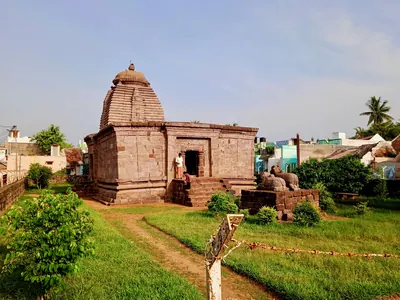 Bhimesvara temple, MukhalingamPhotograph · 2021
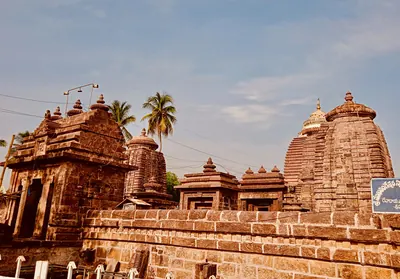 Courtyard of the Madhukesvara (Mukhalingesvara) temple group at Mukhalingam, with shrines along the enclosure wallPhotograph · 2021
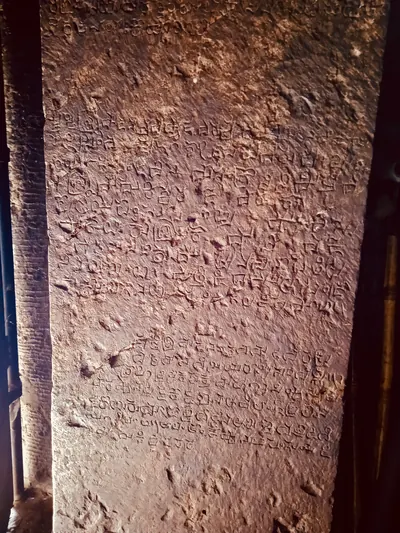 Inscriptions cut on a wall of the Madhukesvara (Mukhalingesvara) temple group at MukhalingamPhotograph · 2021
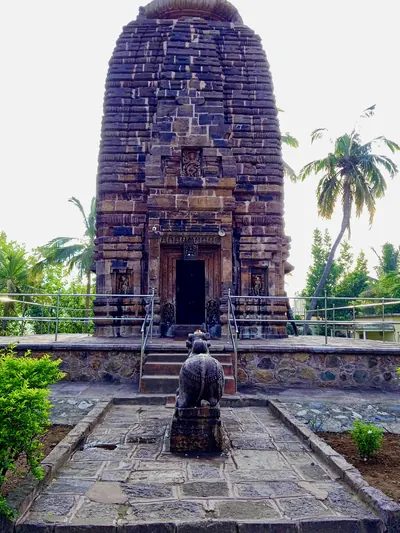 Somesvara temple, Mukhalingam, with a Nandi in frontPhotograph · 2021
References
Notes (0)
Sources (5)
Spotted an error on this page? Tell us
Last updated: